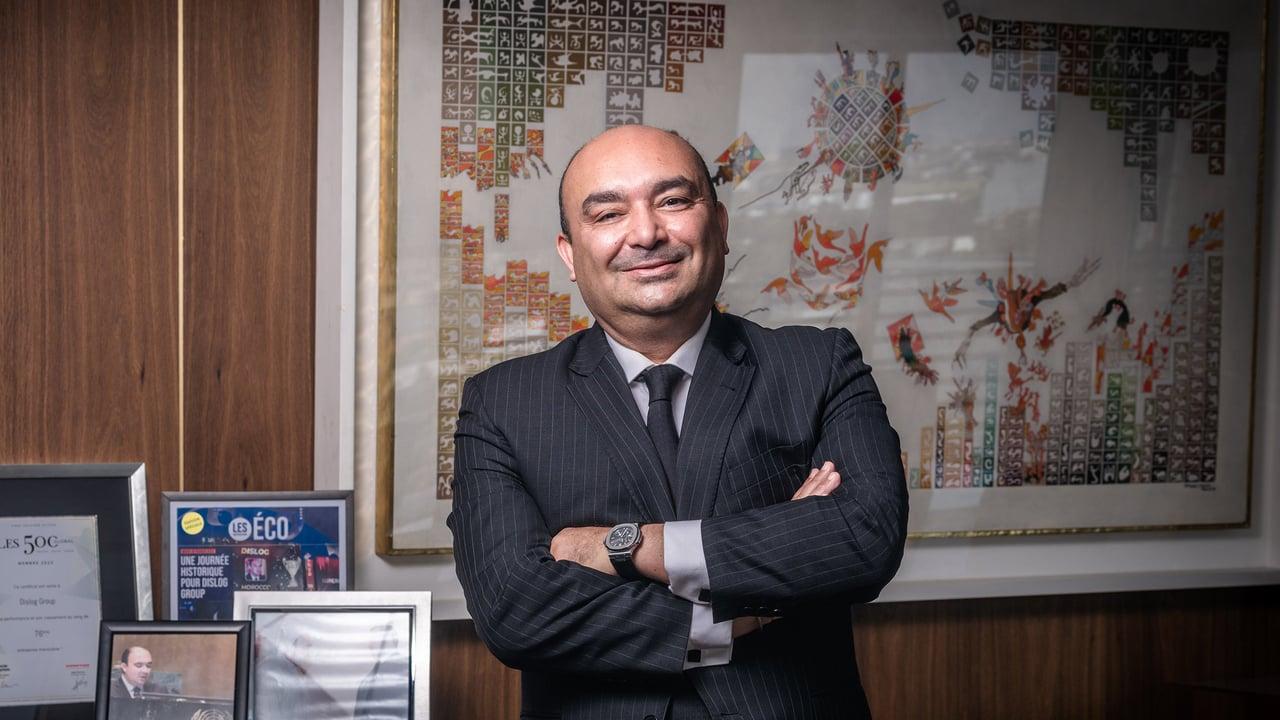
Former Minister of Youth and Sports, Moncef Belkhayat is now primarily known for his business ventures. Behind his name is a collection of companies whose activities directly or indirectly impact the daily lives of millions of Moroccans.
Food products, hygiene, pharmaceuticals, medical devices, warehouses, freight transport, stores, restaurants, advertising, real estate, and financial services: the investments grouped under H&S Group sketch out the contours of a particularly diverse economic organization.
The adventure begins in 2005 with the creation of Dislog and an initial capital of 1.5 million dirhams.
At that time, Moncef Belkhayat had gained experience at Procter & Gamble, an American multinational specializing in consumer goods. This experience influenced his approach to business: understanding brands, mastering distribution, developing sales networks, and seeking economies of scale.
Two decades later, the distribution company of his early days has become the core of a holding company with stakes in several dozen companies.
By October 2026, the group is presented as having 72 subsidiaries, structured around six major economic platforms.
The stated goal is now to exceed 10 billion dirhams in consolidated annual revenue, compared to 6.8 billion achieved in 2025.
Such growth merits detailed examination, as behind these figures lies an expansion strategy largely based on acquisitions, mergers, and opening capital to investors.
H&S Group: The Figures of an Expanding Economic Entity
Subsidiaries announced in October 2026
72
Consolidated revenue 2025
6.8 Billion DH
Revenue target 2026
10 Billion DH
Major activity platforms
6
1. Dislog Group: The Historical Pillar of the Belkhayat Empire
Dislog is the starting point for this expansion.
Initially, the company focuses on distributing consumer goods. It gradually develops a sales network capable of making national and international brands available to shops, supermarkets, and other sales channels.
This activity relies on a complex organization: negotiation with manufacturers, storage, transport, marketing, management of sales points, and brand development.
Over the years, Dislog transcends its initial role as a distributor.
The group invests in industry, acquires brands, and begins to produce certain categories of goods itself.
This distinction is essential.
A distributor makes money primarily by selling products manufactured by other companies. An integrated industrial player can operate at several stages, from manufacturing to sale.
It is this second direction that Moncef Belkhayat has gradually favored.
Dislog's portfolio includes food, hygiene, cleaning products, cosmetics, and health.
It also includes investments in France, such as Carré Suisse in chocolate and Cultures de France in plant product processing.
The strategy is clear: to no longer rely exclusively on distribution contracts but to develop a broader industrial and commercial activity.
2. Dislog Health Care: Entering Pharmaceuticals and Health
Moncef Belkhayat's diversification does not stop at everyday consumer products.
In 2022, the group acquires the Kosmopharm laboratory and accelerates its development in the pharmaceutical industry.
This operation marks a new strategic direction.
Pharmaceuticals and health products require industrial, commercial, and regulatory skills that are very different from those for food or cleaning products.
The group gradually structures its activities around Dislog Health Care, aiming to develop a Moroccan pharmaceutical entity capable of strengthening its national and international presence.
This development is accompanied by investments, institutional financing, and new acquisitions.
The European Bank for Reconstruction and Development is among the institutions that have supported the group's activities.
Through healthcare, Moncef Belkhayat extends his activities into a market characterized by relatively structural demand but also by significant quality, compliance, and research requirements.
Thus, the pharmaceutical industry becomes a new lever for diversification for H&S Group.
3. Dislog Medical Devices: Medical Equipment and Hospital Consumables
Alongside pharmaceuticals, the group develops another branch dedicated to medical devices.
In September 2025, Dislog announces the structuring of Dislog Medical Devices, resulting from the merging of six companies:
-
Megaflex
-
Afrobiomedic
-
Farmalac
-
Eramedic
-
Promed Store Imaging
-
Scomedica
These companies operate in various medical market specialties, primarily providing products, equipment, and solutions aimed at healthcare professionals.
The goal of the merger is to create a larger entity with a common organization and enhanced financial resources.
For H&S Group, this operation also allows for diversifying its outlets beyond the end consumer.
Potential clients for this type of activity include healthcare institutions, clinics, medical professionals, and specialized networks.
Healthcare now represents a distinct set of businesses within the Belkhayat empire: pharmacy, manufacturing, distribution, and medical equipment.
4. La Voie Express Group: Mastering Logistics
One of the most significant operations in recent years concerns logistics.
Through Buildings & Logistic Services, known as BLS, H&S Group has expanded into warehousing and logistics services for businesses.
In 2025, BLS acquires La Voie Express, a Moroccan company specializing in transport, freight, and messaging.
This acquisition is particularly important as it brings together several complementary activities: storage, transport, customs, delivery, and supply chain management.
In February 2026, the group reaches a new milestone with the inauguration of the Lakhyayta II logistics hub in the Had Soualem region.
This platform covers an area of ten hectares and adds 70,000 pallet spaces.
The group then announces that it has raised its total capacity under management to about 500,000 pallet spaces.
BLS also adopts the name La Voie Express Group.
Behind this transformation lies a precise economic logic.
H&S no longer only wishes to distribute goods: it also seeks to master or offer the infrastructure and services needed for their movement.
This complementarity allows the group to work with its own industrial and commercial activities, but also with external clients.
5. One Retail: Franprix, Monoprix, Restaurants, and DIY
Retail is one of the most visible developments of H&S Group.
After being predominantly present in wholesale distribution for a long time, Moncef Belkhayat is focusing more on direct sales to consumers.
In May 2025, his holding announces a master franchise agreement with the French group Casino to develop the Franprix and Monoprix brands in Morocco.
The proposed program outlines an investment of around one billion dirhams over several years and aims to establish a network that could reach 210 stores by 2035.
This is a development goal, not a number of stores already opened.
The retail activities grouped under H&S Retail Holding and later the One Retail organization are not limited to supermarkets.
The portfolio also includes restaurant and specialized retail activities, notably Venezia Ice and Mr. Bricolage.
A dedicated structure for ready-to-wear, H&S Lifestyle Retail, has also been created as part of the group's expansion.
This diversification leads H&S into several commercial realms:
-
Food and neighborhood shops with Franprix and Monoprix.
-
Dining and ice cream parlors with Venezia Ice.
-
DIY, equipment, and home improvement with Mr. Bricolage.
-
Fashion and ready-to-wear through H&S Lifestyle Retail projects.
It is important to distinguish between franchises operated under license and brands directly owned by the group. Commercially operating an international brand does not mean H&S owns the global trademark.
For Moncef Belkhayat, the strategic interest remains significant: after production and distribution, the group is also establishing a direct connection to the consumer.
6. Gidna and Kaya Immobilier: Construction, Major Projects, and Real Estate
Real estate and construction are increasingly significant in H&S Group's portfolio.
Two structures illustrate this focus: Gidna, specializing in building and construction, and Kaya Immobilier, dedicated to real estate development.
Gidna's presence enables the group to position itself in construction projects, primarily related to infrastructure and facilities.
In August 2026, the company notably won, according to information published by Le Desk, the two lots concerning the construction of nine stations for the future express regional network of Greater Casablanca.
This development in major projects shows that H&S's activities now significantly exceed consumer goods and commercial services.
The group is also interested in large-scale real estate operations.
Among the projects mentioned is a future multifunctional complex in Sidi Maârouf, Casablanca, presented as a World Trade Center project.
The envisioned program would include office spaces, hotel infrastructure, shops, as well as a conference and convention center.
Its expected completion is around 2030.
However, this operation should be seen as a proposed project, with its successful realization depending on permits, funding, and work progress.
These investments illustrate a new dimension of Belkhayat's organization: having construction, real estate promotion, and services related to building operations.
7. WB Group: A Presence in Media, Advertising, and Communication
One of the lesser-known branches to the public concerns media and communication.
Through WB Group and its stakes in WB Africa, H&S Group is involved in advertising, space buying, digital services, and publishing.
In April 2024, H&S Invest Holding and Moncef Belkhayat notably strengthened their presence in WB Africa by acquiring a 20% stake previously held by the Amethis fund.
This division has a different positioning from other activities of the group.
While Dislog deals with products, La Voie Express focuses on logistics, and One Retail relates to stores, WB Group operates in the marketing of advertising spaces, communication, and media content.
The economic interest of this diversification is identifiable: companies allocate a significant portion of their budgets to promoting their brands, acquiring customers, and enhancing their visibility.
The media sector also presents specific challenges related to editorial independence and the separation between shareholders' commercial interests and editorial decisions.
H&S's presence in this sector should therefore be distinguished from its industrial activities. It constitutes an economic participation in media and communication, without allowing one to conclude, based solely on this, that they influence editorial choices of the relevant publications.
8. Chari: The Gateway to Fintech and Digital Commerce
The economic ecosystem associated with H&S Group also extends into technology and financial services.
The Chari platform, co-founded by Ismael Belkhayat, is part of this universe.
Its model has developed around the digitization of traditional commerce, providing solutions primarily for grocery stores and local retailers.
The company has gradually expanded its ambitions towards financial services, digital payments, and financing solutions.
In 2025, Chari announces a $12 million fundraising and obtaining a license for payment services in Morocco.
For H&S, the interest in such activities lies in their potential complementarity with traditional distribution.
Where Dislog organizes the physical flow of goods, a digital platform like Chari can intervene in orders, merchant relations, and payments.
However, it is important to distinguish Chari's activities from the subsidiaries fully owned by H&S: presenting them in the same strategic ecosystem does not necessarily imply exclusive ownership by the family holding.
A Mapping of the Belkhayat Empire
|
Sector |
Identified Companies, Brands, and Activities |
|---|---|
|
Industry and Distribution |
Dislog Group, Carré Suisse, Cultures de France, Argapur |
|
Health and Pharmaceuticals |
Dislog Health Care, Kosmopharm |
|
Medical Devices |
Dislog Medical Devices, Megaflex, Afrobiomedic, Farmalac, Eramedic, Promed Store Imaging, Scomedica |
|
Transport and Logistics |
La Voie Express Group, BLS, Logiprod, Transload |
|
Retail and Restaurants |
One Retail, H&S Retail Holding, Franprix, Monoprix, Venezia Ice, Mr. Bricolage |
|
Real Estate and Construction |
Gidna, Kaya Immobilier |
|
Media and Communication |
WB Group, WB Africa |
|
Digital and Financial Services |
Chari and its ecosystem |
This mapping brings together subsidiaries, acquired companies, participations, commercial brands, and franchises operated under license. It does not comprise an exhaustive legal organization chart of the 72 subsidiaries.
How Does Moncef Belkhayat Finance Such Acquisitions?
One of the central questions concerns the funding of this expansion.
Multiplying companies, opening logistics platforms, investing in the pharmaceutical industry, acquiring commercial networks, and developing real estate requires considerable capital.
H&S Group's development relies significantly on private equity.
Rather than financing all acquisitions exclusively with its internal resources, the group regularly opens the capital of some of its companies to institutional investors and specialized funds.
Among the financial partners involved in various operations are notably the International Finance Corporation, SPE Capital, Mediterrania Capital Partners, Sanam Holding, the EBRD, and BluePeak Capital.
In April 2026, H&S Group announced a $25 million raise from BluePeak Capital, aimed at supporting its development strategy, particularly in retail.
These operations allow for obtaining financial resources but also involve sharing equity and economic rights with investors.
In other words, not all companies gathered under H&S Group are necessarily 100% owned by Moncef Belkhayat or his family holding.
The structure relies on variable participation levels, partnerships, and companies with their own shareholders.
This is a fundamental distinction for understanding what this economic empire truly represents.
The Next Step: Opening Subsidiaries to the Casablanca Stock Exchange
Moncef Belkhayat does not hide his ambitions for the stock market.
Throughout 2026, he has mentioned several plans for IPOs of companies within his group by 2030.
Dislog is notably among the companies being considered for these plans.
In October 2026, the businessman also announced plans to open Gidna's capital for approximately 350 million dirhams and One Retail for 200 million dirhams.
The goal is to finance continued growth, broaden capital sources, and provide more financial autonomy to the various sectors.
This strategy represents a new step in the evolution of the holding company.
Companies initially developed within a family context could gradually become groups with institutional shareholders, or even private investors in the case of an IPO.
However, the announcements regarding fundraising and potential IPOs do not guarantee their implementation. These operations remain subject to market conditions, shareholder decisions, and applicable regulatory approvals.
The Challenges of a Group Present in So Many Sectors
Diversification brings growth opportunities, but it also creates management challenges.
Pharmaceuticals, major works, logistics, media, and supermarkets do not operate under the same economic rules.
Each activity has its own financing needs, operational risks, and regulatory constraints.
The success of a multisector organization depends on the quality of its governance, its ability to integrate acquired companies, and the strength of its operational leaders.
A second challenge involves debt and cash needs.
Rapid growth can require significant investments before generating the expected revenues. Opening capital can alleviate part of this burden, without eliminating financial risks.
Lastly, consolidated revenue should not be confused with net profit or Moncef Belkhayat's personal wealth.
The 6.8 billion dirhams announced for 2025 corresponds to a measure of the group's economic activity, not the amount of its profits or the value of its holdings.
From Politics to Business: A Unique Trajectory
Moncef Belkhayat's journey has another unique aspect: his time in the Moroccan government.
He served as Minister of Youth and Sports from 2009 to 2012.
After this government experience, he focused on his entrepreneurial activities and expanding his investments.
In June 2026, his entry into the Bureau of the General Confederation of Moroccan Enterprises further confirmed his presence in representative bodies of employers.
His path illustrates that of an entrepreneur who has held public responsibilities before developing a private organization covering an increasing number of sectors.
This dual experience in politics and economics contributes to his notoriety, but the analysis of his companies should primarily focus on their activities, governance, results, and investment strategies.
Conclusion: A Group Seeking to Cover the Entire Value Chain
The economic empire developed by Moncef Belkhayat is no longer limited to Dislog.
In twenty-one years, the original distribution company has served as a starting point for an organization present in numerous areas of the Moroccan economy.
The common thread among these activities is their potential complementarity.
Dislog can produce and distribute goods. La Voie Express Group can ensure their storage and transport. One Retail can offer them to consumers. WB Group is involved in communication and advertising. Real estate activities can develop commercial and industrial infrastructure. Digital solutions can facilitate certain exchanges and payments.
This organization helps to understand the logic behind the pursued strategy: to multiply business activities while seeking synergies among them.
The target of 10 billion dirhams in revenue by 2026 now represents the next announced milestone for the group.
Beyond the figure, the question will be how H&S will sustainably integrate all these companies, finance their growth, and maintain governance suitable for their diversity.
With 72 subsidiaries announced and activities ranging from everyday products to infrastructure, the conglomerate built around Moncef Belkhayat now holds a notable position in the Moroccan entrepreneurial landscape.
Its evolution serves as an example of the transformation of a family distribution business into a multisector holding company whose ambitions now far exceed its original trade.