Morocco has established itself as one of the most ambitious African players in developing renewable energy. From the solar power plants in Ouarzazate to the wind farms in the north and south of the Kingdom, substantial investments have been made to reduce energy dependence.
Yet, one question remains: Why has Morocco, which has had scientific experience in nuclear energy for several decades, still not built its first nuclear power plant?
This question is far from theoretical. According to figures presented in early November 2026 by the Ministry of Energy Transition, Morocco had an energy dependence rate of 87.91% in 2025, with an energy import bill reaching 107.52 billion dirhams.
Meanwhile, national electricity demand reached around 49 terawatt-hours (TWh) in 2025, an increase of 7.4% year-on-year.
The Kingdom thus faces a complex equation: producing more, reducing imports, decarbonizing its industry, and ensuring a continuous electricity supply.
Could nuclear power be part of the solution?
1. Numbers that Raise Questions
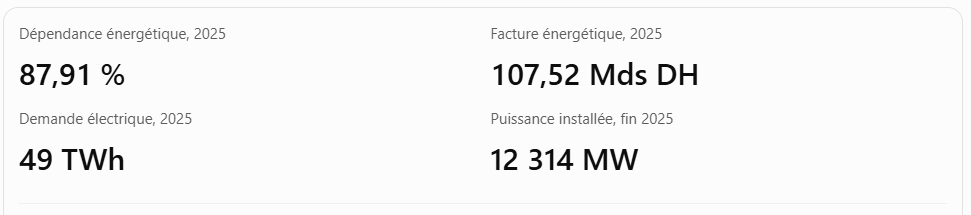
Sources: Ministry of Energy Transition, 2027 budget presentation; ONEE, 2025 report. The energy bill pertains to all imported energy products, not just electricity.
Morocco's electricity production is still largely dominated by fossil fuels.
Estimated distribution of national electricity production in 2025
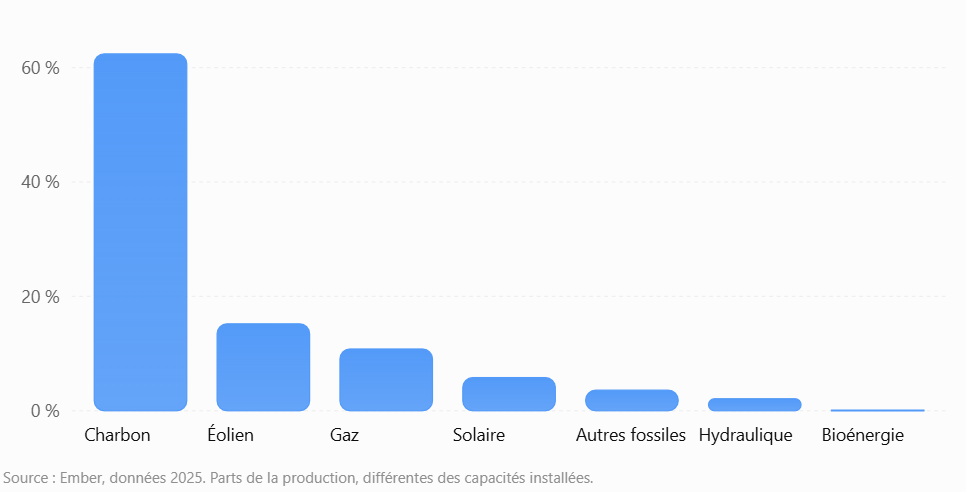
In other words, despite the growth of renewable energies, coal still provides around six kilowatt-hours out of ten produced in the country.
Moreover, it is essential to distinguish between two often-confused indicators: renewable energy accounted for 46.1% of the installed electrical capacity at the end of 2025, but their contribution to actual production remained significantly lower.
This discrepancy is primarily due to the intermittency of solar and wind energy, as well as the limitations of hydroelectric production during drought periods.
Nuclear energy presents a strategic advantage: it can produce large quantities of electricity, day and night, regardless of sunlight or wind.
2. Sidi Boulbra: The Nuclear Project Morocco Never Realized
Contrary to a common belief, Morocco's nuclear ambitions are not recent.
As early as the 1980s, the Kingdom was exploring the possibility of building a nuclear power plant on the Atlantic coast.
The site of Sidi Boulbra, located between Safi and Essaouira, was identified as a potential installation. Technical studies, initiated in 1984, benefited from the support of the International Atomic Energy Agency (IAEA).
The historical project envisioned several production units, with a potential capacity of up to 4,000 MW in the long term.
In 2006-2007, the National Office of Electricity advanced in preparing bidding documents for two reactors with individual capacities between 700 and 1,000 MW.
However, no plants were constructed.
This precedent is revealing: the main obstacle has not been the lack of studied sites or the scientific impossibility of considering a nuclear program.
It has been the failure to transition definitively from the evaluation phase to a phase of industrial and financial commitment.
Forty years after the initial studies, Morocco still has a nuclear option but not yet an active construction program.
3. The Cost: Likely the Main Economic Barrier
A nuclear power plant represents a significant initial investment. Its construction requires billions of dollars, long planning, and financial commitments that can extend over several decades.
Let's consider a working scenario: the construction of a 1,000 MW reactor in Morocco.
To measure the stakes, let's retain three investment assumptions of 5, 8, and 12 billion dollars, which are not official estimates for the Kingdom.
With a hypothetical conversion rate of 10 dirhams to the dollar, the amounts would be as follows:
|
Assumption |
Investment |
Equivalent |
|---|---|---|
|
Controlled Cost |
$5 billion |
50 billion DH |
|
Mid-range Scenario |
$8 billion |
80 billion DH |
|
High Cost |
$12 billion |
120 billion DH |
These amounts correspond only to investment scenarios and do not necessarily cover all financial interests, associated infrastructures, and long-term expenses.
The question of financing thus becomes central.
With a hypothetical investment of 80 billion dirhams, Morocco would need to mobilize an amount more than ten times the total investment made by ONEE in 2025, including water and electricity.
The comparison involves two different categories — a multiyear project against an annual investment — but it illustrates the magnitude of the challenge.
Moreover, the risk of construction delays must be taken into account. A delay of several years can lead to a substantial increase in interim interest and the final cost of electricity.
Hence, nuclear energy requires more than political will: it requires a sustainable financing model, guarantees, and a precise distribution of risks between the state, operators, and industrial partners.
4. Solar, Wind, or Nuclear: Which Choice Would Be More Cost-Effective?
The immediate economic advantage of renewable energies is now significant.
According to the International Renewable Energy Agency (IRENA), the average global production costs for new installations commissioned in 2025 were:
-
$33 per MWh for onshore wind;
-
$44 per MWh for photovoltaic solar.
These figures represent international average updated production costs. They do not correspond to guaranteed rates in Morocco and do not take into account all necessary expenses to ensure a stable electricity supply, notably storage, networks, and backup systems.
Nuclear power offers an alternative proposition: controllable, massive, and low-carbon production, but at the cost of significantly higher initial investment.
Thus, the decision is not merely about comparing the price of a MWh of solar to that of a MWh of nuclear. It involves determining how much a complete, reliable electricity system would cost Morocco each hour of the year.
This partly explains why the Kingdom has so far prioritized renewable sectors, whose projects can be developed more rapidly and in stages.
As a comparison, the 2025 Lazard study estimates the cost of electricity from new nuclear reactors in the United States to be between $141 and $220 per MWh. However, these figures, specific to the American market, should not be directly transposed to Morocco.
5. What Would a Moroccan Nuclear Power Plant Actually Produce?
This is where the debate becomes particularly interesting.
Let's consider a 1,000 MW reactor operating at a 90% load factor, a typical assumption for a high-performing nuclear plant.
Its annual production would be:
1,000 MW × 8,760 hours × 90% = 7.884 TWh per year.
Compared to the 49 TWh of Moroccan electricity demand in 2025, a single reactor could theoretically produce the equivalent of 16.1% of that demand.
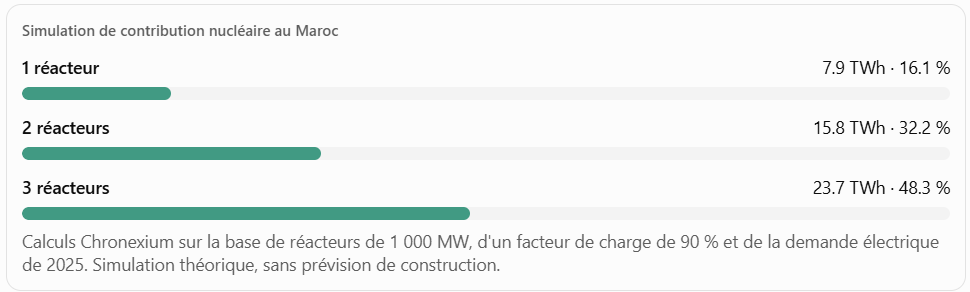
Three reactors could thereby produce nearly half of the electricity demand in 2025.
This does not mean they could mechanically replace half of the existing capacity: the operation of the grid, consumption peaks, maintenance downtime, and demand evolution would require additional planning.
But these simulations demonstrate the strategic importance nuclear power could hold in the national electricity mix.
6. Morocco Already Has a Nuclear Reactor
It would be inaccurate to assert that Morocco has no experience in the field.
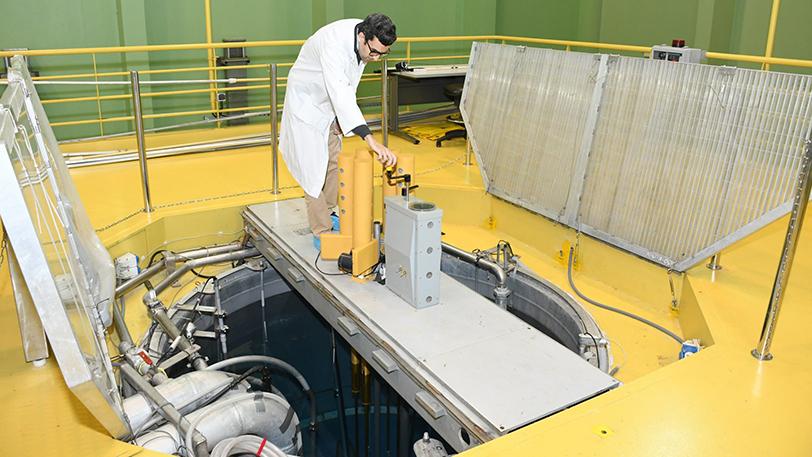
The National Center for Nuclear Energy, Sciences, and Techniques (CNESTEN) operates a TRIGA Mark II research reactor with a thermal power of 2 MW at the Maâmora Nuclear Studies Center.
This facility is used for research, training, and various scientific and medical applications. It does not produce electricity intended for the national grid.
Morocco also has an authority responsible for nuclear and radiological safety: AMSSNuR.
These infrastructures provide a valuable scientific foundation. However, operating a 2 MW thermal research reactor and managing a 1,000 MW electrical nuclear power plant are two radically different industrial scales.
To launch a nuclear program, the Kingdom would need to develop operating skills, control capabilities, emergency planning, maintenance pathways, and waste management mechanisms over several decades.
7. Could Moroccan Phosphate Become a Nuclear Asset?
Morocco has a significant geological characteristic: its vast phosphate reserves also contain natural uranium at low concentrations.
This reality opens up the prospect of recovering uranium as a byproduct of certain industrial phosphate processing operations.
However, three things must be distinguished: owning uranium in ores, being able to extract it at a competitive cost, and having a nuclear fuel manufacturing chain.
The presence of uranium in phosphates does not mean that the Kingdom currently has an autonomous usable fuel supply for a plant.
Its industrial exploitation would depend on concentrations, chemical processes employed, the cost of facilities, and global uranium prices.
The real opportunity would be to gradually develop industrial expertise and an additional value chain around phosphate resources, without presuming its profitability.
8. The New Avenue of Small Modular Reactors
The development of Small Modular Reactors (SMRs) could change how Morocco envisions nuclear power.
Unlike conventional large plants, these reactors are designed around smaller power units, generally up to 300 MW electrical per module.
An SMR of 300 MW operating at a 90% load factor would theoretically produce about 2.37 TWh per year.
These installations could eventually be considered to meet specific industrial needs or complement an electricity system dominated by renewables.
Desalinating seawater is particularly interesting for Morocco, which faces water stress.
However, caution is warranted: most SMR models remain in development or at the early stages of commercialization. Their real competitiveness at a large scale has not yet been demonstrated in all configurations.
Their strategic interest is therefore plausible, but their economic advantage cannot yet be considered guaranteed.
9. March 2026: Morocco Changes Its Discourse
A significant event occurred on March 10, 2026.
During the second International Summit on Nuclear Energy held in Paris, the head of government Aziz Akhannouch, representing King Mohammed VI, confirmed the Kingdom's interest in a responsible and gradual integration of civil nuclear power into its energy mix.
Morocco also participated in an international declaration regarding the financing of nuclear energy.
This is an important political signal: nuclear energy is no longer merely approached as an outdated technical possibility but as a viable option to complement the national energy strategy.
However, there remains a fundamental difference between supporting the international development of civil nuclear energy and deciding to build a plant in Morocco.
To date, no contract for the construction of a Moroccan nuclear power plant or official commissioning timeline has been publicly announced.
10. The 133 Billion Dirham Investment Program Does Not Include Nuclear
The most revealing answer may lie in the latest financial decisions.
On November 3, 2026, data presented as part of the 2027 budget revealed a program of 133 billion dirhams aimed at developing 18,088 MW of additional electrical capacity by 2030.
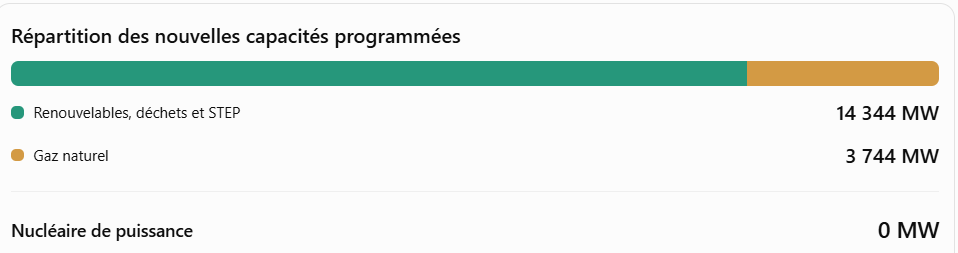
Capacity programmed by 2030, according to data presented by the Ministry of Energy Transition in November 2026. The 133 billion DH pertains to the overall program, without full breakdown by technology in the cited figures.
This programming is one of the strongest indicators for understanding the situation.
Morocco now shows political interest in civil nuclear power, but its electrical investments are heading towards renewable energies, storage systems, and natural gas for 2030.
Nuclear therefore appears as a longer-term option rather than an immediate response to consumption growth.
11. The Real Reasons for the Delay: What Our Analysis Reveals
A review of the data identifies five factors that explain why Morocco has not yet taken the plunge.
The first is financial. Building a plant represents a massive commitment, with risks of budget overruns and a need for very long-term financing.
The second is strategic. Since 2009, the Kingdom has chosen to accelerate solar and wind development. This choice has mobilized significant public policies, financing, and industrial capabilities.
The third is institutional. Despite its experience in nuclear research, Morocco still needs to demonstrate that it has all the necessary frameworks for the construction, operation, and oversight of a powerful plant.
The fourth relates to timelines. According to IAEA references, introducing nuclear power in a new country typically requires ten to fifteen years from initial political decisions to the operation of the first plant. A decision made today would therefore not address 2030 needs.
The fifth is industrial and technical. A plant must integrate into the national grid, have appropriate cooling, meet rigorous safety standards, and ensure long-term fuel and waste management.
These factors are documented to varying degrees. However, no verified public evidence suggests that foreign diplomatic opposition, political pressure, or international prohibition explains the delay of Morocco's nuclear program.
The most solid explanation remains that of an economic and strategic assessment, coupled with institutional and technical constraints.
12. The Real Stakes: Energy Sovereignty by 2050
The nuclear debate in Morocco deserves to be placed within a much broader perspective.
By 2050, the Kingdom may need to power an economy profoundly transformed by desalination, electric transport, new industries, data centers, and hydrogen production.
Such transformation will require not only more electricity but also a permanent availability and control of its cost.
Nuclear could contribute to this goal by producing low-carbon and controllable electricity. It could also reduce coal consumption and vulnerability to international fluctuations in fossil fuel prices.
However, it would not guarantee total energy independence on its own: financing, reactor technologies, specialized services, and initially, nuclear fuel, would likely require international partnerships.
The central question is thus not simply whether Morocco should adopt civil nuclear power but under what conditions this technology could strengthen its energy sovereignty without compromising its financial stability.
For a country aiming to become a regional industrial powerhouse and a green energy exporter, retaining the option to develop a nuclear sector is a strategic challenge.
13. What Would It Cost Morocco Not to Build a Nuclear Power Plant?
The absence of a nuclear power plant does not automatically equate to an economic loss. It all depends on the means of production that replace it, their costs, and their effects on imports.
Let's consider a hypothetical 1,000 MW reactor producing 7.884 TWh annually.
If this production were to entirely replace electricity generated from coal, Morocco could avoid a significant amount of CO₂ emissions.
Using an indicative intensity of 820 grams of CO₂ per kWh for electricity produced from coal, the calculation yields: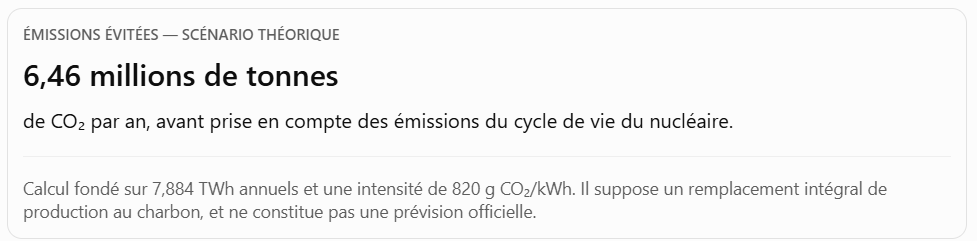
This potential is considerable, but it does not alone conclude that nuclear would be more profitable than renewable alternatives, storage, or gas.
The real cost of inaction would depend on future coal and gas prices, investments in networks, carbon pricing, and future needs of the Moroccan industry.
This is precisely what a comparative national study, made public and updated, should enable us to measure.
14. The Questions Moroccan Authorities Should Address
After several decades of studies, the Moroccan nuclear dossier still raises several crucial questions:
-
Is the historical site of Sidi Boulbra still technically considered for a future plant?
-
Does the government have a recent study comparing the costs of nuclear, gas, and renewables with storage?
-
Is a commissioning goal for around 2040 or 2050 under consideration?
-
Would Morocco favor a traditional large reactor or small modular reactors?
-
Which industrial and financial partners could support a potential program?
-
Could seawater desalination justify an initial nuclear installation for energy purposes?
These questions do not imply authorities have been inactive. They highlight the information still lacking in public debate needed to assess the economic and strategic feasibility of a Moroccan nuclear plant.
Conclusion: Has Morocco Waited Too Long?
Morocco has not abandoned civil nuclear power. It has so far chosen not to prioritize it in its electricity production investments.
This choice can be explained by the considerable costs of a first plant, the duration of its construction, safety requirements, and the growing attractiveness of renewable energies.
But circumstances are changing.
The growth in electricity demand, industrialization, desalination, and the need to reduce carbon emissions increasingly make a thorough reflection on nuclear more relevant.
The Kingdom already has a scientific foundation, specialized institutions, experience in international cooperation, and significant energy ambitions.
It remains to be determined whether these assets justify launching a genuine nuclear program, with a timeline, financing, and publicly defined goals.
The question is not why Morocco would have abandoned nuclear, as it has not. Rather, it is to understand why, forty years after its initial studies, it has yet to make the investment decision that would turn this ambition into reality.
And above all, how much longer can the Kingdom keep this option open before having to decide?