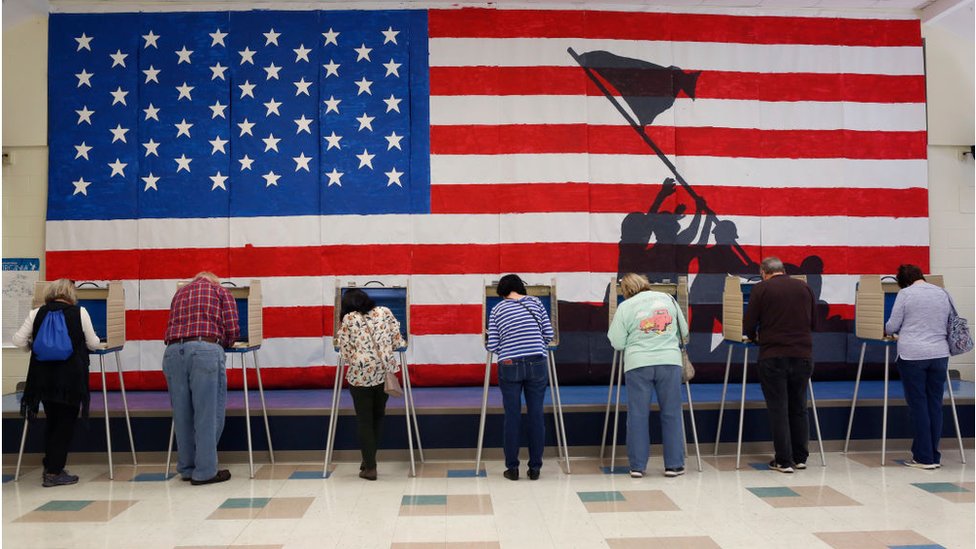
Never before has an American election so vividly reflected the tensions of its time.
The 2028 presidential election is set to be a major test for American democracy, as artificial intelligence, inequality, and identity divisions disrupt the political landscape.
Beneath the slogans and debates lies a fragmented and connected America preparing to decide its future.
1. A campaign under high political and social tension
Since the 2024 elections, the United States has failed to calm its internal fractures.
The fault lines— race, religion, gender, geography, education— have deepened in a climate of political tension and widespread distrust in institutions.
The two main parties, Democrats and Republicans, are now competing in two parallel realities :
-
the Democrats emphasize social justice, climate transition, and tech regulation;
-
the Republicans focus on economic populism, national sovereignty, and moral conservatism.
Yet the debate of 2028 transcends traditional divides: it pitting technological progress against cultural identity, the global against the local, reason against feeling.
2. Artificial intelligence, a new invisible player in the campaign
Never has technology so heavily influenced an election.
Generative AIs, capable of producing ultra-realistic speeches, images, and videos, are upending political communication.
Campaign teams are already using predictive analytics tools to target voters with unprecedented precision, test messages, and adjust speeches in real time.
However, this power of communication comes with a major risk: the algorithmic misinformation.
Deepfakes—those near-undetectable falsified videos—are already flooding social media, fueling confusion and distrust.The Federal Election Commission (FEC) has announced specific regulations for political AI, a first in American history.
The electoral battle of 2028 will be as much
ideological as it is technological3. The influence of digital giants.
Big platforms—
Meta, X, Google, TikTok, OpenAI— have become the invisible arbiters of American democracyTheir power to moderate, censor, or promote content directly influences the perception of candidates..
Campaigns rely on teams of community managers, data analysts, and political AI creators
to shape public opinion.For the first time, some states are considering how to tax or regulate electoral algorithms
, arguing that the manipulation of information flows poses a democratic risk.The line between political influence and digital engineering is blurrier than ever.4. An identity-fractured America
Beyond technology, the 2028 campaign reflects a society
weary from its internal divisions
The debates surrounding abortion, minority rights, freedom of speech, and gun ownership create an explosive atmosphere.Identity politics—whether progressive or conservative—dominates discussions..
In this context, independent voters and younger generations are becoming the
kingmakers
Generation Z, more diverse, educated, and engaged online, could disrupt traditional voting dynamics in America.Yet, it remains the most exposed to digital manipulation..
5. An economy under strain
Economically, the 2028 presidential race will hinge on three major themes:
artificial intelligence and employment
, amidst fears of massive automation;
-
the cost of living, still high despite recovery;
-
and the energy transition
-
, which divides industrial states from green states.The candidate who can propose an “inclusive technological prosperity”
will have a decisive advantage.But in a polarized America, consensus seems further away than ever.6. Geopolitics in the backdrop
The 2028 election will have global ramifications.
Amidst the war in Ukraine, China's rise, and tensions in the Middle East, the United States remains at the center of the international chessboard.
Foreign policy, while marginal in public debate, remains a
test of global leadership
Washington's traditional allies—Europe, Japan, Morocco, Gulf states—are closely watching this election, aware that the American style of governance.
will impact geopolitical balances for the decade to come.7. A democracy to reinventBeyond the candidates, the real question concerns the
democratic model itself
How to maintain trust in institutions amid fake news and AI?How to preserve freedom of expression without descending into informational chaos?.
And how to reconcile an urban, progressive, connected America with a rural, conservative, and skeptical one?
Political scientists already talk about a
“augmented democracy”
, where technology, guided by ethics and transparency, could serve as a tool for civic participation rather than a means of division.ConclusionThe American presidential election of 2028 will not just be a vote: it will be
a global laboratory for digital democracy
Never before has the boundary between reality and fiction, information and manipulation, conviction and programming been so thin.In a world where algorithms vote almost as much as citizens, the United States is preparing for an election that will redefine the relationship between .
technology, truth, and power
And the rest of the world, from Morocco to Asia, will watch for lessons—both hopeful and worrisome.Sources:.
Pew Research Center –
US Politics & Media Report 2025
-
The New York Times – AI and Elections: The Next Frontier of Democracy
-
Brookings Institution – Artificial Intelligence and US Electoral Integrity
-
Reuters / Politico – US 2028 Presidential Race Overview
-
Freedom House – Democracy in the Digital Age (2025)
-
:,