When a drone becomes 'autonomous'
The term 'autonomous' is often misused to refer to a simple armed drone. In practice, autonomy is measured by functional elements.
A drone can be autonomous in taking off and landing, stabilizing its trajectory, avoiding obstacles, or following a pre-programmed route. This is already common on modern platforms. The real shift occurs when AI is involved in the decision-making loop: detecting a signature, classifying a potential target, proposing an action, and then acting with varying levels of supervision.
Generally, three control logic types are distinguished. The first is 'human in the loop': the operator validates the action. The second is 'human on the loop': the system acts, but a human supervises and can intervene. The third is 'human out of the loop': the system can engage without human validation. This last model is precisely what crystallizes international debates, as it touches on lethal decision-making.
The Turkish Model: Industrialization, Export, and Upgrading
Turkey has established itself as a major player in armed drones, with an ecosystem capable of producing, exporting, and quickly evolving its platforms. Two families illustrate this trajectory.
Loitering Munitions: Short-range Autonomy
Loitering munitions (often referred to as 'kamikazes') combine surveillance and striking: they patrol, identify, and dive on targets. The most discussed example is the STM KARGU, often cited in analyses of autonomy in the lethality chain. Academic and institutional publications have highlighted the legal and ethical issues related to these systems, particularly from allegations of use in real contexts.
This type of drone embodies a strong trend: making strike capabilities more 'accessible,' faster, and potentially less dependent on a constant radio link, which matters in a jamming environment.
The Leap to the 'Hunter Drone': KIZILELMA
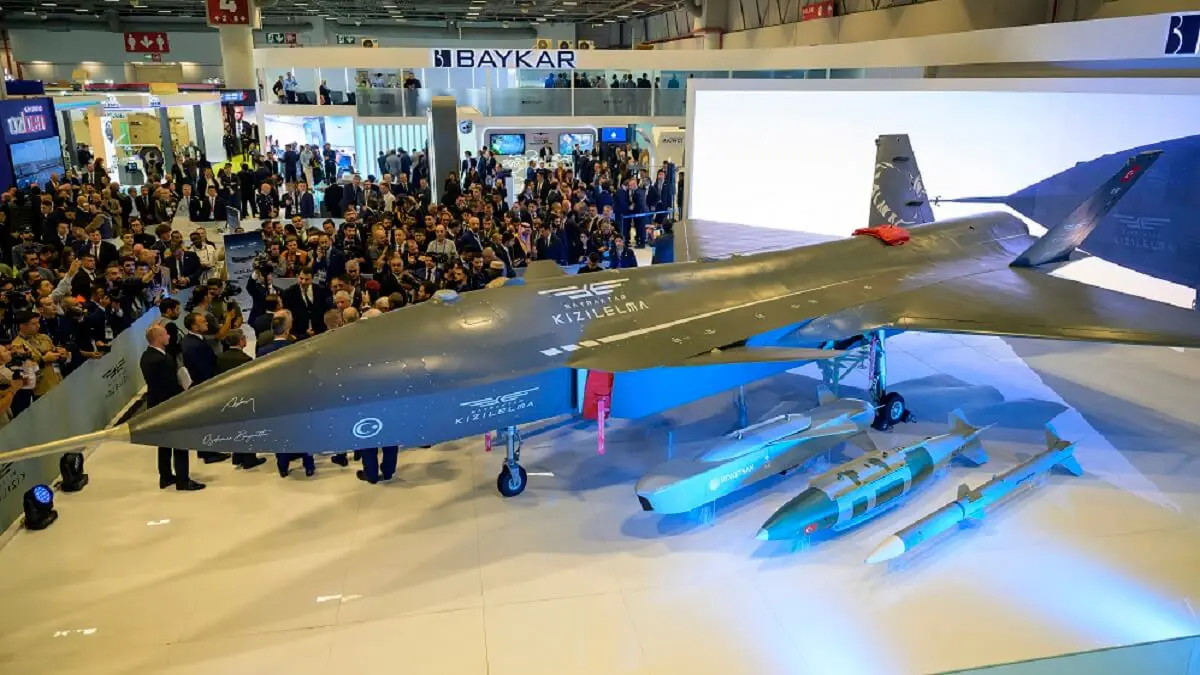
At the other end of the spectrum, Baykar is pushing the concept towards a pilotless combat aircraft designed to operate with advanced flight and mission autonomy capabilities. The Bayraktar KIZILELMA is marketed as a jet UCAV, oriented towards missions similar to those of a fighter jet, incorporating elements of embedded AI and designed for naval uses and short runways.
Even if the marketing discourse should always be read with caution, the direction is clear: transitioning from the 'classic' armed drone to collaborative platforms capable of complex missions, including teaming up with piloted aircraft.
The American Model: 'Collaborative Combat Aircraft' and Team Warfare
In the United States, the current acceleration focuses on one idea: not to think of the drone as a separate tool, but as a combat teammate. The 'Collaborative Combat Aircraft' (CCA) program aims for semi-autonomous devices designed to complement piloted fighters by providing sensors, decoys, payloads, or mass effects.
These 'collaborative' drones are not merely reusable missiles: they embody a hybrid squadron logic, where the piloted aircraft becomes a tactical command platform while multiple drones undertake high-risk tasks.
Examples and Technological Building Blocks
The United States has tested and evaluated 'loyal wingman' concepts for several years. The XQ-58A Valkyrie is often cited as a demonstrator of an 'attritable' approach: drones sufficiently capable to matter but designed to be less expensive and more easily replaceable than frontline piloted aircraft.
The news for 2025 also shows formalization: official designations, increased prototype capabilities, and structuring of the CCA program in increments.
Beyond Turkey and the USA: the movement is global
Combat autonomy is becoming a common language across aeronautics programs. Australia, for example, is advancing on collaborative combat drones, with news of a shift to initial production announced in the international press.
In Europe, industrial discussions around a 'wingman' and cooperations on unmanned fighter technologies signal a reconfiguration: the drone is no longer a byproduct but a pillar of future air forces.
What Autonomy Really Changes on the Battlefield
The military interest in autonomy is not limited to 'replacing the pilot.' It addresses four modern constraints.
The first is speed: detecting, deciding, and acting within increasingly short time windows, especially against missiles and electronic warfare. The second is mass: saturating, multiplying sensors, complicating enemy defenses. The third is resilience: continuing a mission despite jamming or communication degradation. The fourth is political cost: reducing the direct exposure of crews.
But these advantages come with a downside: the faster a system decides, the more significant the issues of misclassification, sensor biases, and incidents become. Hence the growing importance of the concept of 'meaningful human control,' discussed in legal and humanitarian frameworks.
The Limits: Jamming, Identification, Escalation
Autonomy is not a magic wand. Three limits dominate today.
The first is electronic warfare: if GPS is cut off, if jamming occurs, or if sensors are deceived, a drone can degrade its performance or even make errors. The second is identification: distinguishing between a combatant and a civilian, or a military vehicle from civilian use, remains one of the most sensitive issues, especially at a distance and under operational stress.
The third is escalation: rapid systems operating in swarms can accelerate action-reaction cycles and reduce political de-escalation times, especially if the attribution of an attack is unclear.
The Future of the Domain: 5 Likely Trends
The first trend is widespread human-machine cooperation: 'orchestral' pilots and executing drones, with degrees of autonomy adjustable according to context (jamming, rules of engagement, theater).
The second trend is the 'swarm' architecture: multiple specialized drones instead of one very expensive one, increasing redundancy and saturation capability.
The third trend is modularity: interchangeable payloads (sensors, jamming, relays, etc.) to quickly adapt the same airframe.
The fourth trend is the software battle: competitive advantage will hinge as much on embedded AI, sensor fusion, and resistance to deception as on aerodynamics.
The fifth trend is regulation and doctrine: the further programs advance, the more states will be pushed to clarify acceptable autonomy thresholds, responsibilities in case of error, and mechanisms for human control, particularly in international debates about autonomous weapon systems.
Conclusion
The autonomous combat drone is not a weapon of the distant future: it is an ongoing transformation of doctrines, industries, and strategic balances. Turkey illustrates this rise through industrialization and upgrades towards jet UCAVs. The United States, meanwhile, is structuring a new generation of aerial 'teammates' under the CCA framework. Between these two poles, a global dynamic is emerging, where autonomy becomes a military advantage, but also a significant political and ethical issue: who decides, when, and with what control.