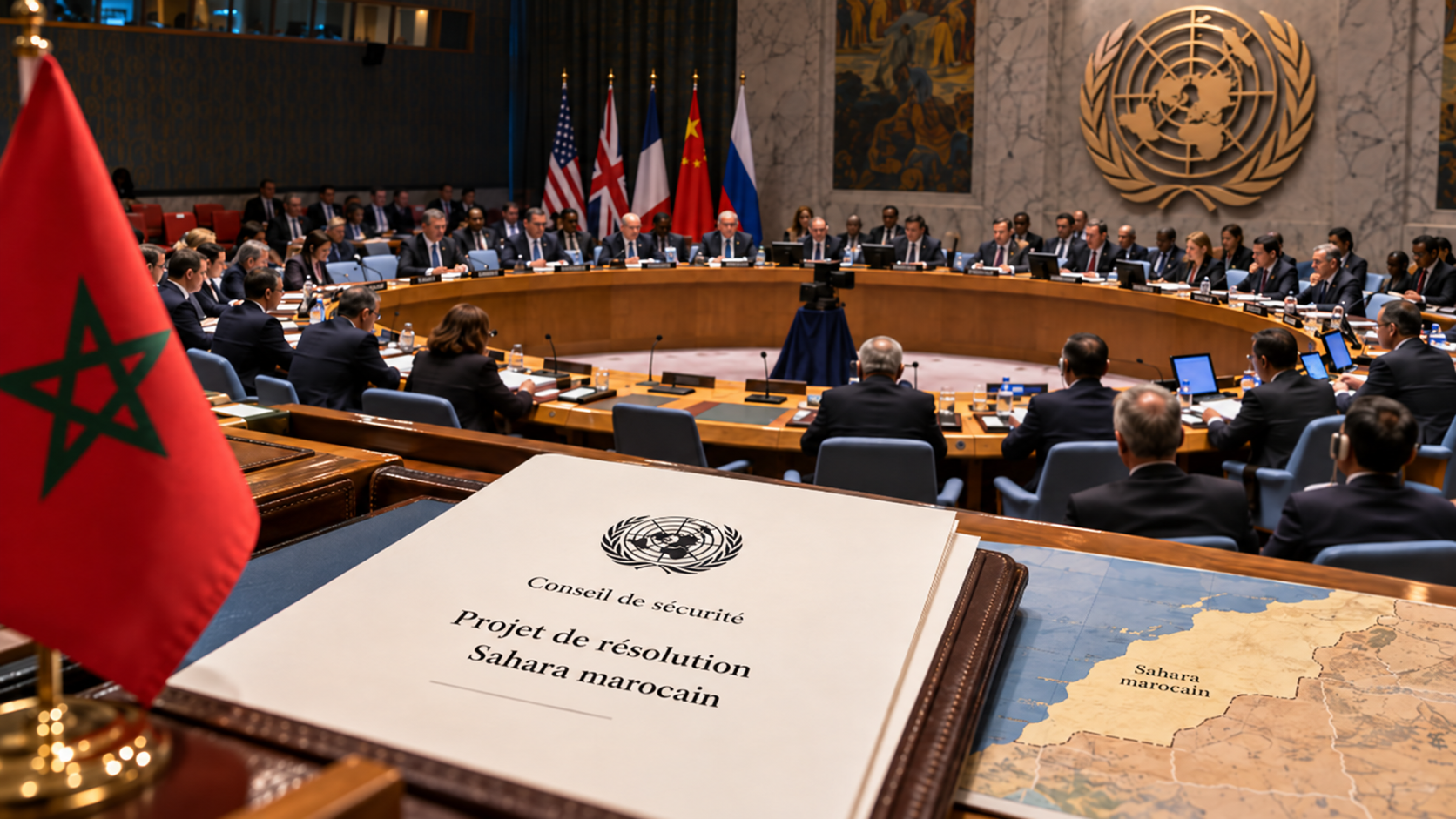
The adoption of Resolution 2797 by the Security Council marks a major diplomatic turning point in the Sahara issue. Officially, it is a resolution renewing the mandate of MINURSO, the UN mission deployed since 1991. However, politically, it signifies much more. For the first time, the Council clearly presents Morocco's proposed autonomy initiative as the realistic and serious path towards a 'sustainable, just, and mutually acceptable' solution, calling on the parties to negotiate based on this framework, without preconditions.
The vote itself reflects the state of power dynamics. The text passed with 11 votes in favor, with no veto and no votes against. Russia, China, and Pakistan abstained. Algeria, a direct supporter of the Polisario Front, made the politically significant decision not to participate in the vote. Its choice of 'voluntary absence' isolated it precisely when discussions were occurring at the highest level of the multilateral system. Many observers view this as a gesture of self-marginalization: Algeria preferred to withdraw from the discussion rather than publicly face a negative vote against the United States, France, the United Kingdom, and a majority of African and Latin American members of the Council.
On the substance, Resolution 2797 renews MINURSO for one year. This is important to note, because some signals suggested the mandate could be limited to six months, as has occurred in the past when the Council sought to pressure the parties. The choice of a twelve-month renewal thus sends a dual message: on one side, operational stability for the mission on the ground; on the other, a political acceleration at the diplomatic level. The Council no longer wants a status quo without an end in sight. It desires a resolution, which it's now articulating in terms very close to the Moroccan position.
The text indeed emphasizes that autonomy under Moroccan sovereignty is no longer merely 'credible and serious' – a phrase often used since 2007 – but that it constitutes the working basis. In UN terminology, this is a significant nuance. Previously, Moroccan autonomy was 'one option among others.' Today, it becomes 'the option around which a solution to the crisis is constructed.' This represents a diplomatic consolidation of the trajectory initiated since several capitals, including Washington, Paris, and London, publicly expressed their view that the autonomy proposed by Rabat is the most realistic solution.
This positioning greatly undermines the narrative of the Polisario Front, which continues to demand a referendum on self-determination that includes the option of independence. The Security Council no longer adopts this logic as a primary horizon. It speaks of a negotiated political solution that is mutually acceptable, within the framework of the Moroccan plan. Polisario leaders immediately condemned the resolution, claiming it 'undermines the Sahrawi people's right to self-determination' and serves 'Morocco's expansionist agenda with the support of certain powers.'
However, the resolution must be read carefully: to avoid a Russian or Chinese veto, the text also retains some classic phrases about 'a just and lasting solution' and 'the commitment to take into account the aspirations of the Sahrawi people.' This is the concession obtained by the most reluctant Council members and by Algeria. In other words, Washington pushed for an explicit recognition of the Moroccan plan as a central basis. Moscow, Beijing, and Algeria sought to maintain a reference to the principle of self-determination in the text. The final result reflects this power struggle. The balance clearly tilts toward Rabat, but it does not entirely eliminate historical UN language.
What changes, however, is almost irreversibly the staging of the actors. For years, Algerian diplomacy maintained an official line: 'We are not a party to the conflict; it is a matter between Morocco and the Polisario.' This position served to refuse being named as involved in a direct negotiation process. Now, Resolution 2797 explicitly calls on all regional stakeholders to participate 'without preconditions' in the political process led by the Secretary-General's personal envoy, Staffan de Mistura. Diplomatic translation: Algeria is called to sit at the table as an actor, not as a spectator. This is precisely what Algeria publicly refuses to assume, and it is one of the political reasons behind its choice not to vote.
The text also sends a signal regarding the role of the United States. Washington is the 'penholder', meaning the principal author of resolutions on the Sahara in the Security Council. This time, the Americans took a further step: they did not limit themselves to managing the technical renewal of MINURSO; they pushed a formulation that aligns the Council with the current American doctrine, namely that Moroccan autonomy is the most credible solution to conclude a conflict that has lasted nearly half a century. The United States also indicates its readiness to host discussions to support UN mediation. This positions them as a political sponsor of the final settlement.
For Morocco, this is a strategic victory. Rabat obtains from the Security Council a public recognition that its 2007 proposal is no longer merely 'diplomatically interesting,' but has become the basis for the exit scenario. The Kingdom can now declare: this is not only our national plan; it is the official lens of the most powerful international community regarding security and peace. This evolution reinforces Morocco's position on three levels: internal (sovereign legitimacy), regional (power dynamics against Algeria), and international (increasing acceptance of the Sahara's attachment under Moroccan sovereignty).
For Algeria, it is more complicated. Algeria finds itself facing a dilemma: either it stays away and lets Morocco and the United States frame the process, or it accepts to be officially regarded as a stakeholder, which would mean abandoning the diplomatic fiction of recent decades. Hence the paradoxical attitude during the vote: refusing to vote so as not to endorse the text, but not willing to vote against to avoid appearing isolated before the Western bloc. This is a posture of symbolic self-immolation: many analysts speak of a 'diplomatic auto-da-fé.'
One question remains: does this resolution resolve the conflict? No. It does not address anything on the military ground in the short term. The Polisario has already made it clear that it will continue its 'struggle,' and skirmishes east of the Moroccan defense wall have not ceased since hostilities resumed in 2020. It also does not resolve humanitarian dimensions (family separations, movement, conditions in the Tindouf camps, resource exploitation). However, it modifies the political balance. For the first time, the Security Council clearly states where it wants to go, and it is no longer towards a binary independence/reintegration referendum. It is towards a controlled autonomy under Moroccan sovereignty, negotiated and guaranteed at the international level.
Provisional conclusion: Resolution 2797 does not put an end to the Sahara issue, but it closes an era. For nearly fifty years, the key term was 'self-determination through referendum.' Now, the key term becomes 'autonomy.' This is precisely what Rabat sought, and exactly what Algeria wanted to prevent.