Morocco has officially stated its position regarding the consequences of one of the most turbulent evenings in the recent history of the Moroccan Sahara issue.
In a statement released this Friday, October 30, 2026, and shared by the Maghreb Arab Press Agency (MAP), the Royal Cabinet presents the non-renewal of the MINURSO mandate as a major turning point, paving the way for a new phase in the political and diplomatic management of the Sahara issue.
After thirty-five years of UN presence in the Southern provinces, Rabat believes that the expiration of the mission's mandate should lead to the withdrawal of its personnel and equipment.
The statement goes further: Morocco believes that this development should also end the periodic review of the issue by the Security Council, while reaffirming its commitment to the ceasefire and continued diplomatic mobilization.
This stance comes just hours after an exceptional confrontation between the United States and Russia at the Security Council.
A diplomatic evening that changes the game.
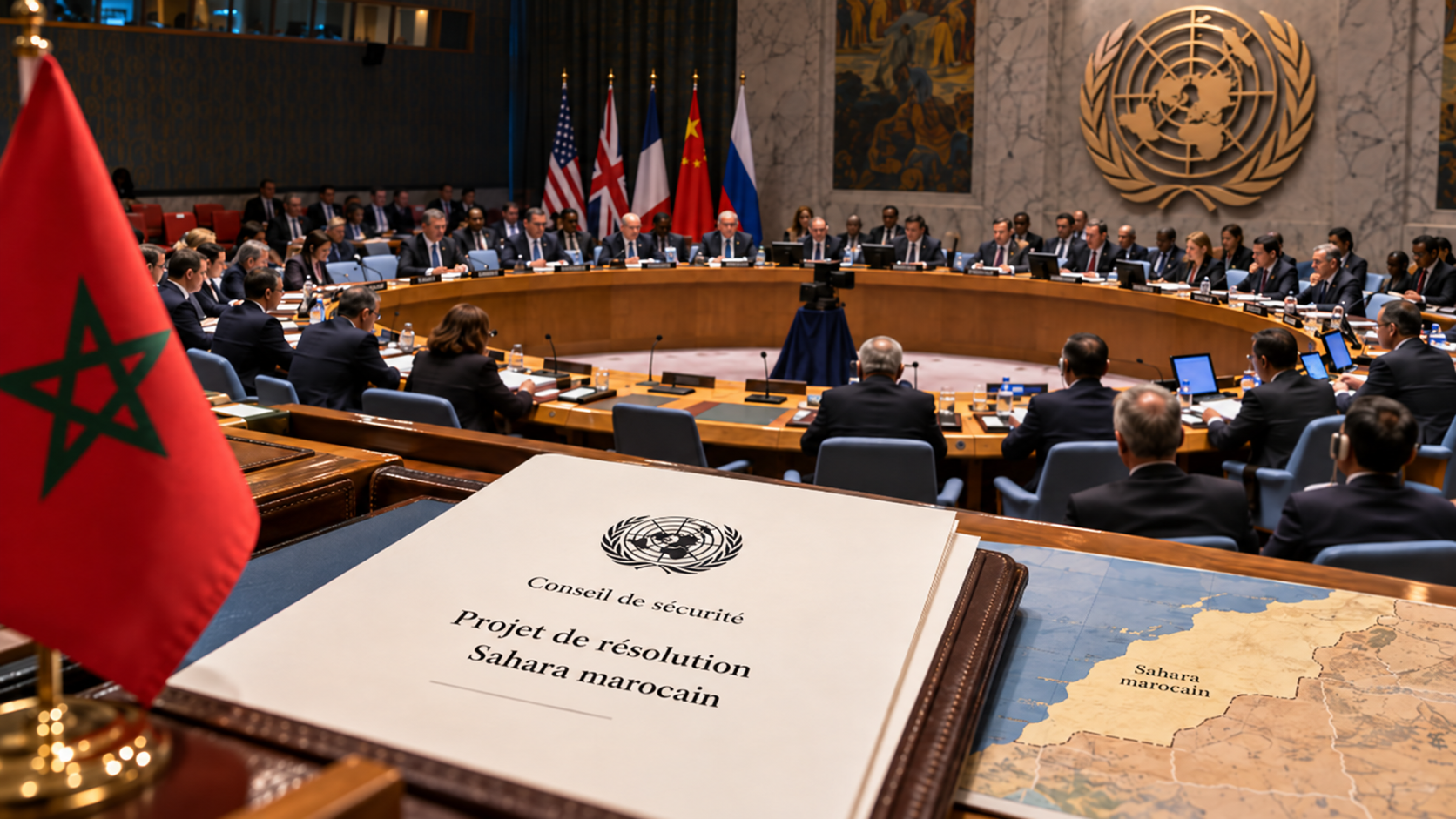
Everything begins in New York, where the Security Council examines two competing proposals regarding the future of the United Nations Mission for the Organization of a Referendum in Western Sahara, established in 1991.
The first text, presented by the United States, proposes to extend the UN presence while significantly transforming its mandate.
Washington particularly wishes to make the Moroccan autonomy initiative the sole basis for negotiations and remove the reference to the referendum from the mission's name.
The American project receives eleven favorable votes, but Russia vetoes it. Three countries, China, Pakistan, and Somalia, choose to abstain.
Moscow then presents its own proposal, aimed at extending MINURSO for another year without substantial modifications.
However, this initiative also fails: it receives three votes in favor, one against from the United States, and eleven abstentions.
Thus, the Russian text does not attain the nine votes necessary for its adoption.
For the first time in this annual cycle, the Security Council fails to renew the mandate of the mission just before its expiration.
It is in this context that the Royal Cabinet intervenes to clarify the Moroccan interpretation of this new situation.
MINURSO: Morocco considers the end of thirty-five years of presence.
The first message of the statement directly concerns the UN mission.
The Royal Cabinet believes that the non-renewal of its mandate marks the conclusion of a mechanism that has been present in the Sahara since 1991.
According to the position expressed by Rabat, MINURSO personnel, vehicles, and equipment should leave the Southern provinces in the coming days.
The significance of this declaration is considerable.
For thirty-five years, the mission has embodied the institutional presence of the UN on the ground. It was established as part of a settlement process that was expected to lead to the organization of a referendum.
This vote has never taken place due to persistent disagreements over its modalities.
Morocco now considers that the indefinite maintenance of a structure designed for an unrealized mission no longer corresponds to the political evolution of the issue.
The non-renewal thus constitutes, in the view of the Royal Cabinet, an opportunity to turn the page on this setup.
Operationally, however, the effective withdrawal of personnel and equipment will need to be organized with the competent authorities of the United Nations.
The expiration of the mandate does not, by itself, mean that the entire withdrawal operation has already been completed.
Rabat also seeks to end the periodic review at the Security Council.
The second part of the statement represents another important evolution of the Moroccan position.
The Royal Cabinet believes that the non-renewal of MINURSO should also lead to the cessation of the periodic examination of the Sahara issue by the Security Council.
For several decades, this file has regularly come before the fifteen members of the body during reports from the Secretary-General and mandate renewals.
For Rabat, the disappearance of the MINURSO setup should now provoke a reflection on the relevance of this monitoring mechanism.
The Moroccan position reflects a desire to move away from an annual management logic of the dispute to favor a new political dynamic.
However, this is an orientation expressed by the Kingdom, not a decision that has already been adopted by the Security Council.
The potential disappearance of the mission does not automatically remove the issue from the Security Council's agenda. This question falls under the procedures and decisions of the United Nations.
This distinction does not diminish the political significance of the message conveyed by Rabat: Morocco intends to evolve the framework within which the issue has been addressed for several decades.
Mohammed VI and the shift in the diplomatic paradigm.
The statement situates this new step within the approach led by King Mohammed VI.
The highlighted orientation is to move beyond the prolonged management of the dispute to foster a sustainable political solution based on the Moroccan autonomy initiative.
This strategy has gradually asserted itself since the presentation of the autonomy plan in April 2007.
In recent years, Morocco has gained support from several international partners for this proposal, notably the United States, France, and the United Kingdom.
Resolution 2797, adopted on October 31, 2025, had already constituted a significant step by explicitly placing the Moroccan initiative at the center of negotiations.
The American project of 2026 aimed to go further by making this initiative the sole basis for discussions.
Although this text was blocked by Moscow, its support from eleven members of the Council represents a significant diplomatic element for Rabat.
In this context, the Royal Cabinet presents the non-renewal of MINURSO as an opportunity to engage in a new phase, less centered on the periodic renewal of a mission and more on seeking a political resolution.
Morocco reaffirms its commitment to the ceasefire.
Another important element of the statement concerns regional security.
Despite the developments at the United Nations, Morocco reaffirms its commitment to the ceasefire, its territorial integrity, and the safety of its citizens.
This clarification comes during a period of persistent tensions surrounding the Sahara.
MINURSO performs monitoring and liaison functions meant to limit the risks of escalation.
The prospect of an interruption of its mandate thus raises questions about the future of these mechanisms.
By reaffirming its commitment to stability, Rabat seeks to clearly distinguish the anticipated end of the UN mission from the continuation of its security responsibilities.
For Moroccan authorities, the change in institutional framework should not be interpreted as an abandonment of the search for a peaceful solution.
The statement thus underscores the continuity of Morocco’s position in favor of regional security and stability.
International support for the Moroccan plan remains at the heart of the strategy.
Finally, the Royal Cabinet confirms that Morocco will continue its diplomatic mobilization.
The statement emphasizes the growing international support for the Moroccan autonomy initiative, asserting that more than two-thirds of UN member states, including permanent members of the Security Council and major global powers, back this approach.
This figure is presented by the Royal Cabinet and should be understood as a portrayal of the Moroccan diplomatic position, with varying degrees of support and recognition among states.
For Rabat, the votes of October 30 do not undermine this dynamic.
The American project received eleven favorable votes, representing a significant majority within the Council.
Its rejection is due to the negative vote from one permanent member, Russia, and not the absence of a favorable majority.
Morocco thus retains the bilateral positions expressed by its partners and the associated diplomatic gains from previous resolutions.
The next step will be to determine how this dynamic can be translated into a new negotiation framework.
Russia and the United States face their responsibilities.
The evening of October 30 also highlighted the deep divergences between Washington and Moscow.
The United States advocated for a transformation of the UN mission and a new architecture for negotiations.
Russia favored the continuity of the existing setup and contested the notion that the outcome of the political process could be predetermined.
The Russian veto prevented the adoption of the text supported by eleven members.
However, Moscow's proposal garnered only three votes, revealing a lack of sufficient support for a simple extension without reform.
This confrontation places the United Nations in an unusual situation: the failure of two competing projects just hours before the expiration of a mandate renewed for thirty-five years.
It also opens a period of legal and operational uncertainty regarding the future of the UN presence.
In this situation, the Royal Cabinet's statement clarifies Morocco’s expectations and its desire to approach the next stage from a new political reading of the issue.
A new chapter for the Moroccan Sahara.
The declaration from the Royal Cabinet comes at a particularly symbolic moment.
October 31, the expiration date of the MINURSO mandate, also corresponds to the Feast of Unity, established in Morocco following the adoption of resolution 2797 in 2025.
This convergence of dates gives particular resonance to the events in New York.
For Rabat, the issue is no longer limited to the renewal or transformation of a mission created in 1991.
It concerns the future of the political, diplomatic, and institutional framework in which the search for a solution to the dispute will continue.
The statement thus highlights three objectives: to draw the consequences of the non-renewal of MINURSO, to preserve the stability of the territory, and to continue international mobilization around autonomy under Moroccan sovereignty.
However, the modalities of the mission's withdrawal, as well as any potential modification of the Council's oversight of the issue, still need to be specified.
Conclusion: Morocco expresses its desire to turn the page on MINURSO.
October 30, 2026 marks a rupture in the history of UN treatment of the Moroccan Sahara issue.
Two resolution projects have failed. The mission created in 1991 comes to the end of its mandate without a new extension being adopted, and the Royal Cabinet has just specified the consequences that Morocco intends to draw from this situation.
Rabat now contemplates the end of the operational presence of MINURSO and wishes to see the periodic review of the issue by the Security Council evolve.
While reaffirming its commitment to the ceasefire, its territorial integrity, and regional stability, the Kingdom intends to pursue its diplomatic efforts around its autonomy initiative.
For Morocco, the message signals a change of era: after thirty-five years of UN presence, the Kingdom seeks to shift from prolonged management of the dispute to a new political phase.
The concrete realization of this transition will now depend on the forthcoming institutional and diplomatic decisions.