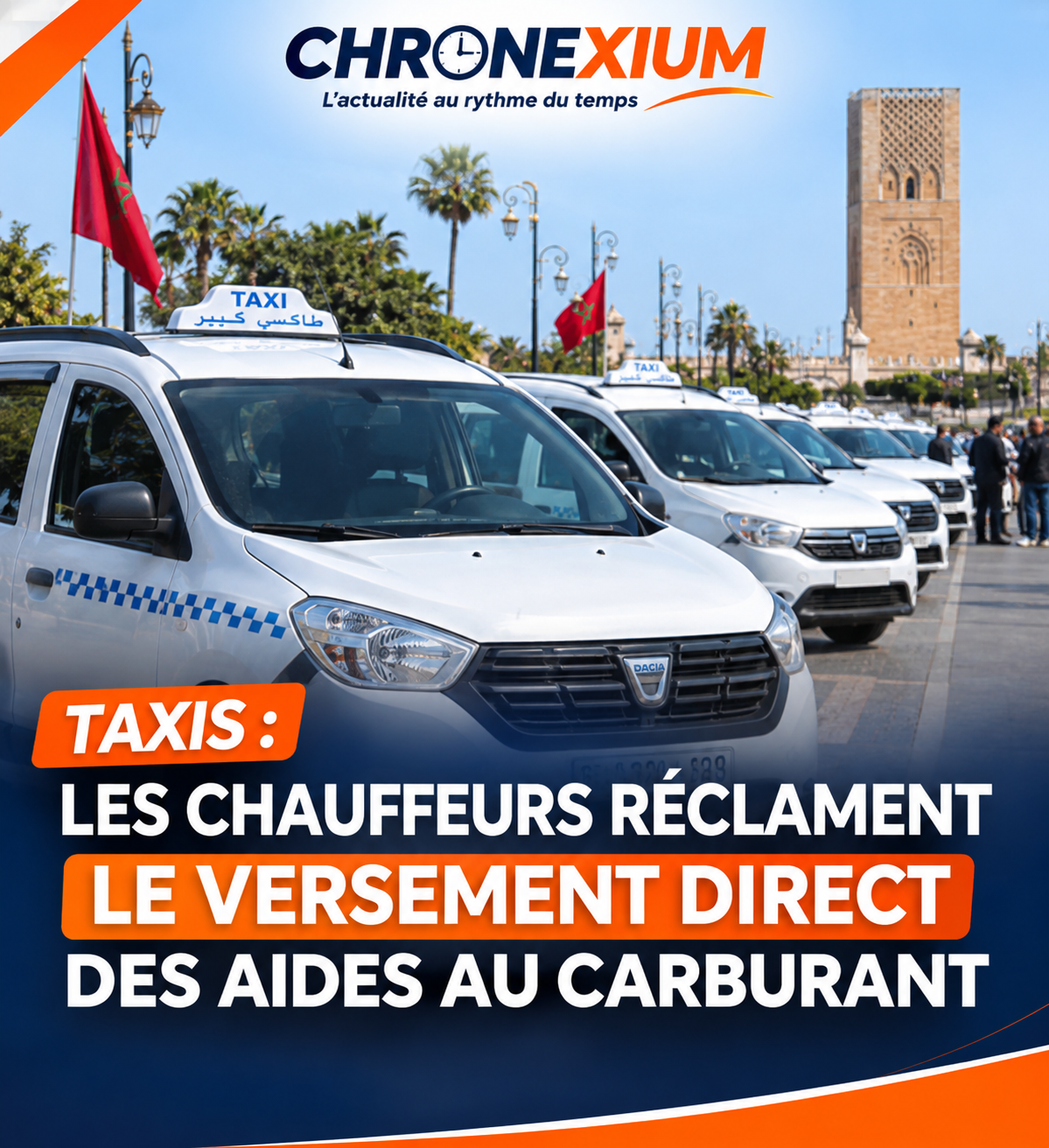
On Saturday, November 7, 2026, grand taxi drivers affiliated with the General Union of Workers of Morocco (UGTM) gathered at Bab El Had in the heart of Rabat to express their dissatisfaction with the economic and administrative difficulties faced in their profession.
At the center of this mobilization is the question of financial support provided by the state to transport professionals to offset the rise in fuel prices.
The protesters are not only contesting the announced amounts. They are particularly condemning the distribution methods of these aids, believing that drivers who bear daily fuel costs do not always benefit directly from them.
This movement comes in a context of recurring tensions within the sector. In October, several mobilizations had already been observed in Casablanca and other cities, with demands focused on fares, social protection, professional licenses, and competition from transport apps.
A central demand: direct payment of aids to drivers
This is the main message conveyed by the protesters in Rabat.
Currently, the aid system relies on the vehicles and their operators. According to representatives of the mobilized drivers, the funds distributed may pass through the owners without being fully transferred to the drivers.
However, in many professional situations, it is precisely these drivers who pay for the fuel and bear part of the operating costs.
Therefore, the drivers are calling for a survey of the drivers who are actually active, accompanied by a mechanism that allows direct payment of public aid to them.
Unionist Khalid Amrani notably advocated for this demand during the gathering on November 7.
The issue goes beyond merely the amount of subsidies: it touches on the very organization of the taxi sector, where the vehicle owner, license holder, and driver can be three different individuals.
400 million dirhams released: what the government plans
On November 5, two days before the sit-in, the Minister of Transport and Logistics, Abdessamad Kayouh, announced a new envelope of 400 million dirhams aimed at supporting road transport professionals for the period from November 1 to November 15, 2026.
According to government details, about 200,000 professional vehicles meeting the required conditions are covered by the scheme, across all categories of transport.
Grand Taxis
1,760 DH
Per vehicle for 15 daysSmall Taxis
1,280 DH
Per vehicle for 15 daysTotal Envelope
400 million DH
Expected start of payments
November 10
The government has also announced a 60% increase in reference amounts compared to the first level of aid, and that support will be adjusted to reflect changes in fuel prices, with a biweekly rhythm.
The stated objective is to support transporters while avoiding that increases in operating costs are directly passed on to consumers.
But for the protesters, the real question remains: who actually receives this money, and who bears the expenses it is supposed to compensate?
Main Demands of Professionals
Beyond the gathering of November 7, various union mobilizations in recent weeks have highlighted several recurring demands.
1. Direct payment of fuel aids. Drivers want the support to benefit those who are actually working and covering fuel expenses.
2. A revision of fares. In Casablanca, some representatives of small taxis are demanding a minimum fare of 10 dirhams for one passenger and 15 dirhams for three passengers to better cover their costs.
3. Regulation of transport apps. Unions denounce competition from services operating without the required licenses and call for enforcement of existing regulations.
4. Better social protection. Several organizations wish to address issues related to contributions to the CNSS, particularly accumulated debts and the situation of drivers with irregular working status.
5. Reform of the licensing system. Professionals are calling for clarification of relationships between drivers and license holders, as well as a shift towards a more transparent professional authorization regime.
6. A revision of administrative procedures. Protesters in Rabat are specifically calling for the cancellation of measures to withdraw confidence permits and for an opening of dialogue with the authorities.
These demands are not all articulated in the same terms by every union organization. They nonetheless reflect common concerns among a significant portion of the profession.
Fare Increases: Will Passengers Have to Pay More?
This issue is particularly sensitive.
On November 2, before the Rabat sit-in, some grand taxis in the capital had already applied a fare increase of 5 to 6 dirhams on several routes, without official permission reported.
Other increases had also been noted at certain stations in Casablanca and around Berrechid.
These initiatives sparked protests among travelers, especially those who use taxis daily to reach their workplaces.
The situation reveals a contradiction: while the state mobilizes resources to limit the consequences of the rise in fuel prices, some professionals are still considering raising their fares.
The Ministry of Transport emphasizes the need to preserve the purchasing power of citizens. However, representatives of the drivers mobilized in Rabat warn that a fare increase could become hard to avoid if their costs continue to rise.
For Moroccan households, particularly those depending on public transport, the risk is to face additional pressure on a budget already strained by food, housing, and other essential service expenses.
The Problem of Moroccan Taxis Exceeds Beyond Fuel
The increase in diesel prices serves as the immediate trigger for many protests, but it does not sum up the difficulties of the sector.
The Moroccan taxi model historically relies on a licensing system whose operating conditions can create complex situations.
In some cases, the driver neither owns the vehicle nor the operating permit. They might have to pay regular amounts to the owner or operator even before earning a personal income.
These expenses are compounded by fuel, mechanical maintenance, insurance, and administrative fees.
This organization explains why aid allocated to the vehicle does not necessarily benefit the driver in the expected proportions.
Digital transformation presents another challenge. Booking and transport apps respond to new consumption habits, while traditional taxis operate under a different regulatory framework.
Unions are demanding fair competition conditions, but the sector's future will also depend on its ability to modernize its services and meet users' expectations.
A New Day of Mobilization Against Fuel Prices
The taxi movement is part of a broader context of dissent against the high cost of fuel.
For Sunday, November 8, the Citizen Initiative Committee for Capping Fuel Prices has called for an operation dubbed "6 Hours Without Transport Means," from noon to 6 PM.
This initiative, distinct from the union sit-in held in Rabat, invites citizens and willing professionals to temporarily halt their travel to draw attention to fuel costs.
The organizers particularly ask that this mobilization occur without blocking roads or disrupting emergency services.
At this stage, this is a call for mobilization, not a confirmed general halt of transport in the Kingdom.
Towards a Sustainable Reform of the Sector?
The sit-in on November 7 highlights a challenge that exceptional aids will likely not be enough to resolve: the coexistence of an outdated operating system with substantially transformed economic and technological realities.
Several pathways emerge from the professional demands: accurately identify active drivers, make aids more transparent, clarify contractual relationships, modernize the vehicle fleet, and adapt regulations to new mobility services.
But this reform must also take into account a fundamental requirement: preserving the financial accessibility of taxis for Moroccans.
Public support can only fully achieve its objective if it truly alleviates the burdens faced by professionals without simultaneously leading to unjustified price increases for travelers.
The next steps will therefore be crucial, starting with the announced launch of payments on November 10 and the possible opening of dialogue between driver representatives and authorities.
For behind the taxi protests lies a broader question: how to modernize Moroccan public transport while ensuring decent incomes for professionals and affordable services for citizens?