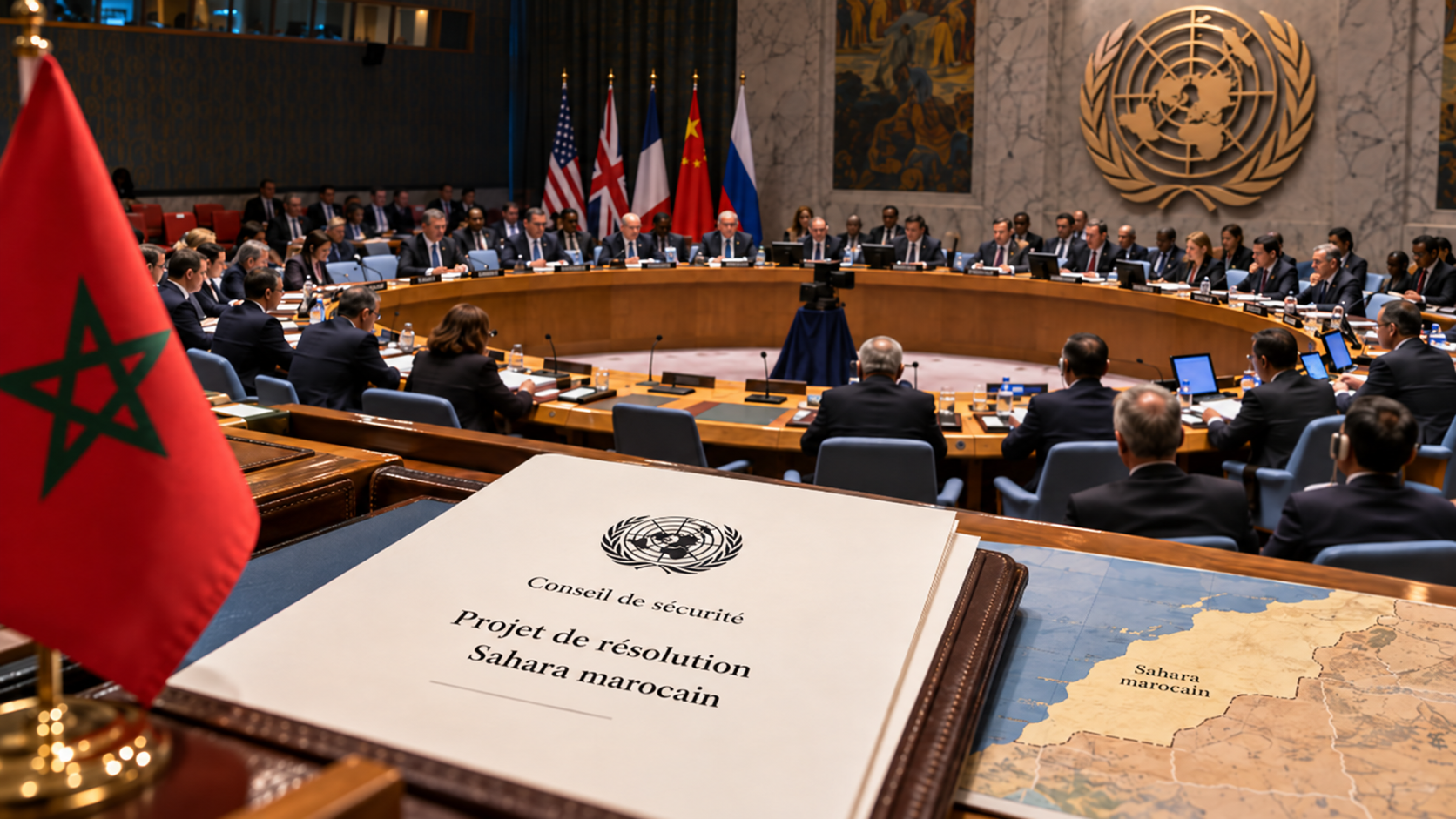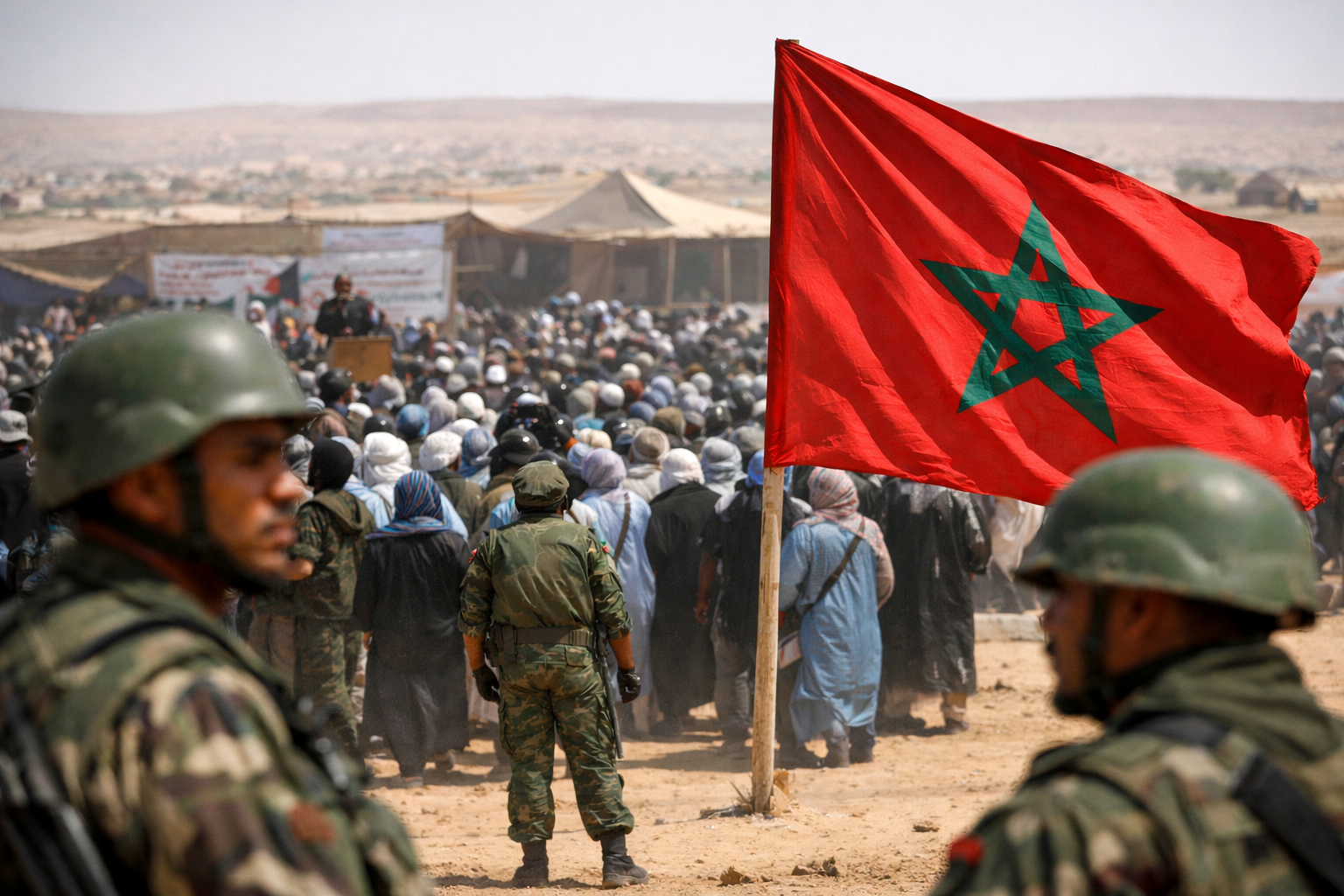
On Wednesday, November 4, 2026, at the Royal Palace in Rabat, King Mohammed VI chaired a working session dedicated to the post-MINURSO phase. Five days after the Security Council did not renew the United Nations mission's mandate, the Sovereign gathered several high-ranking state officials to prepare for a new phase in managing the Moroccan Sahara issue.
Joining the King were the Head of Government, Fatima Ezzahra El Mansouri, royal advisor Fouad Ali El Himma, Interior Minister Abdelouafi Laftit, and General Mohammed Berrid, Inspector General of the Royal Armed Forces and Commander of the Southern Zone.
The composition of this meeting is already a significant element of analysis. It was not simply a matter of commenting on a United Nations decision, but of addressing its political, administrative, and security consequences.
The royal statement of October 30 acknowledged a break. The one on November 4 organizes the conditions for the transition.
It is precisely in this shift from political declaration to institutional action that one of the key messages of the text resides.
1. Sovereignty as the Guiding Principle of the New Phase
The statement reaffirms three priorities: the territorial integrity of the Kingdom, national security, and the peace of citizens, particularly in the Southern provinces.
These formulations are not new in Moroccan institutional discourse. Their reaffirmation, at this precise moment, gives them a particular significance.
For several decades, the question of the Moroccan Sahara has been framed within an international system that included a UN presence, periodic reports, and diplomatic consultations.
The non-renewal of MINURSO alters this environment.
In this context, the reaffirmation of sovereignty reflects Morocco's desire to maintain continuity of its territorial administration, regardless of the evolution of the international framework.
However, a distinction must be highlighted: the end of a peace mission's mandate does not, by itself, equate to a United Nations decision that definitively recognizes sovereignty over a territory. The statement primarily exposes the Kingdom's position and the priorities it intends to uphold in this new configuration.
2. The Presence of Military Command: A Signal of Vigilance
The participation of General Mohammed Berrid, commander of the Southern Zone, is one of the most significant elements of the meeting.
It serves as a reminder that the withdrawal of a mission tasked with monitoring the ceasefire inevitably raises security questions.
The statement emphasizes the firm and vigilant implementation of the royal instructions.
Reading between the lines: Morocco aims to prevent any modification of the UN framework from creating uncertainty on the ground.
This vigilance does not imply the announcement of a military operation. No elements in the statement suggest an imminent change in the operational posture of the Royal Armed Forces.
Rather, it conveys a message of continuity: the disappearance of the international monitoring mechanism should not be interpreted as a reduction in attention to the security of the Southern provinces.
The meeting appears to associate two imperatives: preserving stability and ensuring that Moroccan institutions are capable of managing the consequences of the withdrawal.
3. The Ceasefire: A Particularly Important Diplomatic Formulation
One of the most revealing passages concerns the maintenance of the ceasefire.
The statement emphasizes the voluntary nature of this commitment and specifies that it will remain unchanged despite the end of MINURSO's mandate.
This formulation addresses a central question: What happens to the truce when the mission supposed to monitor its implementation ceases to function?
The Moroccan response is to explicitly dissociate the two elements.
The Kingdom reaffirms its commitment to the ceasefire while noting that the mission has not always been able to effectively control compliance nor establish the consequences of violations.
Behind this formulation lies a double orientation.
On one hand, Rabat seeks to maintain a diplomatic posture based on stability and respect for its international commitments.
On the other hand, the statement contests the notion that MINURSO's presence is essential for maintaining this stability.
The message to the international community is thus clear: Morocco asserts that its commitment to peace does not depend on the continued presence of the UN mission.
4. The Ministry of the Interior at the Center of Withdrawal: A Choice Worth Noting
Another essential announcement: The King has entrusted the Office for Coordination with MINURSO, under the Ministry of the Interior, with the task of overseeing the liquidation and withdrawal of the UN presence.
This administrative choice is revealing.
Morocco does not frame the mission's departure as an improvised expulsion or a break with the United Nations. On the contrary, it envisions a coordination mechanism designed to facilitate various operations.
These may include administrative, logistical, and material procedures, even if their specific modalities are not detailed in the statement.
The presence of the Ministry of the Interior at the center of this framework also highlights the importance given to territorial management during this transition.
It involves organizing the departure of an international mission that has been present since 1991 while preserving the continuity of institutions and services.
The diplomatic reading is significant: Rabat aims to show that a firm stance on sovereignty can be accompanied by orderly institutional cooperation with the United Nations.
Political firmness and administrative mastery appear here as two complementary dimensions of the Moroccan strategy.
5. Development in the Southern Provinces: An Economic Response to the New Situation
The royal statement does not limit itself to diplomatic and security considerations. It also emphasizes the continuation of development in the Southern provinces and the structural projects underway there.
This reference is far from secondary.
It indicates that changes at the UN level should not slow down investment, infrastructure, and territorial development policies.
For several years, Morocco has been pursuing a strategy in its Southern provinces that combines port infrastructure, road networks, renewable energies, public services, and economic attractiveness.
The Dakhla Atlantique port, major transport routes, and regional development projects contribute to this orientation.
In the new phase opened by the end of MINURSO's mandate, these investments gain additional significance.
They allow the Kingdom to continue a long-term development policy beyond diplomatic deadlines.
The reasoning that seems to emerge from the statement is as follows: territorial continuity is expressed not only through institutions or security mechanisms but also through investments, infrastructure, jobs, and improved living conditions for populations.
This approach gives economic development a central place in Morocco's policy regarding the Sahara.
6. Autonomy under Moroccan Sovereignty: The Diplomatic Course Remains Unchanged
Another element merits careful reading: despite the end of MINURSO's mandate, the statement does not depict Morocco as a state retreating from international diplomacy.
On the contrary, it reaffirms respect for international commitments and recalls the diplomatic dynamics accompanying the Moroccan Sahara issue.
The text notably emphasizes the recognition of Moroccan sovereignty by several partner countries and support for the autonomy initiative.
This insistence is not insignificant.
It indicates that Rabat intends to continue its strategy of consolidating international support, regardless of the fate of the UN mission.
The autonomy proposal, presented by Morocco in 2007, thus remains the central axis of its political position.
However, a distinction is necessary: the countries that explicitly recognize Moroccan sovereignty and those that support the autonomy plan do not necessarily adopt legally identical positions.
Nevertheless, the reading of the statement shows that the Kingdom wishes to preserve this diplomatic dynamic and continue to develop it.
In other words, the withdrawal of MINURSO does not signify Morocco’s international disengagement. It accompanies a desire to continue bilateral and regional relations around the solution defended by Rabat.
7. What the Statement Does Not Say: Unresolved Questions
Reading between the lines of an official statement also involves considering what is not specified.
The text from November 4 leaves several operational and diplomatic questions unanswered definitively.
The withdrawal schedule. The Royal Cabinet announces the organization and support for MINURSO's liquidation without detailing the specific stages of its departure, the number of personnel involved, or the timelines applicable to each operation.
The monitoring mechanism for the ceasefire. The Kingdom maintains its commitment, but the statement does not announce any international mechanism intended to replace the mission’s role.
Future relations with the United Nations. Rabat reaffirms its cooperation with the Organization without detailing all the mechanisms that could frame upcoming diplomatic exchanges.
The future of the issue in other international bodies. The October 30 statement mentioned steps aimed at addressing the consequences of MINURSO's non-renewal. The November 4 statement confirms an intention for follow-up at all levels without detailing the timeline for these initiatives.
These silences do not alone suggest the existence of confidential decisions or imminent actions.
They primarily illustrate that the transition still contains dimensions that will need to be clarified.
8. From Conflict Management to Post-Conflict Management: The Change in Vocabulary
Comparing the statements from October 30 and November 4 reveals a significant change in how Morocco presents the issue.
The first emphasizes the historical significance of the non-renewal of the UN mandate and mentions a break with the old management logic.
The second focuses primarily on instructions, institutional responsibilities, and the organization of the next phase.
This change in vocabulary is likely one of the most important keys to understanding.
The debate is no longer exclusively framed in terms of negotiations and the mission's mandate. It now concerns the practical modalities of the period that is opening.
The central question thus shifts from the renewal of an international framework to the organization of the new situation on the ground.
This does not mean that all political and legal dimensions of the dispute are definitively resolved.
But it reflects a real shift in how Rabat wishes to structure its action.
Morocco is seeking to transition from a diplomacy largely shaped by UN deadlines to a strategy focused on consolidating its institutions, partnerships, and territorial projects.
9. A Message Addressed Simultaneously to Multiple Recipients
The uniqueness of the royal statement also lies in the diversity of its recipients.
Within the Kingdom, it reaffirms state priorities, the continuity of regional development, and the importance of citizens' security.
To foreign partners, it sends a message of stability and predictability: Morocco intends to continue its territorial policy and its international commitments without disorderly interruptions.
To the United Nations, it confirms the willingness to accompany the end of the mission within a framework of institutional cooperation.
Finally, to all parties concerned by the dispute, it reminds them that the Moroccan position regarding its territorial integrity and autonomy under national sovereignty remains unchanged.
This combination of firmness, continuity, and cooperation gives the statement its diplomatic significance.
Conclusion: A New Phase Whose Consequences are Yet to be Built
The statement of November 4, 2026, is significant not only for the decisions it announces but also for how it organizes the priorities of the Moroccan state after the non-renewal of MINURSO's mandate.
Three orientations stand out from its reading: reaffirmation of sovereignty and national security, continuity of development in the Southern provinces, and the maintenance of a diplomacy committed to stability and international partnerships.
The end of the mandate of a mission established in 1991 modifies a major component of the UN framework that has accompanied the dispute for 35 years.
For Rabat, this evolution opens the possibility to reorganize its action around new priorities. However, its practical consequences will depend, in particular, on the unfolding of the withdrawal, the maintenance of the ceasefire, and the decisions that will be made in the various relevant bodies.
Through this statement, King Mohammed VI thus sets the directives for a transition that Morocco intends to lead while preserving its territorial interests, its international commitments, and the stability of its Southern provinces.
The real issue of the post-MINURSO era does not rest solely on the departure of an international mission but on how the Kingdom intends to sustainably organize the new situation resulting from it.