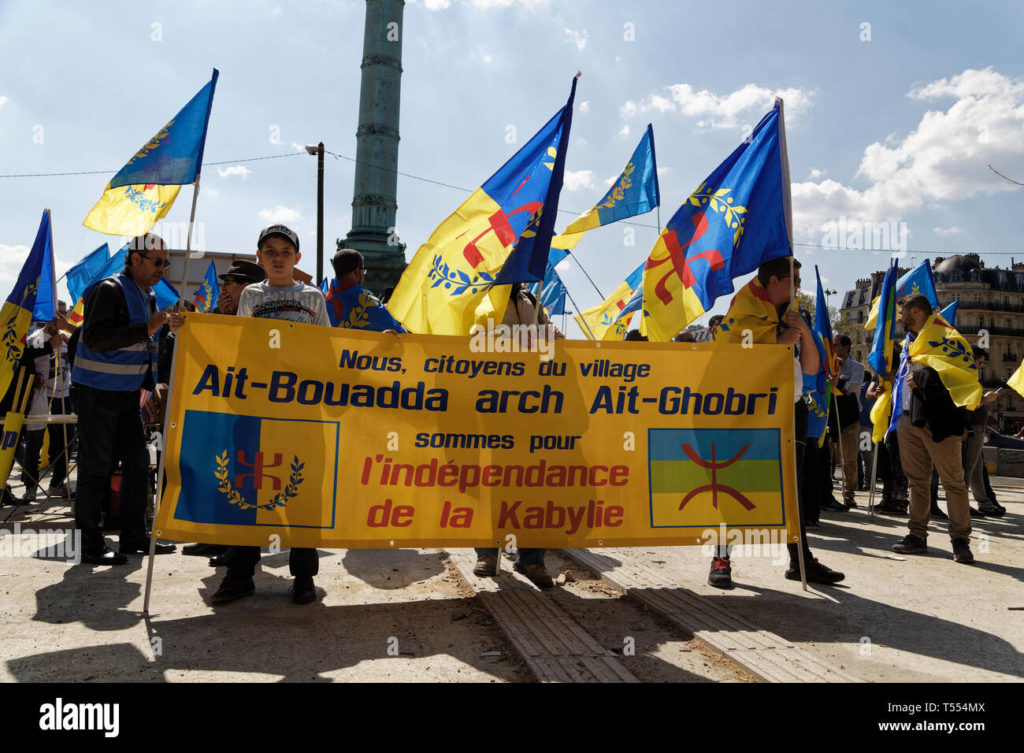
The debate surrounding Kabylie has taken on a new dimension in recent days following the announcement by the Movement for the Self-Determination of Kabylie (MAK) that December 14, 2025, would be declared the 'Day of Independence of Kabylie.' This date is now appearing in various community media outlets, which discuss a political initiative driven by the MAK under the leadership of its president, Ferhat Mehenni. According to shared content, the proclamation will be presented as a founding act, intended to signify the existence of a symbolic Kabyle state, even in the absence of international recognition.
The choice of this date is significant. It fits within a continuity of political actions carried out by the movement over the years, which demands separation from Algeria and the establishment of an autonomous Kabyle state. Community platforms highlight that the announcement is expected to be made from Paris, where Ferhat Mehenni resides, due to his inability to return to Algeria since the movement was classified as a terrorist organization by Algerian authorities in 2021. For MAK supporters, this announcement represents a major step in their self-determination strategy. For Algiers, it holds no legal significance and is part of what the government regularly refers to as 'hostile maneuvers.'
In the publications circulating, the announced independence is not presented as a legally recognized act but as a symbolic gesture intended to mobilize Kabyle and international opinion. The MAK emphasizes the historical and identity dimension of this proclamation, referencing Amazigh aspirations, political claims accumulated over the decades, and ongoing tensions between Kabylie and the central Algerian government. The movement aims to leverage the media impact of this act to reignite the debate surrounding the status of this region, home to over four million inhabitants, characterized by a strong cultural awareness and a long tradition of political dissent.
On the Algerian side, the announcement is perceived as a provocation aimed at undermining national unity. The central government systematically rejects the MAK's claims and asserts that Kabylie is an integral part of Algerian territory. The authorities also consider the movement's initiatives to be acts of subversion and attempts to exploit the Amazigh issue. Since the decision to classify the MAK as a terrorist organization, any independence discourse from this movement is treated as a security threat, further complicating any space for dialogue or mediation.
The proclamation announced by the MAK also occurs in a tense regional context, where issues of autonomy and self-determination are scrutinized closely. Events in North Africa and the Sahel region remind us that identity, cultural, and territorial dynamics are playing an increasingly important role in political balances. In the case of Kabylie, the Amazigh cultural dimension intertwines with political claims shaped over time, particularly during the uprisings of 2001 or the recurring conflicts with Algerian authorities.
While the planned proclamation on December 14, 2025, is unlikely to lead to immediate institutional change, it could nonetheless fuel debates, mobilize the Kabyle diaspora, and provoke a strong reaction from Algerian authorities. Several analysts believe that the MAK mainly aims to occupy the symbolic and media ground at a time when the Kabyle question remains sensitive and internal political tensions weigh on Algeria. The impact of the announcement will also depend on its concrete implementation: speeches, published documents, signatures, diaspora mobilization, and potential positions taken by international actors.
For now, the announced independence remains a strictly militant initiative, without recognition, without a legal framework, and without official support from international institutions. However, the event could become a political marker, utilized by various parties to assert their positions. Amid aspirations for self-determination, identity affirmation, and political tensions, the date of December 14, 2025, is likely to exacerbate tensions affecting Kabylie and elicit new reactions from Algiers.
The next step will be to see how the MAK formalizes this proclamation and what responses will be provided by Algerian authorities. In a country where the issue of national unity is extremely sensitive, this symbolic action could become the focal point of a long-standing debate that is now more intense than ever.