Military movements are increasing in the Middle East. In recent days, the United States has been bolstering its military presence, sending equipment to Israel and U.S. bases in the Gulf, while top Pentagon officials are presenting various intervention scenarios against Iran to Donald Trump.
These preparations, revealed between October 28 and 30, raise fears of a new phase of major confrontations in the war that began on February 28, 2026.
For Washington and Tel Aviv, the goal could be to inflict a new blow to Iran's military capabilities to compel Tehran to accept an agreement. However, behind the prospect of a quick operation looms a much greater risk: that of a regional confrontation difficult to control.
A Stream of American Military Aircraft to Israel
One of the most significant developments involves movements of American military aviation.
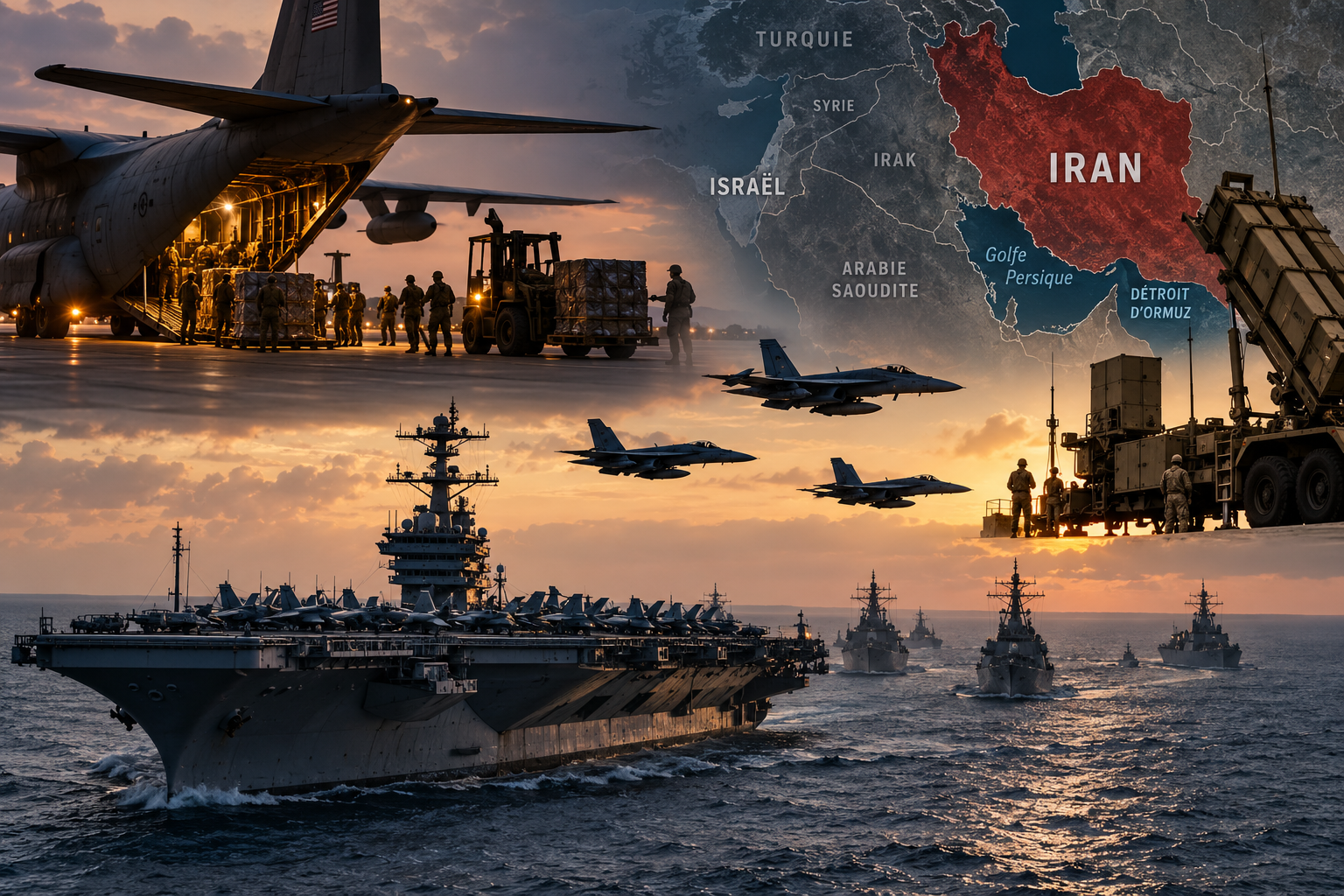
On October 29, several Israeli media outlets, including the public broadcaster KAN and the Times of Israel, reported that at least ten American military transport planes had arrived at air bases in southern Israel.
The aircraft are said to have primarily joined the Nevatim and Ovda facilities, two important bases of the Israeli Air Force. Several flights reportedly took off from Texas, notably from Fort Bliss and Biggs Army Airfield, which hosts U.S. military facilities.
Other aerial movements have been reported towards American bases in Jordan, Saudi Arabia, Qatar, and Kuwait.
The exact nature of the cargo being transported has not been officially confirmed. However, available information suggests a logistical operation aimed at enhancing American military and defensive capabilities in the region.
These movements take on particular significance when contrasted with the warnings addressed by Washington to several Gulf countries.
Patriot Systems and Enhanced Naval Forces
The preparations are not limited to air transport.
According to information published by the Wall Street Journal and echoed by Israeli media, the United States has begun transferring a Patriot missile defense battery from Texas to the Middle East.
This system is designed to intercept certain enemy missiles and aircraft. Its strengthening in the region responds to a major concern: anticipating potential Iranian reprisals.
At the same time, Washington has begun to bolster its ammunition stocks and air defense capabilities, while redeploying some troops from installations deemed particularly vulnerable.
On the naval front, the U.S. had already announced the deployment of the aircraft carrier USS Theodore Roosevelt and amphibious ships carrying Marines. According to the Associated Press, these deployments involve about 9,000 troops.
The reinforcement adds to an already significant American presence in the region, particularly around aircraft carriers and ships conducting surveillance, protection, and air support missions.
It should be noted, however, that operational reinforcements differ from routine rotations of ships: not all announced vessels necessarily represent additional forces present simultaneously.
Nonetheless, this overall increase gives Washington greater capabilities to conduct a large-scale intervention or alternatively increase military pressure without immediately launching new strikes.
At the White House, Military Scenarios are on the Table
Another significant signal occurred on Thursday, October 29.
According to the Wall Street Journal, Admiral Brad Cooper, commander of CENTCOM, responsible for U.S. military operations in the Middle East, visited the White House to present different options regarding Iran to Donald Trump.
U.S. Secretary of Defense Pete Hegseth and Joint Chiefs of Staff Chairman General Dan Caine reportedly participated in this meeting.
Reuters reported this information, noting it could not be independently confirmed.
However, these consultations indicate that intervention scenarios have reached a high level of discussion within the U.S. administration, if confirmed.
Potential targets mentioned in the press include nuclear facilities, ballistic capabilities, drone-related infrastructure, and certain strategic Iranian sites.
No official list of objectives for a possible new campaign has, however, been made public.
November 3: A Critical Date
The American political calendar may play a decisive role.
The midterm elections, scheduled for November 3, 2026, have now become a central reference point in analyses of a potential new offensive.
According to the Associated Press, U.S. officials have warned several regional allies that a resumption of major strikes against Iran could occur after this election.
These warnings were reportedly conveyed through diplomatic and military channels. American interlocutors also asked the concerned countries to prepare for potential Iranian reprisals.
The scenario mentioned would involve an intense military campaign conducted over several days.
However, Gulf governments fear that an initially limited operation could trigger a series of reprisals, transforming a few days of bombings into a prolonged confrontation.
Therefore, the date of November 3 does not constitute an official announcement of war, but a political deadline around which preparations and speculations are focused.
Donald Trump retains the final decision and may also favor a negotiated solution.
Iran Prepares Its Response and Maintains Resilience
In the face of this mobilization, Tehran asserts that it is not willing to yield under pressure.
Iranian authorities warn that a resumption of strikes could lead to an extended response that may target American interests and certain strategic infrastructures in the region.
Iran's capacity for resilience remains a key question.
An investigation published by Reuters on October 29 reveals that networks linked to the Iranian Ministry of Defense may have facilitated the importation of large quantities of military and dual-use equipment, despite Western sanctions and the American naval blockade.
The investigation identifies a set of over 5,000 entities used to acquire equipment, industrial components, explosives, and vehicles that could contribute to missile and drone programs.
These revelations suggest that previous strikes and economic restrictions have not completely interrupted the supply chains of the Iranian military apparatus.
This adaptability complicates American calculations: destroying facilities does not necessarily guarantee the permanent elimination of response capabilities.
The Strait of Hormuz: A Potential Trigger for Regional Escalation
Beyond Iran and Israel, the Strait of Hormuz is one of the main points of vulnerability in the region.
On October 29, Iranian Revolutionary Guards claimed that several tankers had struck mines in this strategic maritime area.
The following day, the British maritime security agency UKMTO reported an attack on a tanker using explosives. The identity of those responsible was not immediately established.
These incidents occur as tensions also affect Saudi Arabia and Yemen.
The Houthis, supported by Iran, have claimed responsibility for attacks against several Saudi installations, including energy infrastructure. The Riyadh-led coalition has also reported intercepting projectiles.
A new American offensive could therefore provoke a direct Iranian response, as well as an increase in attacks by groups allied with Tehran.
The risk would not be limited to military installations: ports, oil terminals, airports, and trade routes could also be threatened.
Oil Prices Reacting to the Prospect of Escalation
The economic consequences of this uncertainty are evident.
On the morning of October 30, December Brent crude was priced at around $117 per barrel, according to Reuters, as markets anticipated new supply disruptions.
Oil was heading for a fourth consecutive monthly rise amid war, maritime tensions, and diplomatic uncertainty.
For energy-importing economies, such as Morocco, a new prolonged surge in prices could exert additional pressure on fuel costs, transportation expenses, and inflation.
The real economic danger lies in the combination of a potential bombing campaign, reprisals against Gulf oil installations, and new disruptions in maritime traffic.
A Last-Ditch Diplomacy?
Despite the accumulation of military signals, diplomatic discussions have not come to a complete halt.
Qatar continues its mediation efforts, and Qatari representatives returned to Tehran on October 30 to attempt to bridge U.S. and Iranian positions.
At the same time, Iran confirmed it received a letter from U.S. Vice President JD Vance addressed to Mohsen Rezaei, head of Iran's Supreme National Security Council.
American media portray this initiative as an attempt to explore a resumption of negotiations. However, Donald Trump stated that this initiative primarily relates to Iran's access to medical supplies.
Deep Divisions Remain.
Washington wants the Iranian nuclear program to be addressed at the outset of negotiations. Tehran, on the other hand, demands lifting the naval blockade, easing sanctions, and stopping hostilities on various regional fronts.
Negotiations therefore continue in a paradoxical atmosphere: both sides maintain channels of dialogue while preparing for a possible renewed confrontation.
A Short Operation, but Potentially an Uncontrollable War
The central question is no longer whether the U.S. has the means to launch a new offensive against Iran. These means already exist and are continuing to be reinforced.
The real unknown concerns the consequences of such a decision.
Washington might seek to conduct a limited strike campaign to weaken Iranian military capabilities and extract diplomatic concessions. However, there is no guarantee that Tehran would accept these attacks without expanding its response.
The Gulf monarchies, geographically and economically exposed, have much to lose in this scenario. Their energy and commercial infrastructures could become targets, even if they did not directly participate in the offensive.
A new military operation would also raise a critical strategic question: after eight months of conflict, bombings, sanctions, and blockades, would a new show of force be enough to achieve a political resolution?
As of October 30, 2026, a new offensive has not been officially decided. However, the preparations reported in recent days are substantial enough to place the entire Middle East on heightened alert.
Amid military pressure and the latest diplomatic attempts, Washington and Tehran now operate in a dangerous zone where a political decision, a miscalculation, or a maritime incident could trigger an escalation with global consequences.