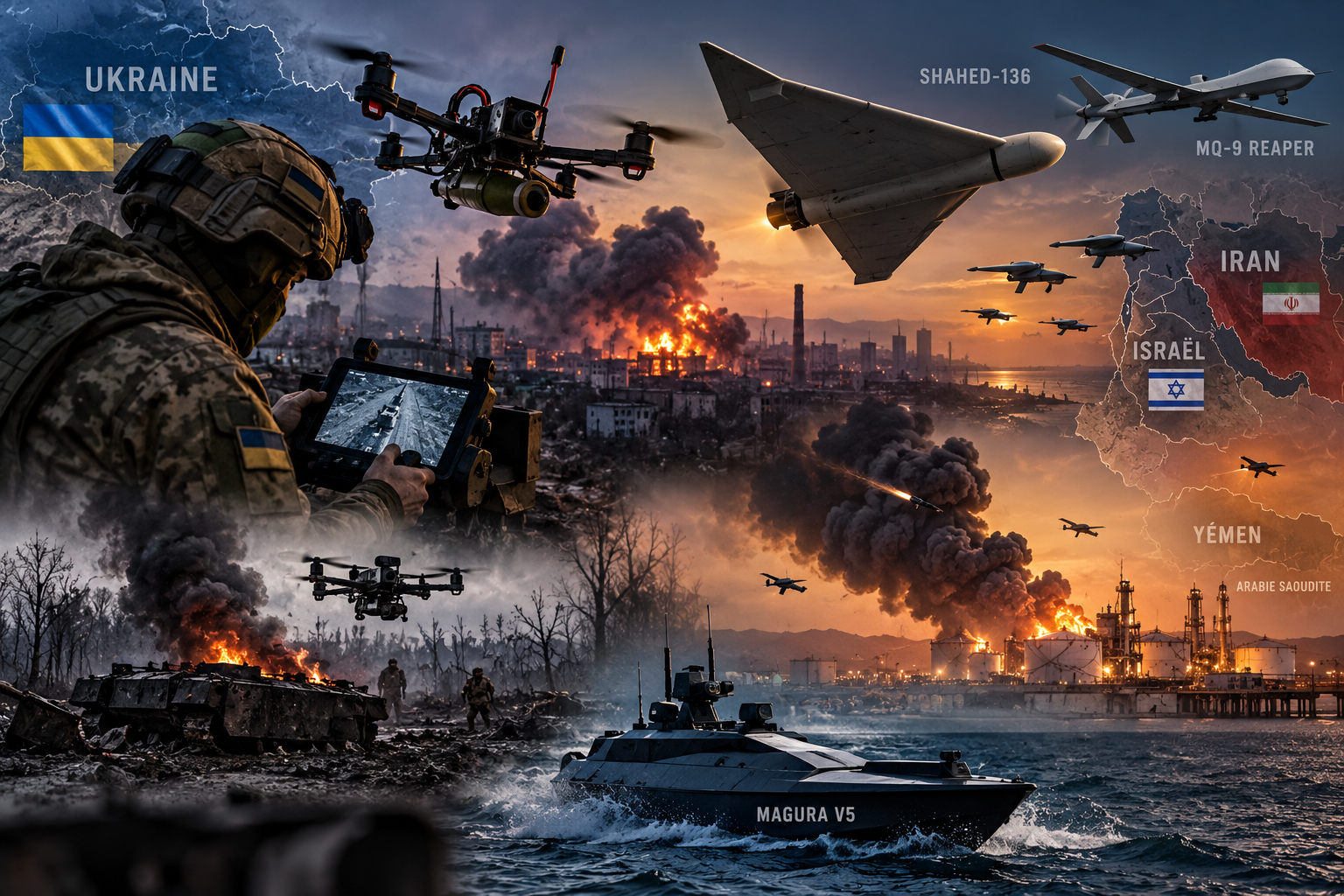
They can sometimes cost less than a used car, but can destroy tanks, disrupt a city's power supply, or force strategic infrastructures to halt operations. In just a few years, drones have become one of the most decisive weapons in contemporary conflicts.
From Ukraine to the Middle East, a genuine military revolution is underway. Russians, Ukrainians, Iranians, Israelis, and Americans are now using unmanned devices for very different missions: reconnaissance, surveillance, vehicle destruction, long-range strikes, or intercepting other drones.
The evolution is particularly dramatic in 2026. Systems are becoming faster, more numerous, more resistant to electronic jamming, and sometimes capable of performing parts of their mission with algorithmic assistance.
This phenomenon raises a fundamental question: Are military superpowers entering an era where quantity, cost, and manufacturing speed matter as much as technological sophistication?
Ukraine: the laboratory of a new form of warfare
Since the large-scale Russian invasion in February 2022, Ukraine has become the primary testing ground for military drones.
Initially, both sides mainly used these devices to observe enemy positions, spot troop movements, and correct artillery fire.
Gradually, their role has changed profoundly.
FPV drones, piloted remotely through an onboard camera, have become strike weapons. Some carry an explosive payload and are destroyed upon impact. Others, larger, drop munitions before returning to their operators.
These tools have transformed the daily lives of combatants.
An armored vehicle, an artillery piece, or a supply truck can be pinpointed by a reconnaissance drone and then attacked by a much smaller device.
The danger has also changed movement patterns. Near the front lines, troop movements and resupply operations must now account for almost constant aerial surveillance.
On October 16, 2026, Ukrainian soldiers interviewed by Reuters near Kramatorsk presented modified FPV drones with a claimed range of 50 kilometers.
One soldier explained that these new devices complicated Russian logistical movements well beyond the forward positions.
The war is therefore no longer solely played out in the trenches: supply routes, depots, and command posts are also exposed.
Russia transforms Iranian Shahed drones into industrial weapons
One of the most significant developments concerns the Shahed family of drones, initially developed by Iran.
The Shahed-136, used by Russia under the designation Geran-2, is a one-way attack drone capable of striking over considerable distances.
Unlike large reusable military drones, its operation is based on a different logic: a relatively simple construction, costs lower than modern cruise missiles, and the ability to produce them in large quantities.
Russia has gradually adapted this model to its specific needs.
The early versions primarily employed propeller propulsion. More recent variants, including Geran-3, Geran-4, and Geran-5, incorporate jet engines, enabling them to reach considerably higher speeds.
This evolution complicates Ukrainian defenses.
A slow drone can be chased and intercepted by certain mobile teams, helicopters, or interceptor drones. A faster device significantly reduces the available reaction time.
According to a September 2026 survey published by Reuters, Russia had approximately multiplied its use of jet drones sixfold over a three-month period during the summer.
An analysis by the Institute for Science and International Security published on October 13 indicates that 6,732 Shahed-type drones, including decoys,were reported in Ukrainian aerial counts for September 2026.
This figure illustrates the industrial scale of the confrontation, even if it is based on data reported by the Ukrainian military and does not constitute an independent count of each device.
Russia also uses decoys, notably Gerbera types, to complicate detection and mobilize enemy defenses.
The stakes are no longer solely about delivering explosives to a target. There is also a need to saturate surveillance, interception, and defense capabilities.
Hundreds of drones targeting Moscow: a war reaching the rear
Ukraine, for its part, has developed its own long-range strike capabilities.
The FP-1 and An-196 Liutyi drones allow it to attack targets far from the front lines, including Russian oil, industrial, and military installations.
This campaign seeks to weaken Moscow's ability to sustain its war effort and demonstrate that its territory is not immune.
On October 9, 2026, Reuters reported that a Ukrainian attack using FP-1 drones hit a major data center of Yandex in the Russian region of Kaluga.
The day before, another facility of the company, located in Sasovo and housing computing capabilities used for artificial intelligence, was also struck.
These operations illustrate the widening of targets: data centers and digital infrastructure are also becoming strategic issues.
The attacks intensified towards the end of the month.
On October 29, the mayor of Moscow announced that 613 droneshad been directed towards the Russian capital overnight, stating that most had been neutralized.
On the following night, Moscow authorities reported a new wave of 862 devices, according to reports from specialized economic media.
These figures remain unverified claims from Russian authorities.
Nonetheless, they signal the now central role of drone attacks in the confrontation between the two countries.
Operation 'Spiderweb': drones against strategic bombers
Among the most notable operations was that of June 1, 2025, dubbed 'Spiderweb'.Ukraine conducted a coordinated operation against several Russian air bases located thousands of kilometers from the front..
Small FPV drones struck high-value military aircraft, including strategic bombers used to launch missiles against Ukraine.
Kiev claimed to have damaged 41 aircraft.
Independent assessments, however, were more cautious. Satellite image analyses confirmed the destruction or damage of several bombers, while American officials estimated around ten aircraft were destroyed.
The most significant aspect was not just the material damage.
The operation demonstrated that a power with sophisticated air defense systems could remain vulnerable to much cheaper devices, particularly near its own installations.
It also forced military commands to rethink the protection of their bases, aircraft, and strategic infrastructures.
The fiber-optic drone: a hard-to-jam weapon
One of the most notable innovations in recent months is the fiber-optic guided FPV drone.
Unlike conventional devices, which communicate with their operator via radio, these drones utilize a very thin cable deployed during flight.
The main advantage is their resistance to radio jamming.
On both sides, Russian and Ukrainian, electronic warfare systems have gradually made some conventional communications less reliable.
Fiber optics provide a solution to this issue.
However, there are constraints: the cable can break or get snagged, and its weight limits certain performances.
Nevertheless, the emergence of this technology has broadened the options for frontline units.
In July 2026, Reuters documented the use of fiber-optic guided Russian drones against Ukrainian electrical installations in the Sumy region.
The evolution has not stopped at European borders.
In Lebanon, Hezbollah adopts methods from the Ukraine war
The conflict between Israel and Hezbollah offers a striking example of technological transfer between theaters of operations.
In the spring of 2026, fiber-optic FPV drones were used against Israeli positions in southern Lebanon.
According to Defense News and El País, these devices, costing a few hundred dollars, allowed for strikes difficult to counter with traditional jamming methods.
Drones were notably used against military vehicles and ground positions.
For Israel, which nonetheless possesses advanced air defense systems, this threat poses a particular challenge.
Systems designed to intercept rockets or missiles do not necessarily respond optimally to small devices operating at low altitude.
Hezbollah has thus integrated technology popularized by the Russo-Ukrainian war into its operations.
On October 26, 2026, a Reuters investigation indicated that the group was looking to rebuild its military capabilities and restart the production of explosive drones, with Iranian financial support.
This evolution highlights how quickly innovations from one conflict can be reproduced elsewhere.
Iran: the Shahed becomes a regional weapon
In the Middle East, Iran has played a crucial role in spreading one-way attack drones.
The Shahed-131 and Shahed-136 models have gained considerable importance due to their range, relative simplicity, and capability to be launched in large numbers.
Since the onset of the Israeli-American war against Iran on February 28, 2026, Tehran has heavily employed drones in its reprisals.
The military objective is twofold: to strike certain strategic installations and to draw out enemy air defense systems.
The early weeks of the conflict illustrated this strategy.
According to official data relayed by Reuters on March 10, the United Arab Emirates had detected 1,440 drones since the start of hostilities, of which 1,359 were intercepted.
These figures only pertain to the studied period and rely on statements from Emirati authorities.
Nonetheless, they demonstrate the quantitative dimension of the conflict.
Even when the majority of devices are destroyed, their interception requires significant military resources.
The threats have also disrupted air transport.
In March 2026, several incidents involving drones affected the vicinity of Dubai International Airport, causing disruptions in one of the world's main air traffic hubs.
The consequences extend far beyond military installations: passenger transport, air freight, tourism, and supply chains are affected.
Israel and the United States adapt their arsenals
In response to this evolution, the most advanced military forces are no longer content with developing combat aircraft or sophisticated missiles alone.
Israel has long used various families of drones, including the Hermes 450 and 900, the Heron, and the loitering munitions Harop.
These devices conduct surveillance, intelligence, target designation missions and, depending on the models, strikes.
The United States, notably, has the MQ-9 Reaper, a long-endurance drone capable of carrying out reconnaissance and attack missions.
But Washington also made a symbolic leap in 2026.
In early March, the U.S. military used the LUCAS drone, a one-way attack device with an architecture reminiscent of the Iranian Shahed, for the first time in combat.
According to the Carnegie Endowment for International Peace, its estimated unit cost is around $35,000, compared to several million dollars for some American cruise missiles.
The two categories do not offer the same performances and are therefore not directly interchangeable.
However, the American choice confirms an important evolution: even the richest armies are now seeking to acquire less expensive weapons that can be deployed in large numbers.
Black Sea: naval drones change the power dynamicsThe revolution is not limited to the skies.
In the Black Sea, Ukraine has developed surface drones Magura and Sea Baby, two families of unmanned vessels used notably against Russian ships and installations.
These systems have helped compel the Russian fleet to alter its deployments and limit certain operations in the northwestern Black Sea.
Their capabilities have gradually evolved.
Some versions of the Magura can carry anti-aircraft missiles, while others serve as platforms for FPV drones.
In early August 2026, Ukrainian military intelligence announced that it had used Magura naval platforms to launch drones against Russian radar installations in Crimea.
The operation illustrates a new combination of unmanned systems: a naval drone carries aerial drones, which can then strike targets on land.
The traditional distinction between air, land, and naval warfare is thus becoming less clear.
Yemen and Saudi Arabia: a threat to energy infrastructures
In Yemen, the Houthis have been using attack drones for several years, notably the Qasef and Samad families.
These devices are employed against military and economic targets, with varying ranges depending on the models.
The return of large-scale fighting in 2026 has given particular importance to this threat.
In September, several pumping stations of the main East-West Saudi pipeline were struck in attacks attributed to Iran-backed armed groups.
On October 27, an Associated Press investigation also highlighted a correlation between the activities of Russian reconnaissance satellites and several attacks conducted against Saudi installations.
Officials interviewed by the agency mentioned intelligence sharing, although satellite observations alone cannot prove every information transmission.
These revelations underscore the importance of the technological environment of drones: satellites, communications, intelligence, and navigation systems.
On October 30, Saudi Arabia also announced it intercepted a Houthi drone near Mecca. The Houthis denied targeting the holy city.
Thus, the drone wars are developing in a context where energy infrastructures and trade routes represent global economic stakes.
Key models transforming conflicts
Several families of devices illustrate this transformation.
Drone or family
Origin
| Main role | Classic FPV | Russia, Ukraine, and others |
|---|---|---|
| Tactical strikes and close reconnaissance | Fiber-optic FPV | Russia, Ukraine, Hezbollah |
| Strikes resistant to radio jamming | Lancet | Russia |
| Loitering munition against military equipment | Shahed-131/136 | Iran |
| Long-range strike | Geran-2 | Russia, derivative of Shahed |
| One-time attack and mass strikes | Geran-3/4/5 | Russia |
| New generations, including jet variants | FP-1/Liutyi | Ukraine |
| Deep strikes against infrastructure | Magura V5/V7 | Ukraine |
| Uncrewed naval operations | Sea Baby | Ukraine |
| Naval strikes and versatile platform | Hermes/Heron | Israel |
| Surveillance, intelligence and military missions | MQ-9 Reaper | United States |
| Armed surveillance and strikes | LUCAS | United States |
| One-time attack drone | Samad/Qasef | Houthis, Yemen |
| Strikes against ground targets | Actual performance varies by version, equipment, and conditions of use. It would therefore be misleading to present all these systems as directly comparable weapons. | The economic battle: producing faster than the opponent |
The drone revolution relies on a new economic equation.
An FPV drone can sometimes cost a few hundred dollars. A modern tank, a radar system, or an air-defense system represents an infinitely greater investment.
This does not mean that a small drone can consistently destroy equipment worth millions.
The outcome depends on many factors, including target protection, environment, and the ability to detect the device.
But the cost difference profoundly alters military reasoning.
For defenders, employing expensive interceptor missiles against industrially produced drones can become unsustainable.
Conversely, interceptor drones and other proximity defense devices represent a less costly response to some threats.
Ukraine is actively developing this type of system.
In September and October 2026, Reuters and the Associated Press documented the difficulties faced by Ukrainian manufacturers in designing interceptors fast enough against new Russian jet drones.
Thus, the confrontation becomes a constant competition between offensive and defensive innovations.
It is not necessarily the army with the most advanced drone that gains the local advantage, but the one able to effectively produce, modify, and deploy its equipment over time.
Artificial intelligence: towards increasingly autonomous drones?
Artificial intelligence represents the other significant transformation underway.
Today, many drones still rely heavily on human piloting, but some functions can already be assisted by algorithms: navigation, object recognition, target tracking, and flight stabilization.
The aim is notably to maintain certain capabilities when communications are degraded.
However, autonomous systems raise major questions.
What level of human intervention should remain in the decision to attack? How to correctly distinguish a military target from a civilian vehicle? How to establish responsibility when an automated system makes a mistake?
These questions take on urgent dimensions with the increasing number of drones on the battlefield.
A less expensive device does not mean a less destructive war.
On the contrary, the availability of large quantities of armed systems can increase the number of strikes and expand exposed areas.
Civilian populations, the primary victims of expanded strikesOn October 29, 2026, a Russian drone strike hit a rail platform in Dnipro, Ukraine.
According to Ukrainian authorities and information reported by international press, at least fourteen people were killed.
This event serves as a reminder that the drone war is not solely about clashes between soldiers.
In Ukraine, repeated attacks against electrical infrastructures, transportation, and communication centers lead to outages, economic disruptions, and population displacement.
In the Middle East, attacks on oil installations, ports, and airports have repercussions across several continents.
The proliferation of drones does not reduce the obligations of international humanitarian law: parties to conflicts must always distinguish military objectives from civilians and their property, adhere to the principle of proportionality, and take necessary precautions.
The presumed technical precision of a weapon does not automatically make its use lawful.
Tomorrow, a war dominated by machines?
The comparison between Ukraine, Russia, and the Middle East reveals a profound transformation in contemporary conflicts.
Drones do not replace fighter jets, missiles, artillery, or ground forces. They add to them, altering their use and vulnerabilities.
However, their proliferation has reduced certain barriers to military power.
A less wealthy state, or even a non-state armed organization, can now possess means of observation and strike once reserved for major armies.
The transfer of technologies also illustrates the increasing interconnectedness of conflicts: Iran has supplied drone models to Russia, Moscow has transformed them industrially, innovations developed in Ukraine have been observed in Lebanon, while the United States has in turn adopted relatively inexpensive attack devices.
This phenomenon does not mean that all actors have equivalent capabilities. Air superiority, the quality of intelligence, logistics, and industrial resources continue to play fundamental roles.
But a new military reality is emerging: armies must now be able to monitor and defend a much broader space against smaller and more numerous threats.
The great military revolution of 2026 may not be defined by the emergence of a unique weapon, but by the transformation of the battlefield into an environment where surveillance and threat of strikes become nearly permanent.
From Moscow to Kiev, from southern Lebanon to the Persian Gulf, the drone war is no longer confined to the front lines. It now extends to economies, infrastructures, and societies.
And it is perhaps here that its most profound consequence lies.
Figures and key facts
6,732
Shahed-type drones reported in September 2026
From Russia to Ukraine, including decoys.
613
Drones announced towards Moscow on October 29Figure from Russian authorities, not independently verified.
1,440
Drones detected in the UAE in early MarchOfficial data as of March 9, 2026.
$35,000
Estimated cost of the American LUCAS droneEstimation by Carnegie Endowment.
.
.