An election under high tension
The current crisis originates from the ballot box. On November 23, 2025, the people of Guinea-Bissau were called to elect their president and deputies, in a context already marred by years of political rivalry and distrust towards institutions. The relatively high turnout reflected a strong expectation for either a change or a reaffirmation of democracy. But soon, the atmosphere became charged with tension.
Even before the announcement of results, both main factions declared themselves winners. On one hand, outgoing President Umaro Sissoco Embaló, seeking a second term. On the other, his main rivals, including Fernando Dias, supported by an opposition that had been denouncing the personalization of power for months. This dual claim of victory created massive doubt regarding the credibility of the electoral process in a country where a succession of crises has already undermined trust in elections.
A pivotal day: gunfire and ‘total control’
The turning point occurs in the hours leading up to the announcement of the first provisional results. Gunfire is heard in several sensitive neighborhoods of Bissau, around official buildings and near the electoral commission. Information is trickling in, with testimonies from civilians hiding at home and rumors of troop movements.
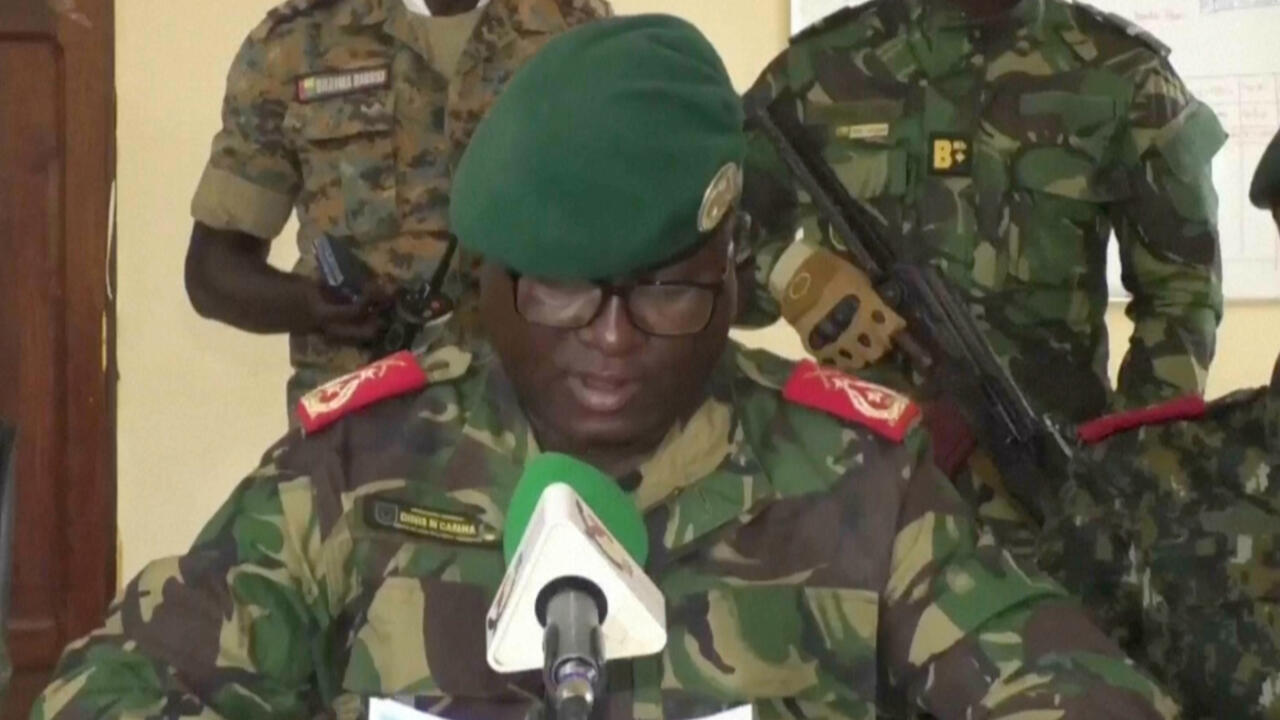
Very quickly, senior officers appear on national television. Calm, but in a martial tone, a spokesperson announces that the army has taken 'total control of the country.' The message is clear: the electoral process is suspended, all borders are closed, a curfew is imposed, and a High Military Command for the restoration of national security and public order is established. The military position themselves as arbiters in a situation they present as uncontrollable, claiming to act to prevent, in their words, 'chaos' and 'national division.'
At the same time, the outgoing president himself confirms, in a brief exchange relayed by international media, that he has been arrested by the army. Several civilian and military officials, as well as opposition figures, are also reported detained. In a matter of hours, the backdrop of an expected democratic transition is replaced by a forcible change of power.
A junta takes power and a vague transition begins
The day after the coup announcement, a general—Horta Inta-A Na Man—is presented as the interim president and head of the High Military Command. A duration of one year is mentioned for this transition, with no detailed timeline or firm guarantees for a quick return to constitutional order. The official discourse emphasizes the need to 'rebuild institutions,' 'restore security,' and 'ensure a credible future election.'
For now, nothing suggests that this transition will be short, nor that the military will remain uninvolved in political life once their mission is theoretically completed. Guinea-Bissau has a long history of coups, failed attempts, overthrown governments, and fragile alliances between civilians and military. This new power grab continues a pattern that raises questions about the possibility of establishing stable democracy in a country where the army remains a central political actor.
A country caught between fear, fatigue, and resignation
In the streets of Bissau, daily life is now marked by patrols, checkpoints, and an imposed curfew. Businesses open intermittently, residents move with caution, and many avoid discussing politics aloud. The fear of violence, arbitrary arrests, and reprisals encourages prudence.
Yet beyond the fear, there is also profound fatigue being expressed. For part of the population, this new coup feels like a rerun: promises of stabilization, speeches about restoring order, followed by blockages, rivalries, and absence of economic prospects. Young people, in particular, see once again the possibility of a more stable future closing off, while poverty, unemployment, and forced emigration remain daily realities.
Instability that transcends the borders of Guinea-Bissau
This coup is not confined to the boundaries of this small coastal country. It fits into a broader sequence of democratic setbacks in West Africa, marked by coups in Mali, Guinea, Burkina Faso, and Niger. The region is experiencing a spiral where the legitimacy of elections is questioned, institutions are weakened, and armies are increasingly intervening in political arbitration.
Furthermore, Guinea-Bissau occupies a sensitive position. Its territory, coastline, and institutional weaknesses have historically made it a major transit point for certain traffics, particularly drugs. The political instability creates an environment conducive to the consolidation of criminal networks and further undermines state structures, with possible consequences for the security of the entire sub-region.
The international community faces a new democratic failure
External reactions have come swiftly. Regional organizations and international partners condemn the military takeover and call for the restoration of constitutional order. Observers deployed during the election, caught off guard as well, denounce an interrupted process at its most critical moment, that of the announcement of results.
But amidst principled condemnations, diplomatic statements, and threats of sanctions, one question remains: what real pressures will be exerted to compel the junta to organize a swift return to legitimate civilian power? Recent experiences from other countries in the region indicate that calls for a return to democracy often struggle to translate into concrete leverage, especially when the military protagonists claim their role as a 'national necessity.'
What lies ahead in the coming months
The outcome will depend on three key factors. First, the junta’s ability to maintain a minimum security stability without resorting to broad repression. Next, how civil political forces—parties, oppositions, civil society—manage to organize themselves to influence the definition of the transition. Finally, the level of involvement from the region and the international community, which could either be content with statements or attempt to impose stricter political conditions.
For now, Guinea-Bissau remains trapped in a limbo: neither a true civil war nor normal political life. A gray area where fear, silence, and military control dictate the pace, while waiting for a clear perspective to finally emerge for a country that seems doomed to relive its own cycles of crisis.