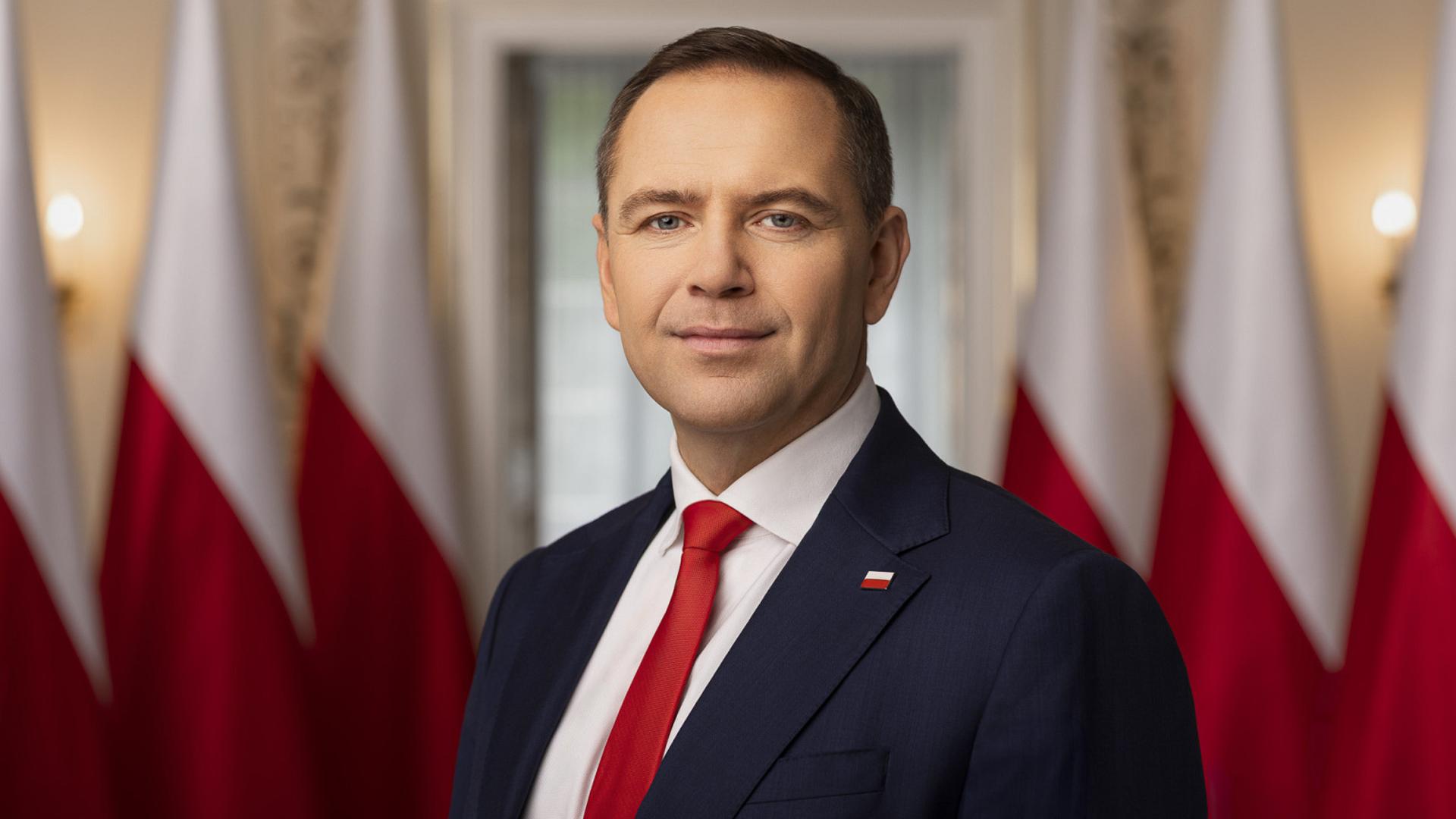
Poland is experiencing a major institutional crisis on Friday, October 30. President Karol Nawrocki ordered his plane to return immediately to Warsaw while flying over southern Spain, interrupting an official visit to Senegal.
The exceptional decision is rooted in a confrontation over the Constitutional Tribunal, the highest court responsible for ensuring laws comply with the Polish Constitution.
The contested suspension of its two main leaders, the deployment of police around its headquarters, and accusations of a coup from the conservative opposition have sparked a dramatic political escalation.
In a country that is a member of both the European Union and NATO, this confrontation reveals the extent of ongoing tensions between the presidency and the government majority led by Donald Tusk.
A presidential plane suddenly changes course
It all begins on the evening of Friday, October 30.
Polish President Karol Nawrocki is aboard his official plane, bound for Dakar, Senegal. He is set to participate in events related to the Youth Olympic Games and meet with Senegalese President Bassirou Diomaye Faye.
However, as the aircraft flies over southern Spain, near Malaga, it suddenly alters its course to return to Poland.
This maneuver is tracked on the flight monitoring platform Flightradar24 and quickly reported by several Polish media outlets.
The president personally confirms his decision on the social media platform X, explaining that a head of state must be present in their country under such circumstances.
This decision comes just minutes after a series of institutional developments in Warsaw, where the situation surrounding the Constitutional Tribunal is rapidly deteriorating.
Thus, based on available information, this is not a technical incident affecting the plane nor a direct alert related to Russia, but a presidential decision motivated by an internal political crisis.
Suspension of the head of the Constitutional Tribunal
The main triggering element is a decision announced on the Polish Constitutional Tribunal's website.
Around 6 PM local time, a statement reports the temporary suspension of Bogdan Święczkowski, president of the institution, and his vice-president, Bartłomiej Sochański.
The measure, presented as applicable for a month, was reportedly taken by Judge Anna Korwin-Piotrowska, who claims provisional leadership of the Tribunal by virtue of her seniority in the judiciary.
Its authors invoke Article 130 of the Polish law on the organization of ordinary courts.
However, the legality of this procedure is sharply contested.
Bogdan Święczkowski and his supporters refuse to acknowledge the change in leadership. A message published on the Tribunal's official account on X denounces an illegal takeover of the institution's website and questions Anna Korwin-Piotrowska's status as a constitutional judge.
Poland thus faces a particularly delicate situation: two factions assert incompatible interpretations of institutional legitimacy.
Police deployed around the Tribunal: what happened?
At the same time, police forces are mobilized around the Constitutional Tribunal’s headquarters, located on Szucha Avenue in Warsaw.
According to the Polish police, this intervention follows information provided by Anna Korwin-Piotrowska regarding security risks for judges and staff.
Gatherings are occurring around the institution and incidents, including the throwing of dangerous objects at law enforcement, have been reported.
Police authorities clarify one essential point: officers are intervening on the institution's grounds but have not entered the building itself.
The police state that their intervention aims solely to ensure safety and public order, without interfering in the Tribunal's judicial activities.
This distinction is crucial as some political figures are condemning this as a forced intervention against a constitutional institution.
Five requests for immunity removal and fifty volumes of documents
The crisis escalates with the intervention of the Minister of Justice and Attorney General Waldemar Żurek.
He announces that he has transmitted five requests for immunity removal targeting the Tribunal's main leaders to the Constitutional Tribunal.
Four concerns Bogdan Święczkowski, while the fifth targets Bartłomiej Sochański.
According to the information provided by the Attorney General, these requests come with fifty volumes of judicial documents.
The ministry aims to allow for an examination of potential criminal responsibilities.
However, it must be emphasized that a request for immunity removal does not constitute either a conviction or proof of guilt.
These moves occur amid an ongoing disagreement regarding the functioning of the Tribunal, the appointment of its judges, and the authority of the leaders tasked with running it.
Why is Poland facing such a crisis?
To understand this confrontation, we must go back several years.
The Polish Constitutional Tribunal has become one of the main points of friction between successive governments and judicial institutions.
Under the previous government of the Law and Justice Party (PiS), several reforms to the judiciary sparked intense tensions with European institutions.
After the coalition led by Donald Tusk took power in December 2023, the new government began efforts to change the functioning of judicial institutions, claiming a desire to restore the rule of law.
However, these reforms have faced resistance from judicial leaders appointed during the previous government, as well as from the conservative camp.
The issue became particularly sensitive in 2026.
Parliament elected new constitutional judges, but President Karol Nawrocki refused to accept the oath of several of them.
Some judges then took their oaths in Parliament without the head of state's presence.
The presidential camp considers this move irregular. In contrast, the affected judges and their supporters argue that the president cannot indefinitely block appointments made by Parliament.
An opinion published in October by the Venice Commission, an advisory body of the Council of Europe, stated that an oath taken without the physical presence of the president could be accepted under certain conditions.
However, the dispute remains unresolved.
The opposition speaks of a coup, the government rejects the accusations
Political reactions come quickly.
Jarosław Kaczyński, leader of the Law and Justice Party, appears before the Constitutional Tribunal's headquarters.
He accuses Donald Tusk's government of attempting to seize control of the institution by force and calls on President Nawrocki to intervene within the bounds of his constitutional prerogatives.
Other opposition figures echo these accusations, with some even speaking of an attempted coup.
On the other hand, representatives of the government majority defend the need to allow judges elected by Parliament to perform their functions.
Jan Grabiec, head of the Prime Minister's Chancellery, argues that the blockage of oaths is itself an infringement on the constitutional order.
However, the debate extends beyond a simple confrontation between the government and the opposition.
Polish lawyer Marcin Matczak, a critic of the previous direction of the Tribunal, has publicly expressed reservations about the legal basis used to suspend its leaders.
Thus, the controversy revolves as much around the goal of judicial reform as the means employed to achieve it.
At this point, the accusations of a coup remain in the political realm of the protagonists' statements and do not constitute an established legal qualification.
What are the consequences for Poland and the European Union?
This crisis occurs in a particularly sensitive international context.
Poland occupies a significant role in European security. As a border country with Ukraine, it is an essential player in the military and logistical support provided to Kyiv.
It is also one of the NATO members most directly concerned by tensions with Russia.
However, the events of October 30 are primarily linked to an internal institutional conflict.
No confirmed information connects them to a Russian military operation or an immediate threat to Polish territory.
On the European level, the situation could nevertheless rekindle debates surrounding judicial independence, the functioning of institutions, and the respect for the rule of law.
The central question remains the legitimacy of the decisions made around the Constitutional Tribunal and their acceptance by the various state authorities.
Can the president's return change the situation?
By deciding to interrupt his visit to Senegal, Karol Nawrocki has chosen to give exceptional importance to this crisis.
His return to Warsaw will allow him to consult with his advisors, meet with institutional leaders, and determine the responses he considers compatible with his prerogatives.
However, presidential action remains framed by the Polish Constitution.
The existence of several competing interpretations of applicable rules complicates the search for a swift resolution.
The immediate question is now whether the institutions will be able to achieve a functioning recognized by all their members or if the confrontation will continue through new judicial and political procedures.
Conclusion: an institutional crisis with uncertain consequences
The spectacular turnaround of the Polish presidential plane has been the most visible sign of a crisis brewing for several months.
Behind this episode lies a deep confrontation regarding judicial independence, the appointment of judges, and the distribution of powers among the presidency, parliament, and courts.
The contested suspension of the leaders of the Constitutional Tribunal, police movements, and mutual accusations now place political leaders before a fundamental question: how to resolve a constitutional conflict when the involved institutions no longer agree on the authority competent to settle it?
As of the evening of October 30, 2026, one thing is certain: Poland is entering a new phase of its institutional confrontation, the political and judicial consequences of which remain to be determined.