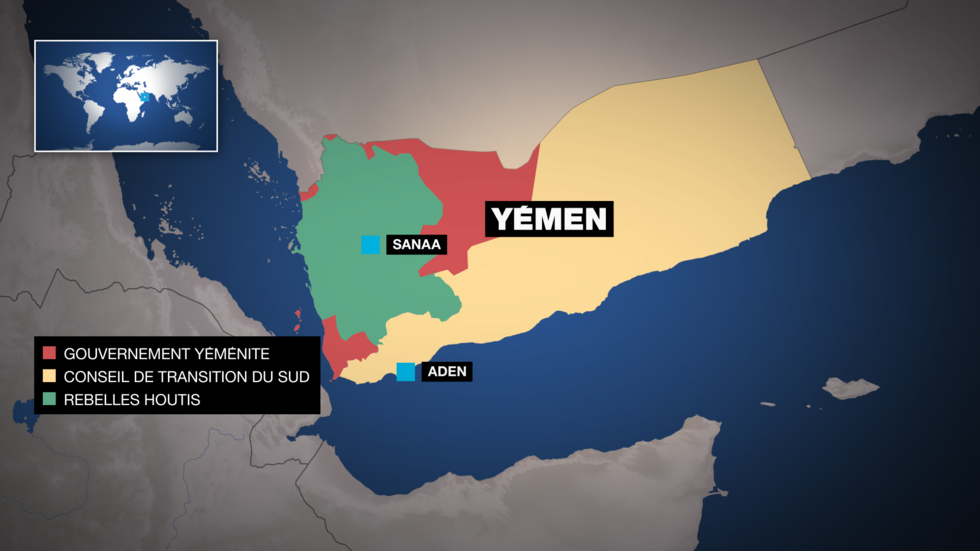
Yemen was already a conflict with multiple layers. It is increasingly becoming a visible theatre for rivalry between two powers that presented themselves as partners: Saudi Arabia and the United Arab Emirates. This competition extends beyond mere diplomatic differences. It involves armed local allies, a battle for influence over southern institutions, and a struggle for control over key areas, ports, and resources. The latest tensions around Aden, along with the growing instability in Eastern Yemen, have brought to light a simple fact: the anti-Houthi camp is not a monolith, and its fragmentation can weigh as heavily as the front line in the North.
At the heart of this rivalry lies a divergence of objectives. Riyadh primarily aims to secure its border, reduce the political and military cost of the war, and maintain a minimal level of Yemeni unity for negotiating an exit from the crisis. Abu Dhabi, on the other hand, has spent years building a network of local allied forces in the South, prioritizing the coast, maritime routes, and influence over port areas. This logic has led to the emergence of dual power: on one side, the internationally recognized government supported by Saudi Arabia; on the other, a key player on the ground, the Southern Transitional Council, closely associated with the UAE.
The escalation recorded in the winter of 2025–2026 illustrates how far this rivalry can go. The closure of Aden International Airport, amid disagreements over inspections and flights between Aden and the UAE, symbolized the depth of the crisis between the two local camps and, beyond that, the breach of trust between Riyadh and Abu Dhabi. At the same time, developments in the East—particularly in Hadramout and Al-Mahra—triggered international alerts, with several actors fearing that instability could extend beyond Yemen and spill over into the entire Gulf region.
The stakes go beyond symbolism. Aden is the de facto capital of the recognized government, but it is also a space where southern forces, aligned with the UAE, hold significant military and political power. Hadramout and Al-Mahra, which have long been isolated from major battles, are now focused on a very tangible competition: resources, access to the sea, logistical routes, military bases, and control of local administrations. For Riyadh, seeing forces aligned with Abu Dhabi establish themselves or advance in these governorates equates to accepting an Emirati sphere of influence that directly impacts its own security priorities. For Abu Dhabi, allowing these territories to fall under forces aligned with Riyadh would constrain the influence architecture built over the years.
This rivalry is rooted in a recent history marked by incomplete political agreements and persistent mistrust. The Riyadh Agreement of 2019, aimed at reconciling the government and the Southern Transitional Council, was designed precisely to prevent the anti-Houthi front from collapsing from within. However, its implementation has been intermittent, resulting in a hybrid reality: occasional institutional sharing, almost permanent security competition, and coexistence of distinct command chains.
The result is a gradual reconfiguration of power in the South. The Southern Transitional Council has strengthened its position, while government institutions often find themselves dependent on local compromises, external funding, and fragile military balances. In this landscape, the Presidential Leadership Council, designed to unify the anti-Houthi camp, finds itself trapped: it must cater to rival forces, each backed by a regional patron, while maintaining the minimum capacity to govern.
The geopolitical dimension adds to this picture. While discussions around a peace roadmap have occurred intermittently, regional dynamics—particularly tensions in the Red Sea and security pressures on maritime routes—have complicated calculations. For Riyadh, the challenge is to stabilize the Yemeni issue sufficiently to reduce the kingdom's exposure. For Abu Dhabi, the stakes are also maritime and strategic: projection, ports, security corridors, and influence over local forces capable of holding ground.
This power play creates three major risks. The first is the lasting disintegration of the anti-Houthi camp, giving the North a political advantage, even without a massive military advance. The second is the transformation of the South into a mosaic of zones of influence, where each local crisis could trigger escalation between regional patrons. The third is the increased internationalization of tensions: as soon as a strategic infrastructure is targeted or a maritime route is disrupted, diplomatic pressure mounts, and scenarios for regional destabilization become credible.
Chronologically, the rivalry crystallized in 2019 when intra-southern clashes led to the Riyadh Agreement on November 5, 2019, designed to integrate the Southern Transitional Council into a governmental framework and reorganize security forces. The following years were marked by cycles of partial implementation, oscillating between announcements of unification and concurrent realities on the ground. Beginning in 2022, the creation of the Presidential Leadership Council formalized an internal coalition model, but did not dissolve existing armed networks.
In 2024, the prospect of a UN roadmap and discussions of de-escalation coexisted with the persistence of a fragmented state and local control lines. In 2025, a shift occurred: the rise of the Southern Transitional Council and its eastward expansion made the Riyadh–Abu Dhabi competition much more visible. By late 2025, the intensification of tensions in Hadramout and Al-Mahra triggered international warnings, opening a crisis sequence where withdrawal demands, force deployments, and pressure measures multiplied. On January 1, 2026, the cessation of flights in Aden and the controversy over inspections of flights between Aden and the UAE symbolized the depth of the rift, as several international actors publicly called for de-escalation.
In the short term, three scenarios dominate. The first is a negotiated de-escalation, freezing advances in the East and returning to coordination mechanisms under diplomatic pressure. The second is an accelerated de facto partition, where institutions become rigid behind lines of influence, and Aden becomes a constantly contested capital. The third is escalation through incidents, where a logistical decision, a local confrontation, or a blockade measure triggers successive retaliations, further undermining the economy and governance in the 'liberated' areas.
For Yemen, the stakes are existential: no sustainable stabilization is possible if the camp opposing the Houthis remains plagued by an internal cold war. For Saudi Arabia and the UAE, the stakes are strategic: Yemen has become a security frontier for one and a maritime influence space for the other. As long as these priorities remain unaligned within a credible political framework, the Yemeni crisis will continue to regenerate, even in the absence of major offensives along the front lines.