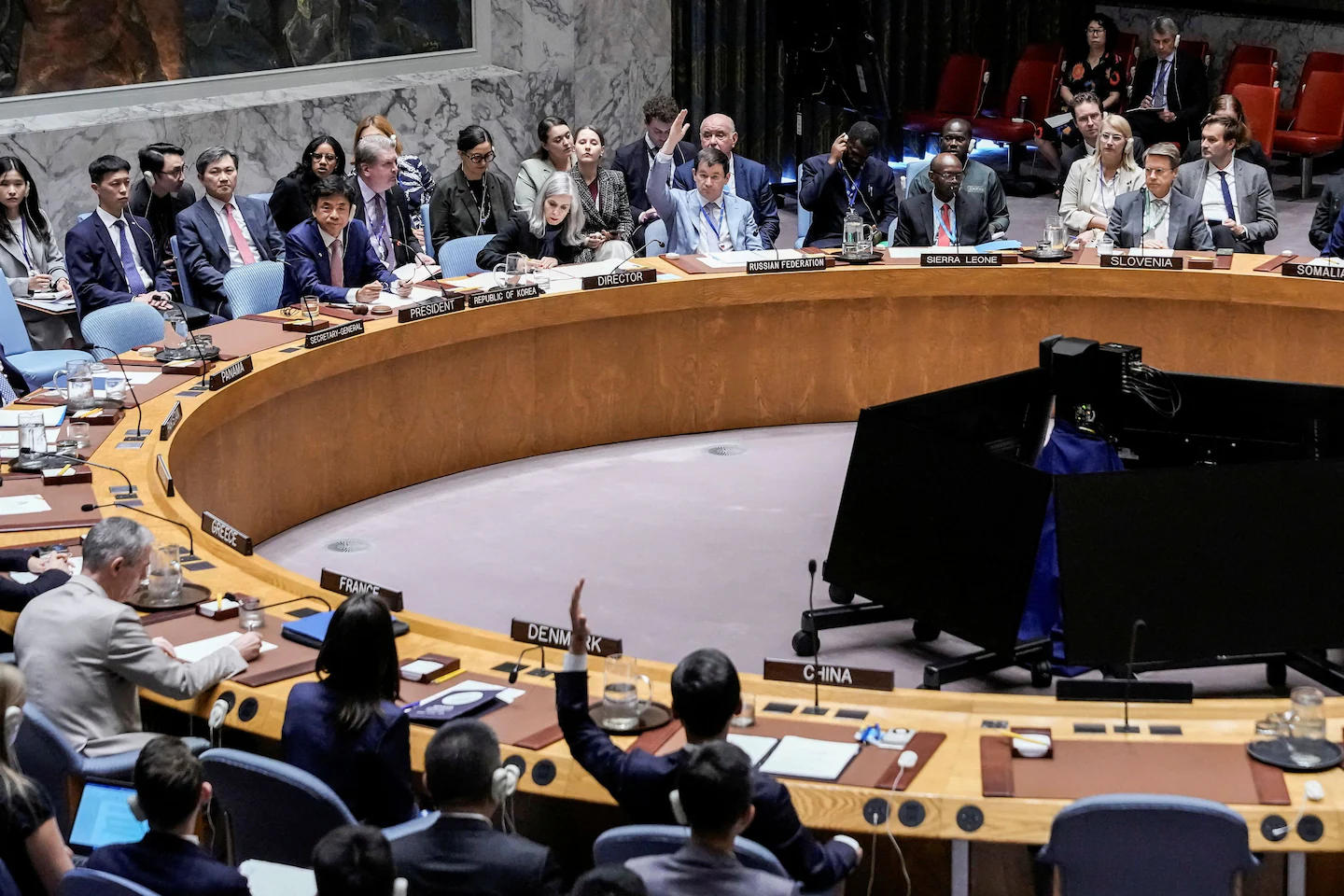
A decisive night in New York.
The UN Security Council has adopted a major resolution concerning the future of the Gaza Strip amid rising tensions, instability, and a prolonged humanitarian deadlock. The text, defended by the United States, received13 votes in favor, 2 abstentions(Russia and China) and no votes against— a rare occurrence in the recent history of the Council.
This adoption marks a significant turning point: for the first time, a Council resolution explicitly validatesthe deployment of an international stabilization forcein Gaza, with a mandate extending until the end of 2027. This force, called theInternational Stabilisation Force (ISF), will be tasked with ensuring security, coordinating humanitarian aid, and assisting in the establishment of a new administrative framework.
A “Board of Peace” for transitional governance.
At the heart of the text is also the establishment of a governance committee—referred to as theBoard of Peace— tasked with managing Gaza during the transitional period. This committee will oversee local institutions, ensure the functioning of essential public services, and prepare the necessary political infrastructure for the future.
The transitional mandate spans two years, with a deadline set for the end of 2027. The text also mentions a possible“future political pathway”, which several Council members interpret as an indirect recognition of a future Palestinian state. This point motivated the abstention of Russia and China, which accuse Washington of "unilaterally defining the contours of a political process without real multilateral consultation."
Mixed reactions: tensions and skepticism.
On the Palestinian side, the strongest reaction came from Hamas, which outright rejected the text. Movement leaders denounce it as an “international tutelage imposed on Gaza” and assert that any lasting solution must stem from “legitimacy derived from the Palestinian people.”
Other regional actors adopt a more nuanced position: several Arab states welcomed the creation of an enhanced humanitarian mechanism while emphasizing that no resolution can achieve lasting effects without a clear ceasefire, a defined political horizon, and recognition of Palestinian national rights.
A diplomatic turning point, but not a final solution.
While this resolution opens a new phase, it does not resolve all critical questions:
-
Who will participate in the international force?
-
How will the transitional governance be structured?
-
What role will the Palestinian Authority play?
-
What will Israel's stance be in this setup?
Nevertheless, this vote constitutes the first outline of a coherent international plan since the escalation in Gaza began. It occurs in a context where diplomatic pressures, humanitarian urgency, and regional dynamics render a structured solution indispensable.
A new map for a decades-old conflict.
The decision made last night does not end the conflict, but it redefines the rules of the game. The presence of an international force and the creation of a transitional governance committee could shift power relations, open space for broader negotiations, and even lay the groundwork for a long-awaited political reconfiguration.
The international community, now engaged, must ensure that this transition does not become another deadlock. The coming months will be crucial in determining whether this resolution marks a genuine advancement… or another episode of unfulfilled promises.