A beautifully Moroccan feminine heritage
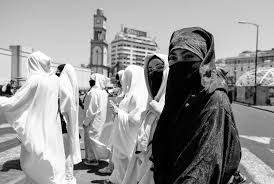
The haïk is a large white or cream fabric, often measuring over five meters in length, wrapped around the body and covering almost the entire woman, leaving only the eyes visible.
Unlike ceremonial garments like the caftan, the haïk is atraditional everyday clothing, a symbol of modesty and timeless elegance, worn in the streets, souks, medinas, and popular neighborhoods for several centuries.
Amazigh and Andalusian roots
The origin of the haïk dates back to North African antiquity: the Amazigh people wore large draped wool and cotton fabrics to protect against the sun and cold.
But it was the influence ofAndalusian, due to the massive return of families expelled from Spain starting in the 15th century, that shaped the haïk into what we know today.
In the imperial cities — Fès, Tétouan, Rabat, Salé — the garment became a social and urban marker, associated with elegance and decency.
The haïk, a symbol of modesty and elegance
Contrary to the notion of a simple ‘veil,’ the haïk is a complex garment:
-
it gently envelops the silhouette,
-
it imposes a measured walk,
-
it creates a form of silent and majestic presence.
It represents several essential values in traditional Moroccan society:
-
modesty,
-
dignity,
-
feminine identity,
-
social respect,
-
elegant modesty,
-
protection in public spaces.
Its whiteness is a powerful symbol: it evokes purity, peace, and light.
Regional variations of the haïk
The haïk is not uniform across Morocco.
Several versions exist:
-
Urban white haïk (Fès, Rabat, Tétouan): the most refined, often made of fine wool or mixed silk.
-
Amazigh haïk (Atlas, Rif): thicker, often made from raw wool, sometimes adorned with red lines.
-
Izar : similar to the haïk but lighter, used in rural areas.
-
Rfoud : a shorter or more practical variant depending on the regions.
This diversity testifies to the deep-rooted nature of the haïk in Moroccan culture, transcending social boundaries.
The “Moroccan Niqab”: the famous “Aâjar”
In certain cities, an accessory complements the haïk:
the “aâjar” (or “njala”), a fine muslin veil covering the face while leaving the eyes visible.
This is a very urban element, mainly worn in Fès, Rabat, and Tétouan.
Unlike other forms of veils in the Muslim world, the aâjar is:
-
light,
-
aesthetic,
-
often embroidered,
-
designed primarily as a complement to modesty, not as a strict religious symbol.
A garment at the heart of 20th-century Moroccan society
From 1900 to 1950, the haïk was omnipresent in the streets of Morocco.
It was worn:
-
to go to the souk,
-
to visit family,
-
for religious ceremonies,
-
for weddings in embroidered versions.
In cities like Rabat or Salé, the sight of white haïks was a true visual signature: a symbol of the refined, dignified Moroccan woman rooted in her culture.
Reasons for its gradual decline
Starting in the 1960s, the haïk began to disappear from major cities for several reasons:
-
rapid urbanization,
-
the emergence of more practical clothing,
-
changing roles of women in public life,
-
Western influence,
-
cultural modernization.
However, its disappearance is not total: it remains present in certain neighborhoods, villages, and especially in the generational gaps, when a grandmother passes the garment to new generations.
The haïk today: a nostalgic heritage symbol
Although it is no longer the everyday garment, the haïk remains very present in:
-
traditional celebrations,
-
heritage parades,
-
cultural festivals,
-
historical representations,
-
artistic photographs.
It has become a cultural object, a symbol of a bygone Morocco, admired for its beauty and significance.
The revival of the haïk in art, fashion, and photography
In recent years, the haïk has experienced a renaissance:
-
Moroccan designers incorporate it into their creations,
-
artists photograph it as a symbol of identity,
-
museums and exhibitions dedicate entire sections to it,
-
festivals restore it to a place of honor.
The haïk has not disappeared: it has changed function, becoming a living heritage, valued and reinterpreted.
A garment that tells the story of a feminine Morocco
The haïk is one of the strongest images of Moroccan culture:
a white silhouette gently gliding through the alleys, a symbol of modesty, dignity, and identity.
It embodies the memory of hundreds of years of history, traditions, and craftsmanship.