Palestine deserves defenders, not owners.
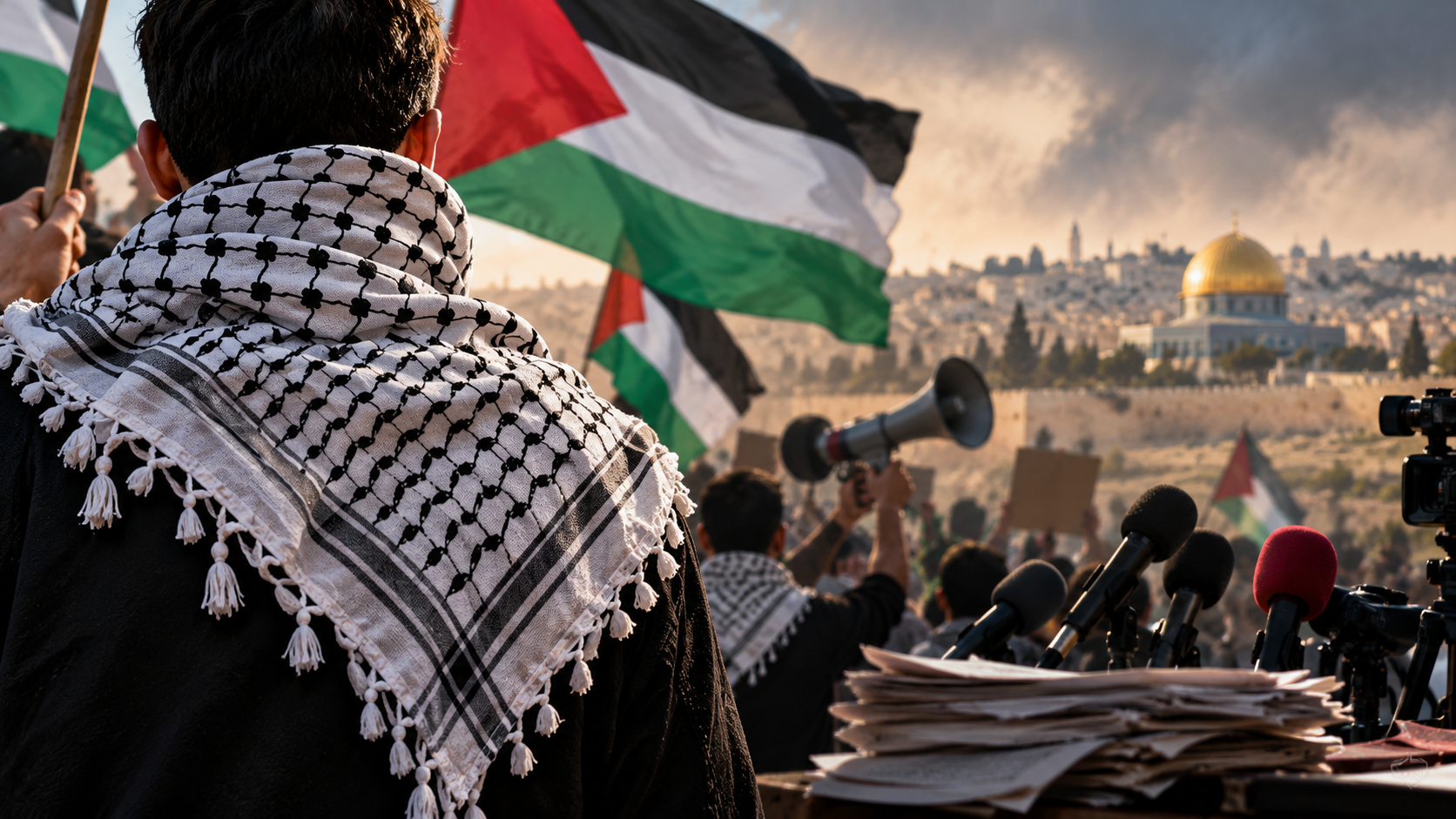
Some causes transcend borders, ideologies, and political affiliations. The Palestinian cause unquestionably belongs to this category. However, in Morocco, there is a concerning phenomenon today: the 'koufiyine,' activists who seem to have transformed the Palestinian keffieh into a symbol of virtue and solidarity into a tool of political pressure.
Let’s not be mistaken: the problem is not the keffieh, a respectable symbol of Palestinian identity, nor the expressions of solidarity that legitimately contribute to freedom of expression. The issue arises when some arrogate to themselves the monopoly on compassion, issuing certificates of patriotic conduct and claiming the right to decide who can support Palestine and how.
Palestine does not belong to any party, organization, or ideological faction, especially not to those who shout the loudest.
Indignation with Variable Geometry
Among some activists we refer to here as 'koufiyine,' solidarity sometimes seems to be measured by the number of slogans shouted, protests organized, or posts shared on social media.
Nonetheless, a vital question arises: what is the real purpose of this agitation when it serves more to attack Moroccan opponents than to make real progress in Palestinian rights?
Critique of political decisions is perfectly legitimate. However, turning every disagreement with Moroccan diplomacy into an accusation of betrayal constitutes a dangerous drift.
One can defend the rights of the Palestinian people without adopting the positions of a specific movement. One can condemn the suffering in Gaza without endorsing all the demands of those who protest in its name. And one can support Palestine while believing that Morocco's strategic interests should not be dictated by public pressure.
No activist has the right to strip a Moroccan of their solidarity with Palestine simply because they do not share their political choices.
When the Palestinian cause becomes a weapon against Morocco
This is likely the most concerning drift: the temptation to import an international conflict into the national debate to make it a permanent instrument of confrontation.
Under the guise of defending the Palestinians, certain discourses gradually shift the focus of the debate. It is no longer just about Gaza, Jerusalem, civilians, or international law. It also involves identifying culprits in Morocco, accusing its institutions, and turning every diplomatic choice into a test of moral loyalty.
Yet, the facts deserve to be recalled.
In July 2025, Morocco announced the dispatch of nearly 180 tons of humanitarian and medical aid to Palestinians, particularly the residents of Gaza. In August of the same year, an additional aid of about 100 tons of food and medicines was announced.
These initiatives do not mean that Moroccan policy is beyond critique. They simply demonstrate that it would be intellectually dishonest to reduce the Kingdom's solidarity to a few slogans or a caricature of its diplomatic action.
Defending Palestine should never become an excuse to systematically deny the actions taken by one's own country.
The keffieh does not replace results or responsibility.
A symbol can carry a history, express resistance, and recall an injustice. However, it cannot exempt the bearer from any critical reflection.
The keffieh is not a political program. A protest is not, in itself, a diplomatic strategy. And an indignation, however sincere, does not automatically respond to the needs of a suffering population.
True solidarity should also be measured by its ability to mobilize humanitarian aid, support victims, advocate for credible political solutions, and keep the Palestinian issue at the forefront of international concerns.
Activists who do this work deserve respect.
Those who prefer to turn Palestinian suffering into a permanent platform should, however, accept a simple question:What remains of their mobilization once the cameras are off and the slogans have ended?
It would be unjust to claim that all mobilizations are useless. They can raise awareness and exert political pressure. However, their legitimacy does not place them above criticism, especially when the debate turns into moral intimidation.
Moroccan patriotism is non-negotiable.
Morocco has a historic relationship with the Palestinian issue. The Kingdom chairs the Al-Quds Committee and intervenes notably through the Bayt Mal Al-Quds Acharif Agency.
This involvement is part of a policy that combines diplomatic commitments, humanitarian actions, and the defense of national interests.
One can debate its effectiveness, its contradictions, or the decisions that compose it. But the idea that supporting Palestine would force Moroccans to give up their own understanding of the Kingdom's interests must be rejected.
Being in solidarity with Palestinians does not mean placing one's country second.
Morocco does not need to receive lessons in patriotism from those who sometimes confuse the intensity of their slogans with the depth of their convictions.
And Moroccan citizens do not have to choose between their attachment to their country and their compassion for the Palestinian people.
Palestine needs solidarity, not excess.
By wanting to speak on behalf of everyone, some end up monopolizing the debate. By presenting every disagreement as a moral fault, they risk deterring citizens, who simply refuse ideological imperatives, from a cause that is widely supported.
This is the paradox of this excess: claiming to gather around Palestine while dividing Moroccan society on how to support it.
Solidarity cannot be decreed. It cannot be imposed through accusations, insults, or public ultimatums.
It is built through conviction, coherence, and action.
A cause too important to become a political instrument.
The Palestinian cause deserves better than partisan rivalries, visibility calculations, and indignation contests.
The Palestinians are not mere background figures in Moroccan political battles. Their suffering should not be used as a shortcut to fame or an automatic argument to disqualify an opponent.
The 'koufiyine' who use this cause as a tool for dominating public debate must understand one thing: wearing a keffieh does not grant any moral superiority over those who choose other forms of solidarity.
One does not measure love for Palestine by the number of attacks on Morocco. And one does not become a better defender of Palestinians just by speaking louder than others.
Palestine deserves sincere commitments, results, and solidarity that unites.
Not a competition to see who holds the greatest monopoly on its suffering.