The transition to a green economy is no longer a choice, but a necessity.
For Morocco, a developing country facing the dual pressure of urban growth and resource scarcity,recycling and the circular economyhave become strategic priorities.
In recent years, the government, local authorities, and the private sector have ramped up initiatives to transform waste into resources, losses into opportunities, and waste into jobs.
However, behind the promising figures, the journey towards a truly effective circular economy remains long.
1. An alarming observation: tons of waste are still poorly managed
Each year, Morocco produces nearly7 million tons of municipal waste, with more than half coming from large urban agglomerations.
According to the Ministry of Energy Transition and Sustainable Development,only 10 to 12%of this waste is currently recycled. The rest ends up in controlled landfills or, worse, in illegal dumps.
The situation is particularly critical in certain rural areas, where collection and sorting infrastructure is nearly non-existent.
This ineffective management comes at a high cost to the community and harms the environment: soil pollution, methane emissions, groundwater contamination, and increased health risks for nearby populations.
2. Stated ambitions: Morocco's vision for the circular economy
Morocco has established anational strategic framework for the circular economy aiming for 2030, in line with the National Sustainable Development Strategy (NSDS).
The objective is clear:to reduce by 50% the waste sent to landfills by 2030and make recycling a fully-fledged economic sector.
Several public initiatives are heading in this direction:
-
National Household Waste Program (NHWP), launched in 2008, to standardize organized collection and rehabilitate landfills.
-
National Waste Recovery Program (NWRP), which encourages sorting, recovery, and composting.
-
National Charter for Environment and Sustainable Development, enshrined in the Constitution since 2011.
However, results have been mixed. The country has made progress in terms of infrastructure, butindustrial recyclingremains in its infancy, and the informal sector still dominates the market.
3. The invisible yet essential role of the informal sector
In Morocco, thousands of people depend on sorting and reselling waste.
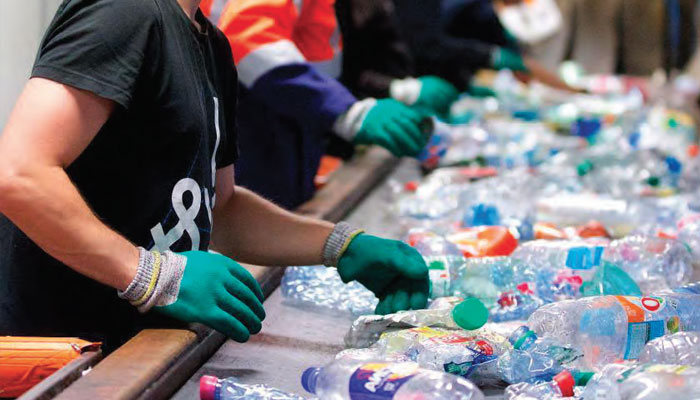
These ‘baraka’ — informal recoverers — collect plastic, metal, cardboard, and glass from landfills or the streets.
According to a GIZ study,nearly 85% of the country's effective recycling relies on this informal sector..
The paradox is striking: those who contribute most concretely to waste reduction work without protection, status, or official recognition.
Several pilot projects, especially in Rabat and Fez, aim to integrate these actors into formal value chains. Yet, their social and economic inclusion remains a major challenge.
4. Private initiatives: when recycling becomes an economic opportunity
Many Moroccan companies are beginning to invest inwaste recovery..
Startups likeCleanergy,, Zéro Zbel,, Snam Maroc,orEcomeare developing innovative circular models: source sorting, selective collection, community composting, and transforming plastics into reusable raw materials.
The industrial sector is also getting involved:OCP,, LafargeHolcim Morocco,, Ciments du Maroc,andMaghreb Steelare gradually integrating recovery and reuse processes into their production chains.
These efforts not only help reduce costs but also improve the environmental image of companies — an increasingly vital asset in international markets.
5. Recycling and employment: a value-creating sector
The circular economy is not just an environmental issue; it is also asocial and economic lever..
The ministry estimates that the widespread implementation of recycling could createup to 50,000 direct jobs by 2030..
Jobs in sorting, logistics, transformation, and maintenance represent a pool of green jobs that could promote the inclusion of youth and women.
Some cooperatives, likeCoopérative Attawafouk in Marrakech,, are leading the way by formalizing sorting activities and providing decent working conditions.
These local successes prove that a participatory and community-based approach can make a difference.
6. Structural challenges: financing, selective sorting, and awareness
The main barrier to the circular economy remainsthe lack of sustainable financing..
Local authorities have limited budgets and still largely rely on state subsidies.
Source sorting, which is essential for improving recycling quality, is only partially implemented, often due to logistical constraints or a lack of incentives for citizens.
Public awareness is also crucial. Despite ongoing campaigns, many households continue to mix all their waste.
Without upstream sorting, the cost of recycling remains high and profitability low.
Finally, the legal framework, while progressive, suffers from a lack of coordination.
Several ministries are involved (Interior, Environment, Industry), but often without harmonizing their actions.
7. Towards a true circular economy: keys to change
To transform the current linear model (‘produce-consume-dispose’) into a circular model, Morocco will need to act on several levers:
-
Environmental education, starting in primary school, to instill a culture of sustainability.
-
Fiscal and regulatory incentivesfor companies that recycle or reduce their waste.
-
Strengthening public-private partnerships, especially in collection and processing.
-
Integrating the informal sector, through cooperatives supported by municipalities.
-
Research and innovation, to develop recyclable materials and short supply chains.
Examples like theBouskoura industrial zone, which aims for carbon neutrality, show that change is possible. But it requires a shared vision and ongoing political will.
Conclusion
Morocco has the means to become an African model for the circular economy, provided it turns ambition into action.
The ecological transition is not just a slogan: it is anational project, engaging citizens, businesses, and the state.
By 2030, the kingdom must demonstrate thatrecycling is not just fixing, but preparing— preparing for a more sustainable, fairer, and smarter future.
Sources:
-
Ministry of Energy Transition and Sustainable Development – Strategic Framework for Circular Economy 2030
-
GIZ Morocco – Report on Informality in Recycling in Morocco
-
World Bank – Green Jobs in MENA
-
Cleanergy Morocco – Initiatives 2024
-
UN Environment – Circular Economy in North Africa 2024