The ocean, once viewed as a natural boundary, has now become for Morocco anarea of the future.
From the Strait of Gibraltar to Dakhla, including the ports of Agadir, Safi, and Laâyoune, the kingdom now looks to the sea as a major economic lever.
This vision aligns with a global movement: theblue economy, which aims to exploit marine resources sustainably, balancing growth and ecology.
For Morocco, located at the crossroads of Europe, Africa, and America, the sea is not just a geographical asset: it is anational strategy.
1. A Strategic Maritime Wealth
With its3,500 km of coastlineon the Atlantic and Mediterranean, Morocco possesses one of the most diverse coastlines in Africa.
This maritime territory represents immense potential: fishing, renewable energy, biotechnology, transport, tourism, aquaculture.
According to the World Bank, the maritime sector could generate over400,000 direct jobsand11% of Morocco's GDPby 2030, if current policies are reinforced.
However, to sustainably harness this potential, Morocco must find a balance between economic development and environmental preservation.
2. Fishing: A Historical Driving Force and Sustainability Challenge
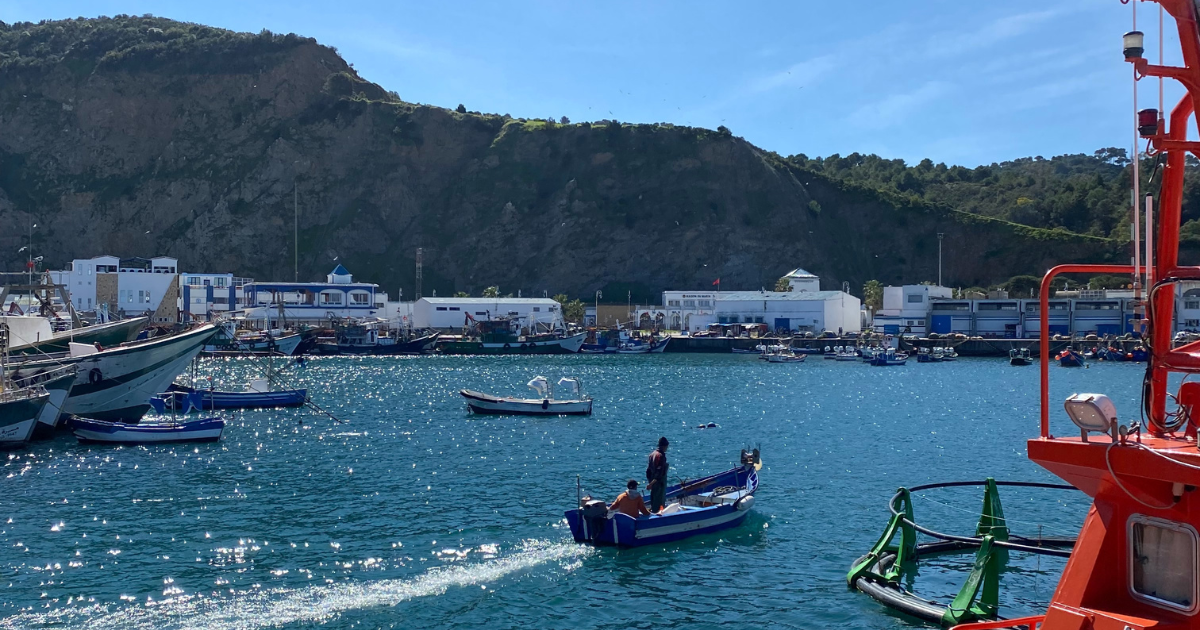
Morocco isAfrica's leading fish producerand the25th in the world.
The sector employs over 500,000 people, exports to 100 countries, and accounts for approximately2% of the national GDP.
TheHalieutis Plan, launched in 2009, has increased production while promoting responsible fishing.
However, challenges remain numerous:
-
overfishing of certain species;
-
modernization of artisanal fleets;
-
combating illegal fishing;
-
and protecting fragile coastal areas.
To address these issues, Morocco is focusing ondigital traceability, thesatellite monitoring of vesselsand thestrengthening of marine protected areas..
The new strategyHalieutis 2030emphasizes local valorization of products and the creation of sustainable jobs.
3. Ports and Logistics: The Sea as a Route for African Integration
Morocco's port infrastructure has become a continental model.
TheTanger Med complex, inaugurated in 2007, is nowthe largest container port in Africa and the Mediterranean, ahead of Piraeus and Port Said.
It connects Morocco to over 180 ports worldwide.
But the port strategy doesn’t stop at Tanger:
-
Dakhla Atlantic, currently under construction, will serve as a logistics hub for West Africa.
-
Nador West Medtargets the Mediterranean market and energy trade.
-
Agadir, Safi and Laâyouneare undergoing modernization to enhance internal flows and exports.
These infrastructures consolidate Morocco as themaritime gateway of the African continent, combining trade, transport, and maritime security.
4. Coastal Tourism and the Local Economy: The Sea as a Social Engine
Maritime tourism represents a considerable yet underutilized potential.
The beach resorts of Agadir, Essaouira, Dakhla, and Saïdia welcome millions of visitors each year, but development remains concentrated in a few hubs.
Morocco now aims todiversify the offering: ecotourism, cruises, water sports, educational marine parks.
Local initiatives are paving the way:
-
InDakhla, kitesurfing and ecological tourism have transformed the city into a global capital for water sports.
-
InEssaouira, sustainable coastal management and the promotion of maritime heritage attract cultural and responsible tourism.
-
InLarache and Asilah, women’s cooperatives transform seafood products into cosmetics and local crafts.
This "blue and inclusive" approach illustrates how the sea can become asource of revenue and social empowerment.
5. Marine Energy and Environmental Sustainability
Morocco is also exploringmarine renewable energies, notably offshore wind and wave energy conversion.
Pilot studies have been conducted off Tarfaya and Dakhla, where winds reach record speeds.
These projects form part of the national strategyMorocco Renewable Energies 2030, which aims to make the country a green electricity exporter to Europe.
However, the blue economy is not limited to energy:
it includesthe preservation of marine ecosystems, combating plastic pollution, and sustainable coastal management.
Morocco has ratified theNairobi Conventionon the protection of African seas and adopted aNational Coastal Charterin 2022.
Pollution cleanup programs for ports and beaches are underway, especially in Casablanca, Tanger, and Safi.
The challenge is toprotect biodiversity while fostering blue growth.
6. African Cooperation and Maritime Diplomacy
Morocco does not view its blue economy in isolation.
As part of theAfrican Commission on the Blue Economy, the kingdom plays a leading role in sharing its expertise with coastal countries across the continent.
Partnerships have been established with Senegal, Ivory Coast, Cape Verde, and Mauritania for training, oceanographic research, and maritime surveillance.
The National Fisheries Research Institute (INRH) also collaborates with African centers to strengthen regional scientific capacities.
This cooperative approach positions Morocco as anAfrican leader in ocean diplomacy, a key role in global debates on ocean governance.
7. The Challenges of Morocco's Blue Economy
Despite its potential, Morocco's blue economy faces several obstacles:
-
institutional fragmentation among the relevant ministries (Fisheries, Environment, Energy, Interior);a
-
lack of scientific coordination between universities and economic operators;and the
-
vulnerability of the coastlineto erosion and climate change.To overcome these challenges, Morocco plans to create a
High Authority for the Blue Economy, tasked with overseeing public and private strategies related to the sea.Such an organization would centralize efforts, streamline investments, and ensure the sustainability of maritime policies.
Conclusion
The blue economy is not just a simple environmental concept: it is
the new strategic horizon for MoroccoBy leveraging its ports, fishing resources, marine energy, and coastal tourism, the kingdom positions itself as.
an essential hub of the African coastlineHowever, for this ambition to become a reality, it must combine growth, social inclusion, and ecological preservation..
From the Atlantic to the Mediterranean, the sea is no longer a boundary: it is
the future of an open, sustainable Morocco looking towards the world.Sources:.
Ministry of Agriculture, Fisheries, and Rural Development – Halieutis 2030 Strategy
-
World Bank – Blue Economy in MENA 2024
-
INRH – Report on Moroccan Fishery Resources
-
Tanger Med Port Authority – 2024 Assessment
-
UN Environment – Blue Economy Africa Initiative
-
National Coastal Charter, 2022
-
.