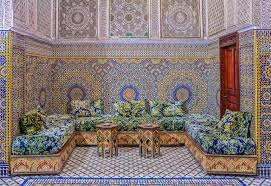
Beneath the domes of madrasas, in royal palaces or the riads of Fez and Marrakech, the glimmers ofMoroccan zelligetell a story: one of a craft passed down through the centuries, balancing patience, symmetry, and spirituality.
An Art Born from the Dialogue Between Andalusia and the Maghreb
Zellige has its roots in Hispano-Moorish art, developed in Andalusia before flourishing in Morocco starting in the 13th century, especially under the Marinid dynasty.
At this time, Moroccan artisans elevated this art to an unparalleled level of excellence, transforming ceramics into a unique artistic language.
Each piece, handcrafted, fits into a perfect geometric ensemble, inspired by the principles of Islamic spirituality:harmony, balance, and infinity.
Fez, the Cradle of Moroccan Zellige
It is inFez, the spiritual and artisan capital of the Kingdom, that zellige reaches its purest form.
In the workshops of the medina, themaâlems(master artisans) work according to an unchanging tradition:
-
The clay is shaped, dried, and then fired.
-
The tiles are then glazed and colored with natural pigments: cobalt blue, copper green, ochre, manganese black, or pure white.
-
Each piece is then cut with surgical precision before being hand-assembled like an infinite puzzle.
The result? Hypnotic compositions, where each pattern tells a piece of Morocco's story.
A Spiritual and Geometric Symbolism
Zellige is not just a decoration: it carries meaning.
The repetitive shapes and geometric patterns express asearch for spiritual perfection.
The circles evoke divine unity, the stars symbolize light, and the arabesques remind us of endless creation.
Thus, the art of zellige is also aform of artistic meditation, a quest for harmony between man, matter, and the divine.
From Heritage to Modernity
Long confined to mosques and palaces, zellige is now making its way into modern architecture and contemporary design.
Moroccan architects and decorators are reinventing this ancestral art by integrating it into minimalist spaces: hotel walls, fountains, tables, or urban facades.
International brands are now making it asymbol of luxury and authenticity, exporting Moroccan craftsmanship to every corner of the globe.
Preservation and Transmission
Listed in Morocco's intangible heritage, zellige enjoys initiatives to preserve its tradition.
Craft schools, such as those in Fez or Meknes, train young generations in this demanding art where every mistake is noticeable, but every success is breathtaking.
However, artisans are warning: faced with modernization and industrial production, traditional zellige must beprotected and valued, so that the hand of man continues to speak through the earth.
A Mirror of Eternal Morocco
Beyond its beauty, zellige is a reflection of Morocco: a country of balance between tradition and modernity, heir to a prestigious past and looking towards the future.
Each colored tile, each precise motif, reminds us that patience and passion are at the heart of Moroccan identity.
As an old proverb from the artisans of Fez says:
"Zellige does not lie: it retains the imprint of the one who shapes it."