Atop a mountain, clinging to a cliff, or hidden behind imposing stone walls, strange constructions still dominate the landscapes of southern Morocco. From afar, they resemble abandoned citadels. Yet, behind their small wooden doors and thick walls lies one of the most remarkable systems of community organization in Morocco’s history.
These structures are called igoudar, the plural of agadir in Amazigh.
Long before modern banks, secure warehouses, and insurance systems appeared, the Amazigh communities of Morocco had developed a collective solution to preserve their harvests, protect their valuables, and ensure their survival in times of drought, famine, or conflict.
These fortified granaries, some of which belong to an architectural tradition that is centuries old, today stand as exceptional testimonies of Moroccan heritage.
However, their significance goes far beyond that of mere historical monuments. The igoudar narrate a story of solidarity, customary rights, architectural ingenuity, and trust among community members.
Community banks long before their time
To understand the importance of igoudar, one must return to a time when wealth was not solely measured in currency.
In the mountainous and pre-Saharan regions of Morocco, harvests often constituted the primary capital of families. A good agricultural season could guarantee several months of food security, whereas prolonged drought could jeopardize the survival of an entire community.
Thus, preserving the harvest was a crucial issue.
The inhabitants built true collective citadels where each family had one or more storage cells.
These spaces could contain barley, wheat, dates, almonds, dried figs, honey, or oil.
Additionally, jewelry, property deeds, contracts, family documents, and sometimes weapons were stored there.
The agadir thus served multiple functions: a food granary, a safe, an archive depot, and a space for collective protection.
Each family kept its own belongings while the community ensured the security and maintenance of the whole.
This organization was based on a fundamental idea: the protection of individual wealth depended on collective effort.
Architecture designed to withstand
One of the most impressive aspects of the igoudar lies in their architecture.
Unlike buildings constructed solely for storage purposes, these granaries were designed to withstand external threats.
Their location was not left to chance.
Many of them were built on heights that were difficult to access, atop rocky promontories or cliffs overlooking valleys.
This position allowed them to monitor their surroundings while complicating intrusion attempts.
The walls were generally built with locally available materials: stones, earth, wood, and clay mortar.
Choosing these resources allowed the structures to blend naturally into their environment.
Some igoudar almost merge with the reliefs on which they were built, becoming difficult to see from the valley floors.
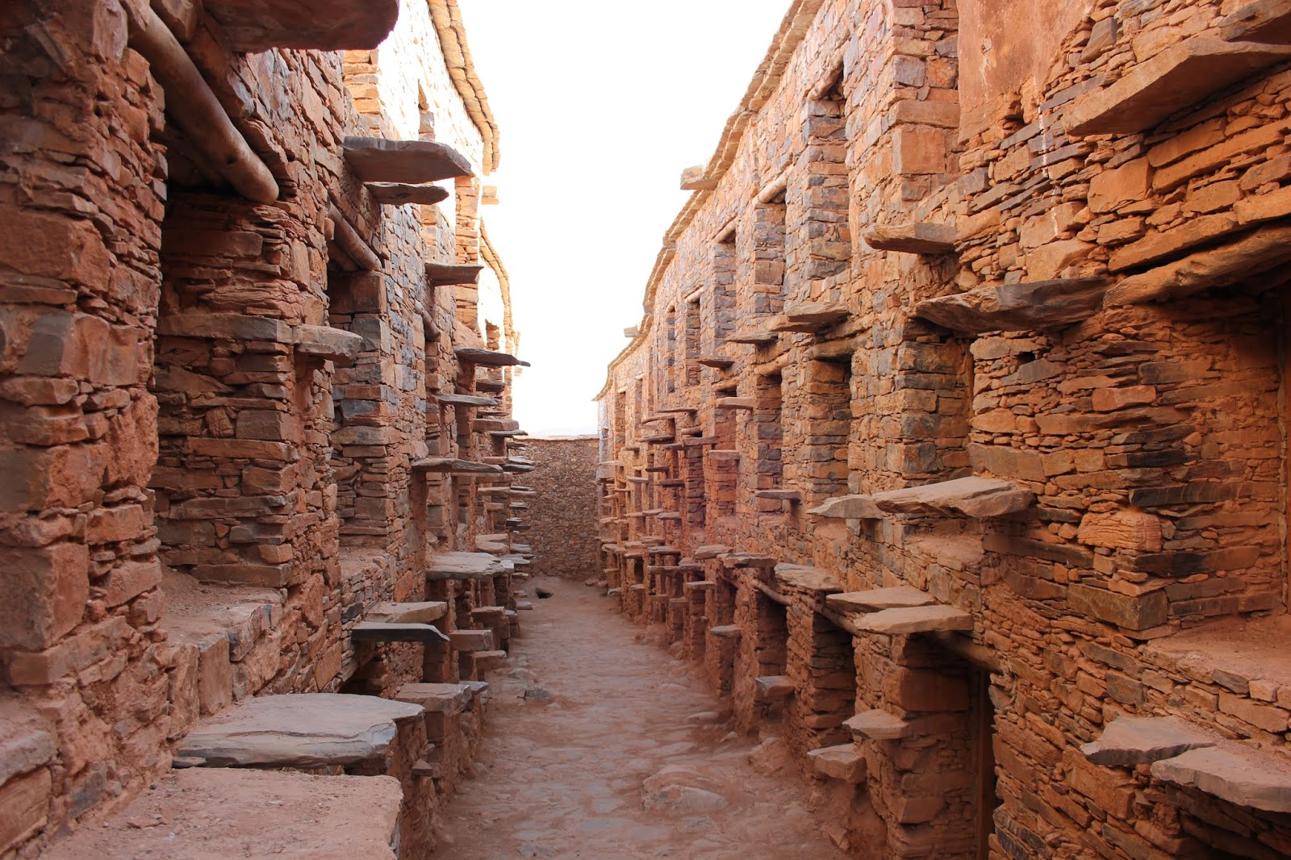
Inside, a network of narrow passages leads to dozens, sometimes hundreds, of storage cells.
The doors, often small, were made from solid wood and equipped with traditional locking systems.
Some complexes also had watchtowers, cisterns, prayer spaces, and installations for coping with sieges or isolation periods.
Everything was designed to combine protection, preservation, and daily use.
These structures bear witness to a remarkable understanding of the constraints of the terrain, climate, and building materials.
A management system governed by precise rules
The igoudar did not operate on improvisation.
Behind these constructions lies a community management system organized around established and recognized rules by the inhabitants.
Management could be entrusted to a responsible individual called the amin, tasked primarily with supervision and adherence to functioning rules.
In several communities, a council of notables, known as inflass, also participated in the administration of collective assets.
The rights of families, maintenance obligations, access methods, and penalties in case of violations were regulated by customary law.
These provisions were sometimes recorded in texts called louh or azerf.
Access to reserves could be regulated, storage operations monitored, and behaviors harmful to others' property penalized.
The aim was to avoid conflicts and preserve the trust necessary for the institution's functioning.
This organization illustrates an important characteristic of Moroccan rural societies: their historical capacity to establish common institutions tailored to their economic and social needs.
Long before the advent of modern administration, these communities had developed elaborate mechanisms to manage their resources.
Amtoudi, where granaries dominate the mountains
Among Morocco's most remarkable sites is Amtoudi, in the Guelmim province.
Nestled in a spectacular landscape, this oasis is dominated by rocky formations featuring several remnants of traditional defensive architecture.
Two complexes are particularly well-known: the agadir of Id Aïssa and that of Aguelly, also called Ugelluy.
Perched above homes and palm groves, these granaries seem to naturally extend the mountain.
Their geographical position immediately reveals the logic behind their construction: to see without being easily seen, protect the reserves, and monitor access routes to the valley.
The interior architecture reveals a precise arrangement of cells, corridors, and common spaces.
Stone walls, traditional frameworks, and rainwater collection systems demonstrate meticulous adaptation to local conditions.
The preservation of these edifices has particularly benefited from the work of Moroccan architect and anthropologist Salima Naji, who has been dedicated to preserving the architectural heritage of the Kingdom's south for many years.
Today, Amtoudi represents one of the places where this story can still be uncovered through monuments that have endured through the centuries.
Innoumar, a true storage city
In the Chtouka-Aït Baha region, south of Agadir, lies another particularly impressive complex: the agadir of Innoumar.
With its hundreds of storage cells spread over several levels and covering an area of around 5,000 square meters, it ranks among Morocco's grand traditional communal granaries.
Its interior alleys, aligned doors, and massive walls create the impression of wandering through a small fortified city.
Each space had a specific function.
The reserves of families were organized in a way that allowed for monitoring while keeping the goods secure.
The building also served as a meeting place and coordination space for community members.
The agadir of Innoumar thus illustrates a form of architecture in which economic, defensive, and social functions are closely intertwined.
It also demonstrates the ability of Moroccan artisans to design large complex ensembles without resorting to modern industrial techniques.
Places of solidarity and social cohesion
To reduce the igoudar solely to their storage function would overlook their historical significance.
These edifices also represented a social institution.
The preservation of harvests relied on a common organization, requiring residents to adhere to shared rules and contribute to the security of the reserves.
During difficult periods, the presence of food stocks could play a decisive role in the continuity of communal life.
However, the granaries also contributed to building trust relationships.
Their existence implied that families accepted to place part of their wealth under the protection of a collective institution.
This system, combining family ownership and community responsibility, constitutes one of the most interesting characteristics of the igoudar.
Some of these places also possessed a religious and symbolic dimension, linked to local traditions and the relationships maintained with the zaouïas.
The granaries were thus much more than buildings: they participated in the economic, legal, and cultural organization of the communities that created them.
A heritage that also tells the story of coexistence
The igoudar also testify to the historical diversity of Moroccan communities.
In some regions of the south, Muslim and Jewish families long participated in the same economic, commercial, and social networks.
The collective granaries were part of this environment where the security of goods, exchanges, and community rules helped organize daily life.
This dimension reminds us that Morocco’s history was not solely built around great dynasties and urban centers.
It was also shaped in villages, oases, and mountains, through local institutions capable of organizing relations among inhabitants.
The igoudar belong to this often lesser-known but essential history for understanding the depth of Moroccan heritage.
Construction techniques that still inspire today
At a time when contemporary architecture seeks to reduce its environmental impact, the igoudar offer an interesting example of building adapted to its territory.
Their builders primarily used local materials, thus limiting transportation needs.
The thick walls helped mitigate temperature fluctuations, while the buildings' placement exploited the natural features of the terrain.
In some sites, rainwater collection systems provided water for the cisterns.
Construction therefore addressed several simultaneous imperatives: protection of goods, climate adaptation, resource availability, and durability.
These edifices were not designed according to current environmental standards, but they reflect empirical knowledge developed over generations.
Their study is of interest today to architects, historians, and conservation specialists, particularly for the insights they provide on traditional techniques and the reasoned use of natural resources.
An exceptional heritage now at risk
Despite their historical importance, many igoudar are now threatened.
Rural exodus, changes in agricultural practices, and evolving storage systems have gradually reduced their traditional use.
Some buildings have been abandoned. Others have lost their guardians and the community mechanisms that once ensured their maintenance.
Erosion, heavy rainfall, and the aging of materials can accelerate their deterioration.
In February 2026, the condition of several historic granaries in the Middle Atlas, particularly in the provinces of Azilal and Béni Mellal, was the subject of a parliamentary inquiry.
Concerns were particularly focused on the impact of bad weather on certain structures, as well as the risks to their conservation.
These alerts remind us that preserving the igoudar cannot be limited to recognizing them as historical monuments.
It requires appropriate interventions, the mobilization of specialists in traditional architecture, and the involvement of local communities.
Because restoring an agadir is not merely about rebuilding walls.
It also involves preserving the skills, artisanal techniques, and social memory associated with the building.
Towards international recognition of igoudar heritage
Morocco has undertaken initiatives to better document and promote its collective granaries.
The ministry responsible for Culture has notably prepared a project aimed at their inclusion in the UNESCO World Heritage list.
This work highlights the diversity of these constructions, their geographical distribution, and their significance in the history of rural communities.
However, it is important to distinguish this heritage approach from a definitive listing on the World Heritage list.
Beyond international recognition, the challenge is to establish a sustainable conservation strategy.
The development of respectful cultural tourism at the sites could also contribute to their preservation.
The regions of Amtoudi, Aït Baha, Tata, and certain valleys of the Atlas hold significant potential for showcasing these monuments to Moroccan and foreign visitors.
Such valorization should, however, preserve the integrity of the buildings and benefit local populations.
The future of the igoudar will thus depend on the ability to reconcile heritage protection, cultural transmission, and territorial development.
Igoudar, a Moroccan lesson from the past
What makes the igoudar particularly remarkable is not just their antiquity or spectacular architecture.
It is primarily the philosophy that guided their creation.
In sometimes challenging environments, Moroccan communities understood that protecting resources required collective organization.
They built institutions that combined individual responsibility with community solidarity.
They established rules, appointed leaders, organized surveillance, and developed architectural techniques adapted to the territorial constraints.
These achievements testify to a form of social ingenuity as much as material skill.
Even today, as contemporary societies debate food security, resource management, and solidarity, the igoudar remind us that these concerns have traversed history for centuries.
In the mountains of Morocco, these silent fortresses continue to tell a profoundly human story.
One of families who, generation after generation, have chosen to protect together what ensures their future.
Thus, the igoudar are not mere remnants of the past. They are witnesses of collective intelligence, cultural richness, and the historical depth of Moroccan heritage.