Chronexium | October 30, 2026 — Sports, Economy, and Geopolitics
It is now official. The Dakar Rally will return to the African continent in January 2027, twenty years after its last edition held in Africa. Morocco will host most of this 49th edition, with eleven stages crossing the Kingdom from north to south, culminating in a spectacular arrival in Marrakech.
The announcement was made on Friday, October 30, by Amaury Sport Organisation (ASO), the organizer of the event, and confirmed by the Fédération Internationale de l'Automobile (FIA).
Originally planned in Saudi Arabia, Dakar 2027 was exceptionally relocated due to the worsening security situation in the Middle East.
This decision places Morocco back at the center of one of the most famous motorsport competitions in the world, with stakes that extend far beyond the sporting context.
Saudi Arabia forced to relinquish organization
Since 2020, Saudi Arabia had hosted the Dakar Rally, following eleven editions held in South America.
However, regional military tensions, exacerbated by the war involving Iran and the Houthi attacks on Saudi infrastructure, have profoundly changed security conditions.
On October 25, 2026, the organizers announced that the upcoming edition could not take place on Saudi territory after all.
Five days later, the new route was officially unveiled.
Portugal and Morocco were chosen to host the event, allowing the competition to return to some of its historical roots.
However, this is an exceptional transfer: the organizers confirmed their intention to return to Saudi Arabia in 2028 for the 50th edition of the Dakar.
A route of 7,824 kilometers, including eleven stages in Morocco
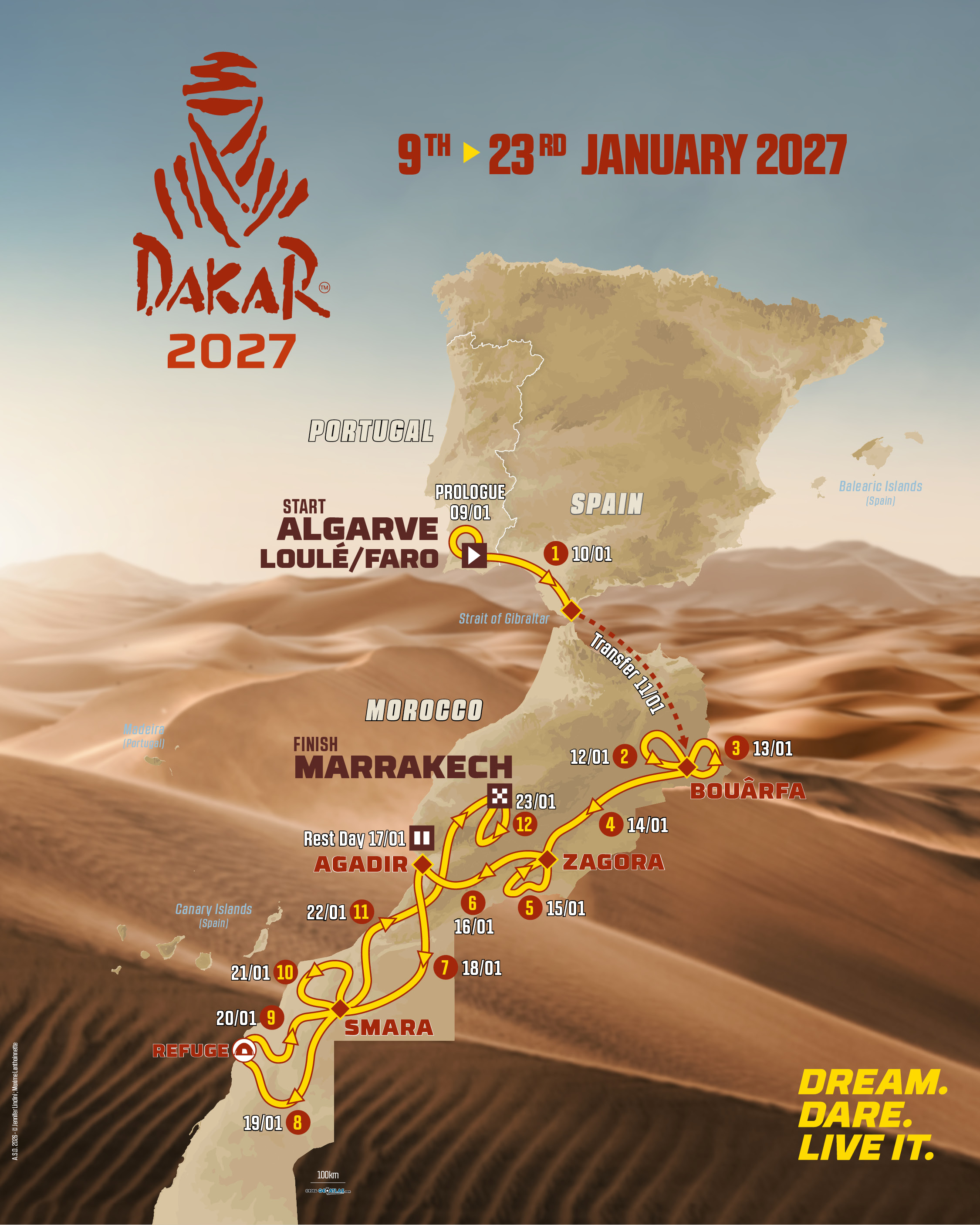
Dakar 2027 will take place from January 9 to 23, pending final validation of the schedule by the relevant authorities.
The departure will be given in Loulé-Faro, in the Algarve region of Portugal, with a prologue on January 9, and the first timed stage on January 10.
Competitors will then cross the Mediterranean to reach the port of Nador, Morocco, on January 11.
The caravan will head towards Bouarfa in the Oriental region, before continuing on to Zagora and Agadir.
After a rest day scheduled for January 17 in Agadir, the competition will enter its second phase, with particularly demanding stages in the desert regions of southern Morocco.
The route will pass through Smara and approach Dakhla before making its way back north, particularly along the Atlantic coast.
The final arrival will take place in Marrakech on January 23.
In total, teams will have to cover 7,824 kilometers, including 4,341 kilometers of timed specials, with six main bivouacs.
The most challenging stages can reach several hundred kilometers on particularly difficult terrain.
The Moroccan Sahara at the heart of the 2027 edition
One of the most remarkable elements of the unveiled route is the significant inclusion of the Moroccan Sahara.
The official map explicitly includes Smara and a passage near Dakhla among the key sectors of the second week.
For the Kingdom, this crossing represents significant importance in terms of international visibility.
Images of vehicles traversing desert landscapes, Sahara tracks, and Atlantic regions could be broadcast to a particularly large international audience.
The rally's passage also presents an opportunity to promote the infrastructure, landscapes, and tourism potential of the southern provinces.
On a diplomatic level, it intervenes in a context where Morocco continues to promote its autonomy initiative under Moroccan sovereignty.
However, it is essential to differentiate the media and symbolic significance of this route from the question of the international legal status of the territory, which is subject to a political process led under the auspices of the United Nations.
Beyond this dimension, the choice of Smara and the greater South showcases the ability of these territories to host a demanding international competition from a logistical and sporting perspective.
An exceptional showcase for Moroccan tourism
The potential benefits do not only concern the cities crossed.
The Dakar mobilizes drivers, mechanics, technical teams, journalists, commercial partners, and a significant logistical organization.
Accommodation, catering, transportation, fuel, maintenance, and event services are among the sectors likely to benefit directly from the competition's presence.
Marrakech, which will host the final arrival, could gain significant tourist visibility.
Agadir will benefit from the rest day, traditionally dedicated to vehicle maintenance and team recovery.
Bouarfa, Zagora, and Smara will also have the opportunity to feature in reports covering the competition.
Beyond immediate spending, organizing such an event serves as a tool for international promotion of adventure tourism and desert destinations.
However, no consolidated official estimates of the economic impacts of the 2027 edition have been published at this stage.
Morocco, a historic land of rally-raids
The return of the Dakar to Morocco is not coincidental.
The Kingdom has extensive experience in organizing off-road motor competitions, notably through the Morocco Rally, which is part of the rally-raid world championship calendar.
Its deserts, mountainous terrain, and long tracks provide the characteristics sought by organizers to test the endurance of teams and the reliability of vehicles.
Morocco had also hosted several historic editions of the Paris-Dakar, particularly in the early 2000s.
The last African edition took place in 2007, before the 2008 rally was canceled for security reasons and then moved to South America in 2009.
Twenty years later, Morocco regains a central role in the history of this competition.
For the Dakar director, David Castera, the speed of preparation should not lead to a reduction in the sporting demands of the event.
The organizers have thus retained a format comprising twelve stages and over 4,300 kilometers of timed sections.
An organizational challenge to be met in a few weeks
The scale of the event also poses a challenge.
Preparations must be completed within particularly tight deadlines, as there are just over two months before the start.
The authorities and relevant partners must coordinate issues of security, medical assistance, traffic, logistics, and protection of traversed natural spaces.
The maritime transport of vehicles and equipment between the Iberian Peninsula and Nador will be one of the key operations in the setup.
The Royal Moroccan Federation of Automobile Sports (FRMSA) is among the national bodies with recognized experience in supporting international competitions.
The organizers will also be able to rely on lessons from the Morocco Rally and the reconnaissance of the route conducted in recent weeks.
Weather conditions, participant safety, and preservation of the areas crossed will remain determining factors for the success of this edition.
More than a rally, an opportunity for the Kingdom's image
Dakar 2027 arrives at a time when Morocco is pursuing its strategy for developing infrastructure, tourism, and hosting international sports events.
After several years of absence from the African continent, the return of the competition represents a unique opportunity to highlight the Kingdom's organizational capabilities and the diversity of its territories.
From the Atlas Mountains to the tracks of the Moroccan Sahara, passing through Atlantic landscapes and the city of Marrakech, the route will showcase several facets of the country.
The importance of this edition also lies in the organizers' choice: faced with an increasingly uncertain security situation in the Middle East, Morocco and Portugal were selected to host one of the most demanding events in motorsport on very short notice.
Thus, Dakar 2027 will not only mark the return of a competition to Africa. It will also represent a major opportunity for Morocco to enhance its sporting, tourism, and international profile, with the Moroccan Sahara among the main stages of this adventure.