
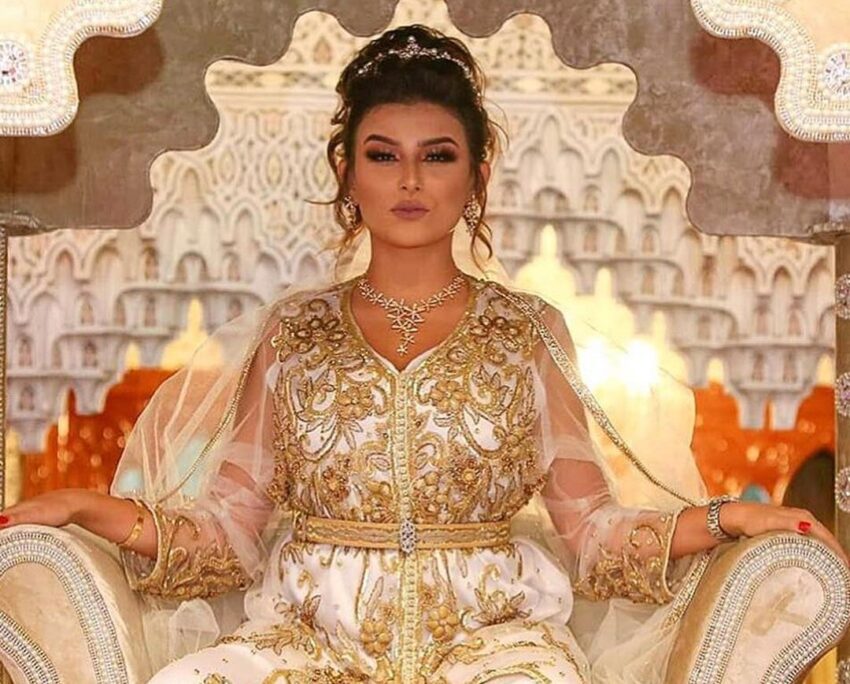
A royal garment at the heart of Moroccan history
The Moroccan caftan is one of the most prestigious traditional garments in the Arab and Muslim world. Its history in Morocco dates back over a millennium, to the time of the Almoravids and Merinids, when the kingdom's elites adopted court attire inspired by Andalusian refinement.
At that time, it was worn by sultans, princesses, scholars, and high dignitaries: a garment that symbolizes power, nobility, and educated culture.
Andalusian, Ottoman, and Persian influences
The Moroccan caftan is not a copy of a foreign model: it is a unique synthesis.
Over the centuries, it has absorbed several influences:
-
Andalusian, with their fine embroidery and understated elegance;
-
Persian, particularly for the long, straight cut;
-
Ottoman, for certain embellishment techniques;
-
Berber, for colors, patterns, and weaving techniques.
Morocco has transformed these heritages into an unmistakable style, instantly recognizable among all.
The evolution of the caftan in Moroccan dynasties
Under the Merinids and Saadians, the caftan became established in the palaces. It became an official garment worn at major ceremonies, religious holidays, and royal audiences.
With the Alaouites, its use gradually democratized in the major cities: Fez, Rabat, Meknes, Marrakech, and Tetouan.
Bourgeois families adopted the caftan for weddings, festivals, and receptions — making it a transgenerational garment.
A symbol of feminine elegance
The Moroccan caftan is intimately linked to feminine identity.
It is:
-
graceful,
-
long,
-
flowing,
-
adorned with complex embroidery (tarz),
-
fitted with a belt (mdamma) that accentuates the silhouette.
Worn during celebrations, it becomes a symbol of beauty, dignity, and family transmission.
In many families, a caftan is passed down from mother to daughter, carrying stories and memories.
The artisans' work: exceptional craftsmanship
Each caftan is a work of art requiring dozens of hours of labor.
Moroccan artisans perpetuate ancient techniques:
-
tarz maâlem (traditional embroidery),
-
sfifa (hand-braided trimmings),
-
aqaa or aâkad (traditional buttons),
-
randa (openwork embroidery),
-
tissage jbira,
-
beading and gold embroidery.
These techniques create a unique garment, of unmatched finesse.
The caftan: from family salons to international runways
Since the 1990s, the Moroccan caftan has left the family sphere and become a globally recognized piece.
Moroccan designers modernize cuts, materials, and colors while respecting traditional essence.
Prestigious fashion shows like "Caftan du Maroc" or Fashion Weeks give it global visibility.
Today, the caftan:
-
inspires the leading fashion houses,
-
is featured in collections by international designers,
-
and stands out as one of the most admired festive garments in the Arab world.
A vector of identity in the Moroccan diaspora
For Moroccan women living in Europe, the Middle East, or North America, the caftan is more than just a garment.
It is a direct link to their homeland, a symbol of roots, memory, and belonging.
It accompanies weddings, religious festivals, and family gatherings, marking cultural continuity despite distance.
Morocco, guardian of a living textile treasure
Even today, the caftan remains:
-
a heritage reference,
-
a national pride,
-
a cultural ambassador,
-
a vector of art and craftsmanship.
It traverses centuries without losing its sacred character: that of a garment that tells the story of Morocco, its influences, dynasties, and artisans.
Conclusion: a timeless symbol of Moroccan elegance
The caftan is not a fashion: it is a heritage.
It embodies Moroccan beauty in all its depth, blending ancient traditions with creative modernity.
Through it, an entire country continues to transmit its history, culture, and art of living.