
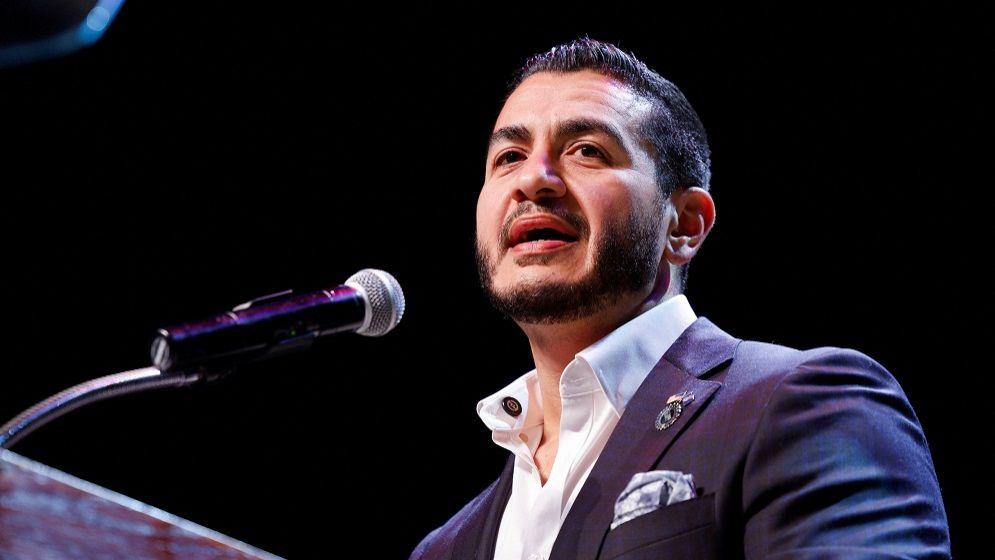
November 3, 2026, will remain a significant date in U.S. political history. For the first time since the creation of the American Senate in 1789, a citizen of the Muslim faith has been elected to the upper house of Congress. His name: Abdul El-Sayed, 42 years old, a Democrat, trained as a doctor, and the son of an Egyptian immigrant.
By winning the Senate seat from Michigan against Republican Mike Rogers, this former public health official takes a historic step. However, this electoral victory is primarily rooted in the journey of a man who gradually left the scientific world to engage in the major political and social battles of his country.
An American childhood with Egyptian roots
Abdul El-Sayed was born on October 31, 1984, in Michigan, into a family with multicultural origins. His father, Mohamed El-Sayed, left Egypt to settle in the United States, where he built his professional and family life.
Young Abdul grew up in the Detroit area, in a state profoundly marked by American industrial history. Michigan, the birthplace of automotive giants like Ford and General Motors, was undergoing significant economic and social transformations.
His childhood reflects that of an American of immigrant descent, caught between his family's cultural heritage and the realities of the society in which he grew up.
Being of the Muslim faith, he navigated an environment where issues of identity, religious diversity, and integration were of significant importance.
These elements would later become a visible dimension of his political career, although Abdul El-Sayed has always sought to position his commitment within concerns that transcend community affiliations.
A distinguished scientific background before politics
Long before becoming a senator, Abdul El-Sayed distinguished himself by his academic journey.
He first studied at the University of Michigan, graduating in 2007. His results earned him a Rhodes Scholarship, one of the most prestigious academic honors in the world.
This scholarship opened the doors to the University of Oxford in the UK, where he received a doctorate in public health.
He then continued his medical training at Columbia University in New York, graduating in 2014.
His specialty is epidemiology, a scientific discipline dedicated to studying diseases, their spread, and the factors that influence population health.
However, he chose not to pursue a traditional career as a practicing physician. His objective gradually shifted to addressing the social and economic causes of health issues.
He advocates the idea that access to care, income, environment, and living conditions play a critical role in the health status of citizens.
This conviction will constitute the foundation of his future political commitment.
Detroit, the laboratory of his public engagement
In 2015, Abdul El-Sayed became head of the Detroit Department of Health.
The city was going through an especially difficult period. After decades of deindustrialization, resident exodus, and budgetary struggles, it was attempting to rebuild itself following municipal bankruptcy.
As the head of the health administration, El-Sayed was involved in reorganizing public health services.
He focused on prevention, child health, the consequences of pollution, and health inequalities.
This experience allowed him to understand the mechanisms of public administration and the challenges faced by the most disadvantaged populations.
In 2017, he decided to leave his position to take a new step: entering politics directly.
An initial defeat that does not end his ambitions
In 2018, Abdul El-Sayed ran in the Democratic primary for the governor of Michigan.
His candidacy attracted attention from the progressive wing of the American Democratic Party.
He received support from Senator Bernie Sanders and Alexandria Ocasio-Cortez, two figures associated with the American left.
His platform advocated for universal healthcare, improved access to education, environmental protections, and reducing the influence of large corporations in politics.
However, he was defeated in the primaries by Gretchen Whitmer, who would later win the governorship.
Far from disappearing from the public scene, El-Sayed continued his engagement through publications, media appearances, and activities focused on health policies.
He also returned to administrative responsibilities by leading the health and social services of Wayne County, which includes Detroit, from 2022 to 2025.
This new experience bolstered his profile as a public official specialized in health and social protection issues.
A progressive voice within the Democratic Party
Abdul El-Sayed belongs to a generation of Democratic leaders who want to change the economic and social priorities of the United States.
He champions the principle of Medicare for All, a universal healthcare system that would supposedly guarantee healthcare access for all Americans.
He also advocates for higher taxes on the wealthy, limiting the power of economic monopolies, and reforming campaign financing.
For him, one of the main challenges of the American political system lies in the role played by private financial interests.
His 2026 Senate campaign largely reflects these themes.
In a context marked by concerns over purchasing power, healthcare spending, and housing costs, he attempts to mobilize voters around everyday economic issues.
His message particularly targets workers, the middle class, and households facing financial difficulties.
Palestine, a point of disagreement with part of his party
Foreign policy is another important aspect of Abdul El-Sayed's engagement.
He has particularly stood out through his criticism of Israeli policy in Gaza.
Opposed to continued American military aid to Israel, he believes Washington should reevaluate its international priorities and allocate more resources to the domestic needs of the American population.
He has also used the term genocide to describe Israeli military operations in Gaza.
These stances have caused significant divisions with certain Democratic leaders and organizations that support ongoing American assistance to Israel.
During the primaries, his candidacy faced strong political opposition and campaigns funded by external groups.
Despite these tensions, El-Sayed secured the Democratic nomination for Michigan on August 4, 2026, against Representative Haley Stevens.
This victory allowed him to confront Republican Mike Rogers in the November elections.
A highly charged electoral campaign
The battle for the Michigan Senate seat became one of the most closely watched races in the 2026 midterm elections.
Mike Rogers, a former member of Congress and ex-FBI agent, enjoys the support of Donald Trump.
The two candidates present very different visions for economic policies, healthcare, and international relations.
However, the campaign also takes on a religious dimension.
Abdul El-Sayed's Muslim faith becomes the target of political attacks. Some Republican officials seek to establish links between the Democratic candidate and Islamist organizations.
El-Sayed rejects these accusations, while several Democratic leaders decry the Islamophobic attacks.
Nonetheless, the Democratic candidate continues his campaign in industrial towns, working-class neighborhoods, and rural communities across Michigan.
He seeks to convince voters that issues of religion and origin should not overshadow the economic problems faced by American families.
November 3, 2026: entering history
After a particularly contested campaign, Abdul El-Sayed wins the Michigan Senate election against Mike Rogers.
He will succeed Democrat Gary Peters, who decided not to seek re-election.
This victory makes him the first Muslim elected to the U.S. Senate, an institution that consists of one hundred members representing the fifty states of the country.
The event holds significant symbolic importance.
While several Muslim figures have been elected to the House of Representatives, none had previously won a Senate seat.
For American Muslims, whose presence in the country dates back several generations, this election marks a new milestone in national political representation.
It also comes at a time when Democrats made gains in the 2026 midterm elections, allowing them to regain control of both houses of Congress.
A senator facing the realities of power
However, the electoral victory is just the beginning of a new chapter for Abdul El-Sayed.
By joining the Senate, he must now transform his political commitments into legislative proposals and work with elected officials whose views may differ significantly from his own.
Reforming the American healthcare system, taxing the wealthy, and limiting private campaign financing remain deeply debated topics in Washington.
His position on foreign policy, particularly regarding Israel and the Middle East, may also lead him to advocate for views different from those of some of his Democratic colleagues.
The doctor and former public administrator will thus have to adapt to the compromises and negotiations that characterize the workings of the American Congress.
From the son of an immigrant to U.S. senator
At 42, Abdul El-Sayed embodies a unique journey in American political history.
He is the son of an Egyptian immigrant who grew up in Michigan, received an international academic education, led public administrations, and ultimately won a major federal election.
His ascent to the Senate also reflects the demographic and political shifts in an American society where citizens from diverse cultural and religious backgrounds are gradually ascending to the highest responsibilities.
But beyond the historical dimension of his election, his true legacy will now depend on the decisions he makes and the reforms he manages to advance.
One thing is already certain: Abdul El-Sayed's name is now etched in the history of the American Senate, as the first Muslim elected to this institution after more than two centuries of existence.