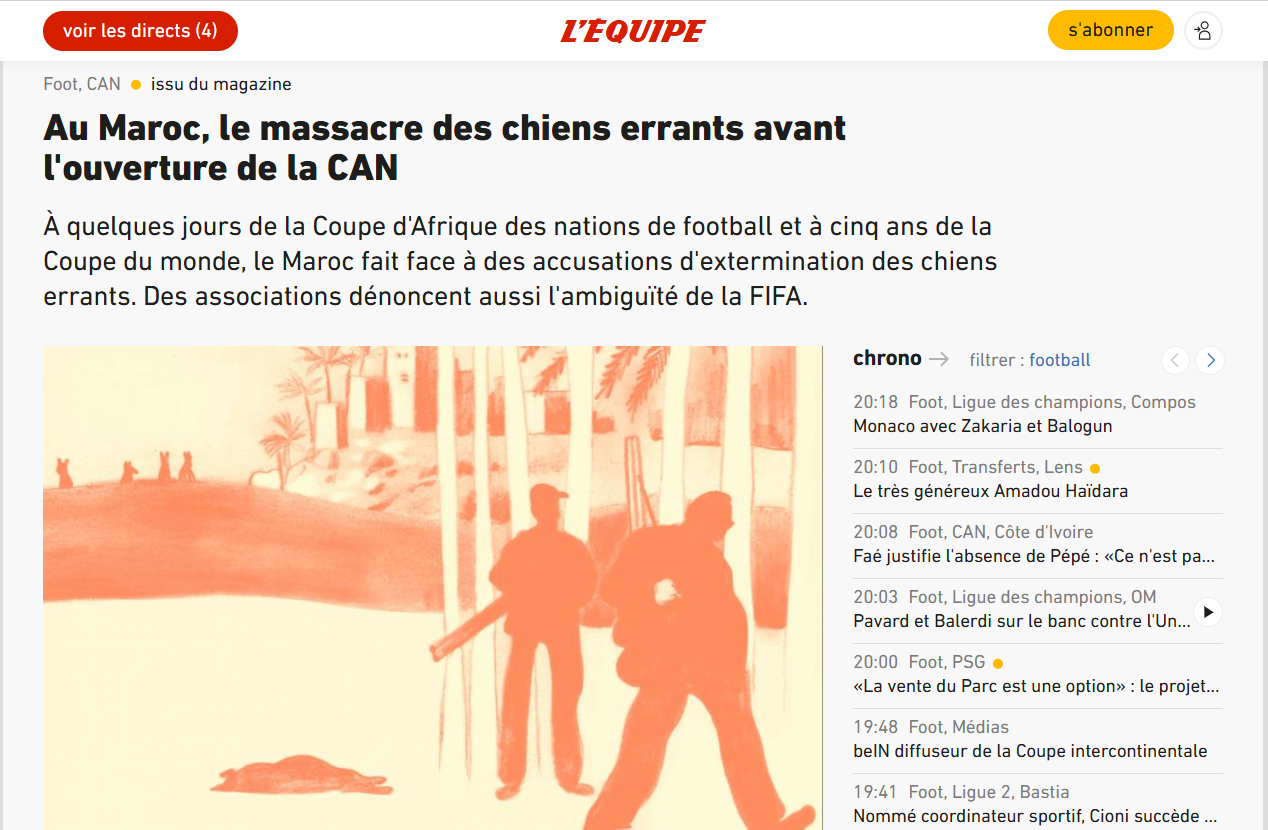
What L'Équipe's article discusses
In its article about Morocco, L'Équipe claims that just days before CAN 2025, the country would be witnessing a 'massacre of stray dogs'. The text relies on testimonials from international NGOs, mentions shocking images of animals being killed, and links these alleged practices to the preparation for the tournament, as well as to the 2030 World Cup. For a reader unfamiliar with the subject, the clear implication is that the Moroccan state is organizing or tolerating a vast extermination plan tied to major football events.
NGO accusations: necessary alerts, inflated figures
For several months, animal protection associations – both Moroccan and foreign – have raised alarms about cases of violent killings of stray dogs in certain cities. They report shootings, poisonings, and 'nocturnal cleanings'. Their role as watchdogs is real and has helped document brutal or illegal practices. However, part of their narrative is based on very high estimates, sometimes presented as certainties: several million dogs 'promised to slaughter' by 2030, without any official document confirming the existence of such a national plan. Thus, we find a mix of localized facts, projections, and activist scenarios.
The official position of Morocco
In response to this surge of accusations, Moroccan authorities have spoken out. The Kingdom has formally denied the existence of a massive euthanasia plan linked to the 2030 World Cup or CAN 2025, calling the allegations unfounded. Legally, several developments contrast with the term 'massacre': an interministerial agreement adopted in 2019 references the TNVR method (trap, neuter, vaccinate, return), a circular from the Ministry of the Interior instructs municipalities to abandon the use of bullets and poisons, and a specific law project on stray animals and animal welfare has been drafted. On paper, the official line is not one of systematic extermination, but of regulated management, even if implementation remains highly imperfect.
A structural problem, pre-dating the CAN
The issue of stray dogs in Morocco did not begin with CAN 2025. It lies at the heart of long-standing tensions between public health, safety, tourism, and the defense of animal welfare. Residents complain about bites, aggressive packs, and cases of rabies; local elected officials sometimes resort to the quickest solution by permitting culling campaigns, often without centralized oversight. These practices existed well before Morocco became the center of African and global football attention. Competitions serve as a media accelerator, but they do not create the problem.
Where L'Équipe's article goes too far
The main criticism of the article is not that it ignores animal suffering – which is real – but that it presents as near-certain what largely falls under accusation. By associating, even in the title, the notion of 'massacre' with the preparations for CAN, the text implies that this is a concerted policy of the Kingdom, tailored for the event. However, the available evidence portrays a more fragmented landscape: on one side, a legal framework evolving toward a more regulated approach; on the other, local excesses, illegal practices, and uneven implementation of national directives. By not clearly distinguishing these levels, the article fosters confusion that undermines a proper understanding of the issue.
Finding a balance between animal welfare, public health, and international image
Acknowledging the exaggerations in some headlines should not lead to downplaying on-the-ground issues. Morocco faces a real challenge: reducing health and safety risks related to stray dogs while adhering to increasingly demanding animal protection standards, particularly in the eyes of international opinion. The success of CAN 2025 and, later, the 2030 World Cup will also hinge on this credibility. But the solution lies in coherent public policies, resources for municipalities, partnerships with associations, and greater transparency, rather than through communication campaigns that accuse or defend one camp or another.
As it stands, L'Équipe's article raises a valid question – how does Morocco manage its stray dogs in the context of major competitions? – but answers it through a highly activist lens, where hyperbole overshadows nuance. The debate deserves better: sourced figures, a clear distinction between local excesses and national policy, and acknowledgment of the still-unfinished efforts to move away from a logic of permanent crisis.