
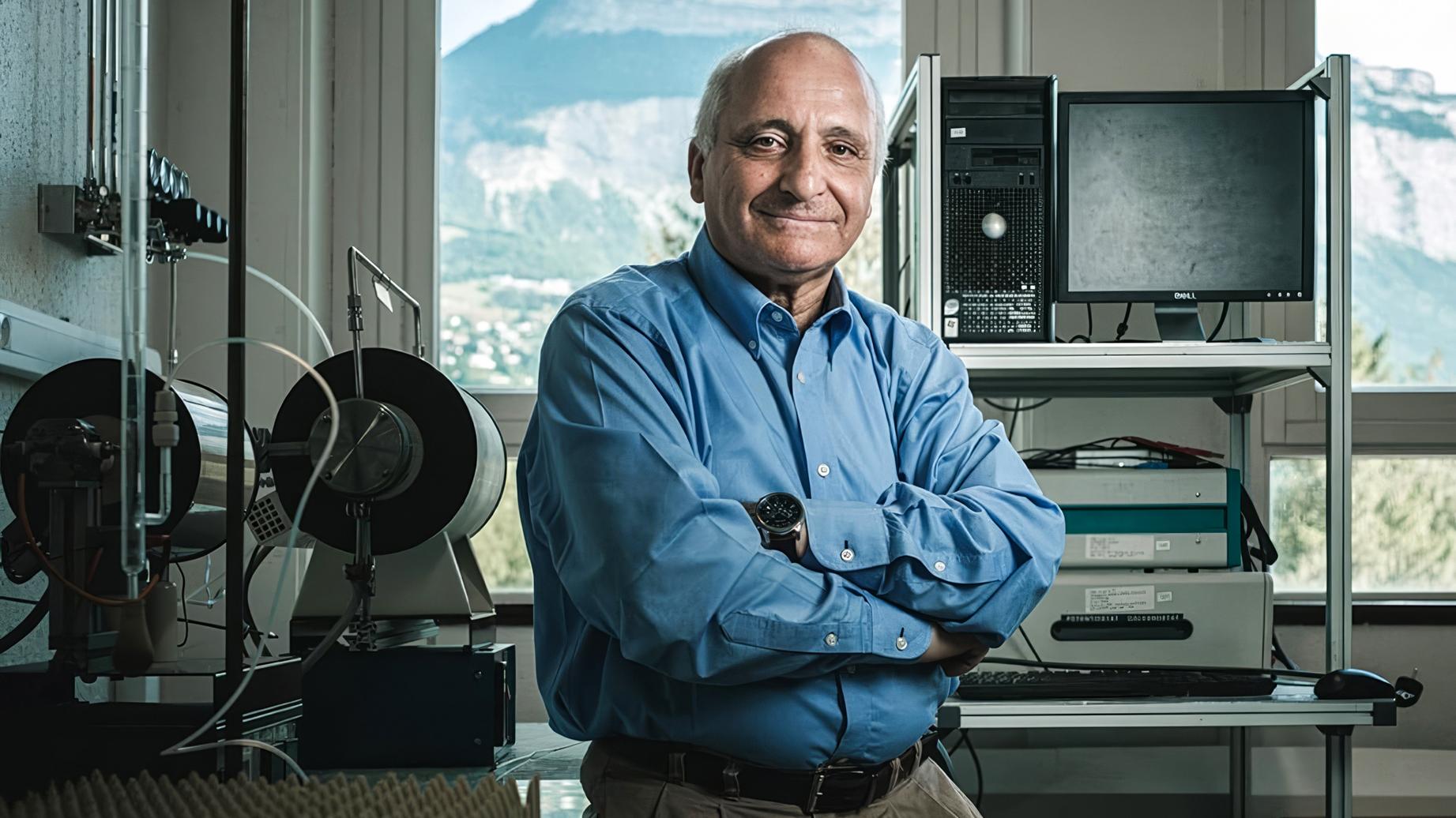
There are individuals whose inventions change the course of history without their names necessarily being known to the general public. Scientists whose discoveries impact billions of people each day through essential objects. Rachid Yazami belongs to this exceptional category.
Behind smartphones, laptops, and electric vehicles lies a technological revolution to which this Moroccan researcher has made a fundamental contribution.
Born in Fez in 1953, Rachid Yazami is now regarded as one of the pioneers of modern lithium-ion batteries. His journey, from his early years in Morocco to the most prestigious international laboratories, embodies a scientific success that transcends the borders of the Kingdom.
From Fez to top French schools: the birth of a vocation
Rachid Yazami was born on April 16, 1953, in Fez, one of Morocco’s great historical and intellectual capitals.
From a young age, he showed a particular interest in science and natural phenomena. Geology, in particular, sparked his curiosity and gradually nurtured his taste for observation and experimentation.
After his early years of study in Morocco, he continued his education in France, where he attended the National Polytechnic Institute of Grenoble, a renowned institution for scientific and technical education.
He obtained his engineering degree in 1978, before completing a doctorate in 1985, focusing on the materials and electrochemical phenomena involved in lithium batteries.
At that time, no one could foresee the extent of what his research would bring to the world.
1980: the discovery that would change history
The late 1970s marked a decisive turning point in the career of the young Moroccan researcher.
In 1979 and 1980, while working on the electrochemical properties of graphite, Rachid Yazami demonstrated that it was possible to insert lithium ions into this material and then extract them reversibly.
Behind this scientific formulation lies a considerable discovery.
Graphite can now be used as a negative electrode, known as the anode, in a rechargeable lithium battery.
This advancement paves the way for the design of more efficient batteries capable of storing energy and undergoing many recharge cycles.
However, it should be noted that the modern lithium-ion battery is the result of several major scientific contributions. The research of John Goodenough, Stanley Whittingham, and Akira Yoshino has also been essential in its development.
But Rachid Yazami's contribution is critical: the graphite anode he developed is one of the fundamental components of the technology now used worldwide.
A discovery made by a young Moroccan who was only 26 years old at the time.
An invention found in billions of devices
The impact of this discovery extends far beyond university laboratories.
From the 1990s onward, lithium-ion batteries experienced rapid industrialization. Their ability to store a significant amount of energy in a small volume has transformed consumer electronics.
Mobile phones, laptops, cameras, medical equipment, and, more recently, electric cars: applications are multiplying.
The graphite anode resulting from Yazami's research has become one of the most widely used technologies in this industry.
This is the uniqueness of his journey: having contributed to an innovation whose impact is now measured in billions of devices and profound transformations of our daily habits.
The man from Fez has helped make possible a part of our connected world.
From CNRS to NASA: an international scientific career
After his foundational work in Grenoble, Rachid Yazami continued his career at the National Center for Scientific Research, CNRS, in France.
There, he developed his research on electrochemical materials and took on significant scientific responsibilities.
His expertise gradually attracted the attention of major international institutions.
He notably collaborated with the California Institute of Technology, the prestigious Caltech, on work related to NASA's Jet Propulsion Laboratory.
This experience allowed him to expand his research to energy storage technologies suitable for demanding environments.
His career then took on a new dimension in Asia.
From 2010 onwards, he joined Nanyang Technological University in Singapore, where he participated in research programs focused on batteries and new energy technologies.
Over the decades, his scientific activity has resulted in several hundred publications and over 150 patents or patented inventions.
An exceptional output that reflects the consistency of his research.
The scientist who refuses to stop at his first discovery
For Rachid Yazami, the invention of the graphite anode has never constituted a final achievement.
Far from being satisfied with this historic contribution, he continues his work on new generations of batteries, their safety, lifespan, and recharge speed.
In Singapore, he is involved in the development of KVI, a company specializing in battery technologies and charging management systems.
One of his most noted research areas concerns ultra-fast charging.
The ambition is bold: to significantly reduce the time required to recharge batteries while managing thermal constraints and preserving their longevity.
His work focuses on recharge methods using adapted electrical profiles and intelligent monitoring systems.
These technologies open significant perspectives for electric mobility, although their large-scale industrial deployment still depends on many technical and economic parameters.
At over 70, the Moroccan researcher continues to engage with the major energy issues of the 21st century.
2014: global recognition with the Draper prize
Rachid Yazami's international recognition took on a special dimension in 2014.
That year, he received, alongside John Goodenough, Stanley Whittingham, and Akira Yoshino, the prestigious Charles Stark Draper Prize awarded by the National Academy of Engineering of the United States.
This distinction, often presented as one of the most prestigious engineering awards in the world, honors their contribution to the development of rechargeable lithium-ion batteries.
For the Moroccan scientist, this recognition comes more than three decades after his initial discoveries.
It confirms the historical importance of his work.
That same year, he was also honored in Morocco for his scientific achievements.
Other awards have enriched his journey, including the French Legion of Honor, the Takreem award for scientific and technological innovation, and the VinFuture Grand Prize, received in 2023 in Vietnam alongside other battery pioneers.
These distinctions place Rachid Yazami among the great names in international energy storage research.
The Nobel, a distinction that eluded him
In 2019, the Nobel Prize in Chemistry was awarded to John Goodenough, Stanley Whittingham, and Akira Yoshino for their contributions to the development of lithium-ion batteries.
The absence of Rachid Yazami among the laureates raised questions, especially in Morocco.
His discovery of the graphite anode, however, represents a major contribution to this technology.
This absence, however, does not undermine the scientific value of his work.
The Nobel Prize cannot be shared among more than three people for the same award, and the choice of laureates is determined by the institutions responsible for its awarding.
The 2014 Draper Prize remains, in this regard, a particularly strong testament: it collectively recognized the contributions of Yazami and the three future Nobel laureates.
The history of science is not just a list of awards. It is primarily written through discoveries that transcend generations.
A Moroccan dedicated to his nation’s scientific development
Despite a career built between France, the United States, and Singapore, Rachid Yazami maintains close ties with Morocco.
Through his public engagements, he regularly advocates for the importance of scientific education, research, and industrial innovation.
His ambition goes beyond mere tribute to an individual success.
He wishes to see a real ecosystem dedicated to batteries, energy technologies, and applied research emerge in Morocco.
This vision resonates particularly as the Kingdom develops its automotive industry, attracts investments in electric mobility, and seeks to strengthen its position in the value chains of new technologies.
Morocco possesses significant industrial and human assets. However, transforming these advantages into technological strength requires sustained investment in research, skills, and intellectual property.
Yazami's journey precisely reminds us that the true wealth of a nation also lies in its capacity to produce knowledge and innovations.
An inspiration for Moroccan youth
Beyond his inventions, Rachid Yazami represents a model of perseverance and excellence.
His journey demonstrates that a young Moroccan passionate about science can access the world’s foremost laboratories and contribute to major technological transformations.
In an era where fame is often built around entertainment or media exposure, his journey reminds us that there are other forms of greatness.
Those that arise from patience, intellectual labor, experimentation, and research.
His successes send a message to a whole generation: great inventions are not reserved for a few nations, and Moroccan scientific talent can contribute to the progress of humanity.
Rachid Yazami, a Moroccan scientific pride and a universal legacy
There are personalities whose work transcends their time. Rachid Yazami is among those who have contributed to permanently transforming the world.
Without his contribution to the graphite anode, the story of rechargeable batteries would likely have taken a different path.
His name will remain associated with one of the essential technologies of the digital revolution and the energy transition.
For Morocco, he embodies much more than personal success: he symbolizes the capacity of Moroccan scientists to play a leading role in global advancements.
And perhaps that is his most precious legacy.
To have demonstrated that a discovery born from the curiosity of a young researcher from Fez could, a few decades later, contribute to the functioning of billions of devices around the planet.
Rachid Yazami did not just accompany a technological revolution. He helped make it possible.