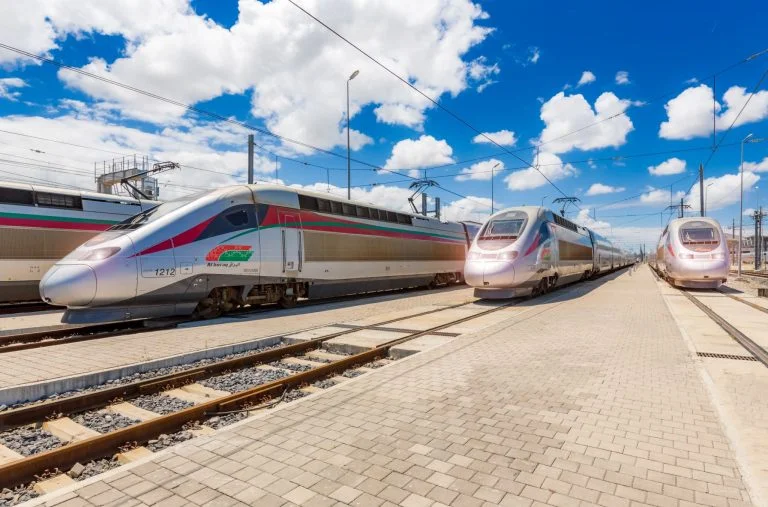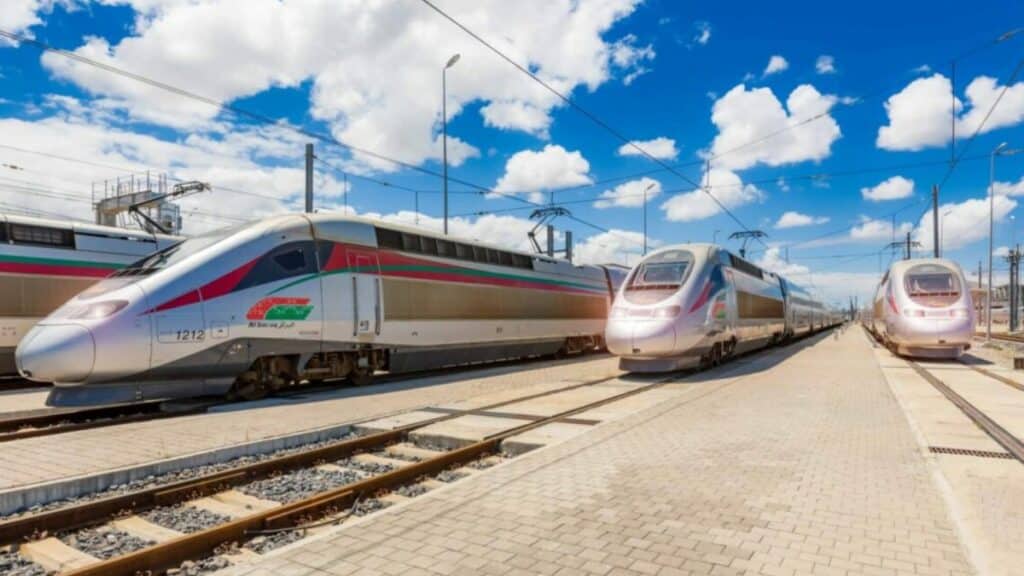
When in November 2018, Morocco inaugurated its first high-speed line,Al Boraq, connecting Tangier to Casablanca in two hours, it became the first African country to have an operational high-speed train.
Six years later, the kingdom is preparing to write a new chapter in this rail adventure: the extension of the line to Marrakech, one of the country's most iconic cities and a cornerstone of national tourism.
This project is not merely a technical feat: it embodies a vision of a connected, competitive, and sustainable Morocco, where mobility becomes a vector for regional and social development.
1. A structuring project for national mobility
The extension of the high-speed line Casablanca–Marrakech, measuring nearly 320 kilometers, is one of the largest infrastructure projects in the country.
Led by the National Office of Railways (ONCF), it aims to reduce the travel time between Rabat and Marrakech to only 2 hours and 30 minutes, down from over 4 hours currently.
Construction work, set to officially begin in 2026, is part of the ongoing north-south rail corridor, which will ultimately connect Tangier to Agadir.
This infrastructure will transform the country's economic geography: it will bring tourist, industrial, and administrative hubs closer together, while supporting decentralization and territorial cohesion.
2. Marrakech, future rail hub of Morocco
The ochre city is not only the kingdom's leading tourist destination: it will become the new strategic rail junction of southern Morocco.
The future high-speed station in Marrakech, envisioned as an intermodal hub, will connect with regional lines and urban transport.
Beyond tourism, this infrastructure will foster trade between Marrakech, Casablanca, and Tangier, and support the development of industrial zones in Haouz and Chichaoua.
It is also expected to reduce logistics costs and enhance Morocco's attractiveness to investors.
The project is accompanied by a urban redevelopment program around the stations and tracks, featuring green spaces, tertiary hubs, and housing connected to public transport.
3. An ecological and energy ambition
One of the project's major advantages lies in its reduced ecological footprint.
Morocco has chosen to make high-speed rail a tool for green mobility, relying on 100% electrification and power supplied from renewable sources.
According to the ONCF, over 90% of the energy used for the high-speed train already comes from wind and solar, a figure that is expected to increase with new energy parks in the south.
The extension to Marrakech aligns with the national strategy for decarbonized mobility, contributing to the reduction of CO₂ emissions in intercity transport.
This approach positions Morocco as a pioneering African leader in sustainable mobility, alongside the most advanced European countries.
4. A project with significant socio-economic impact
Beyond the technical feat, the high-speed rail is a social project.
Its extension to Marrakech is expected to create around 15,000 direct and indirect jobs during the construction phase, and stimulate local employment in services, maintenance, and tourism.
The economic benefits are considerable: increased tourist traffic, revitalization of interregional trade, and development of high-speed freight transport.
The impact will also extend to the rural areas along the route, with integration and training programs for young people.
Morocco thus reaffirms its intention to use infrastructure development as a lever for national inclusion, rather than a luxury reserved for metropolitan areas.
5. Strengthening Moroccan expertise
If the first high-speed rail line heavily relied on foreign partners, particularly from France, Morocco is now building on growing local expertise.
The engineers, technicians, and consulting firms involved in Al Boraq will play a central role in this new phase.
More than 60% of the project will be carried out by national expertise, according to estimates by the ONCF.
This increasing capability of Moroccan expertise in major construction projects fits into a broader strategy: that of technological and industrial sovereignty.
The kingdom also aims to export this expertise to Africa, particularly through railway partnerships with countries like Senegal, Côte d'Ivoire, and Nigeria.
6. Challenges: funding and coordination
Despite its ambitions, the high-speed rail project to Marrakech faces several challenges.
The total cost is estimated at over 50 billion dirhams, a colossal amount requiring public-private partnerships and international financing.
Morocco is already exploring avenues with the African Development Bank, the World Bank, and several European partners.
Coordinating the work with other infrastructures (roads, urban planning, energy) will pose another major challenge.
However, the successful experience of the Tangier–Casablanca line is reassuring: Morocco has already demonstrated its ability to deliver large-scale projects on time and to international standards.
7. A showcase for the Morocco of the future
The extension of the high-speed rail to Marrakech goes beyond just being a railway project.
It symbolizes the vision of a modern Morocco, rooted in sustainability, efficiency, and shared mobility.
It also sends a signal to Africa: a development model where innovation and inclusion mutually reinforce each other.
The rail thus becomes more than just a means of transport: it is an instrument of national cohesion and continental influence.
Conclusion
With the extension of the high-speed rail to Marrakech, Morocco affirms its status as a pioneering African leader in sustainable mobility.
This project, at the crossroads of technology, ecology, and social development, illustrates the kingdom's ability to think big while building locally.
Tomorrow, traveling from Tangier to Marrakech in a few hours will not only be a comfort: it will be the symbol of a dynamic Morocco, fast, green, and confident in its future.
Sources:
-
ONCF – Morocco High-Speed Rail Extension Program 2025–2035
-
Ministry of Equipment and Water – Infrastructure Report 2024
-
African Development Bank – Transport & Mobility Report 2024
-
World Bank – Morocco Infrastructure Outlook 2030
-
Reuters / MAP – Strategic railway projects in Morocco