
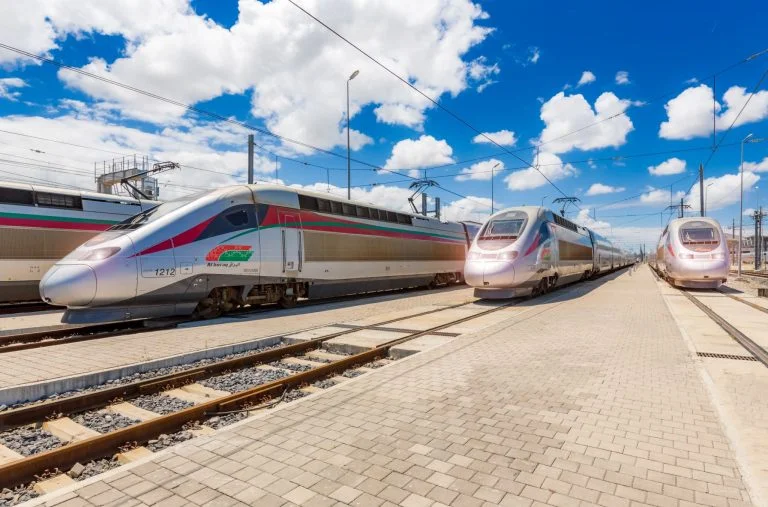
The African Railway is Experiencing a Renaissance
Long neglected, African rail transport is undergoing a true resurrection.
From Lagos to Nairobi, and from Dakar to Abidjan, projects are multiplying to connect major capitals and support intra-African trade.
The African Continental Free Trade Area (AfCFTA) is stimulating these initiatives by promoting extensive logistical integration.
Yet, behind these colossal projects, one observation stands out: the continent needs expertise, funding, and technology. This is where Morocco comes into play.
Morocco's Experience as a Diplomatic Lever
With the inauguration of the Tanger–Casablanca high-speed line in 2018, the first of its kind in Africa, Morocco demonstrated its ability to design, finance, and operate a modern railway network.
The ONCF (National Office of Railways) is now considered a regional model in terms of governance and performance.
This expertise becomes a diplomatic tool.
Countries like Senegal, Mali, and Niger have sought Moroccan technical support for their national and cross-border line projects.
Morocco is thus leveraging its know-how for South-South cooperation, in line with the royal vision of an integrated and connected Africa.
Structural Projects on the Horizon for 2030
Morocco is not just exporting its expertise: it is strengthening its own network.
The Casablanca–Agadir high-speed train project, for which studies are underway, is expected to enhance the national territory's connectivity and pave the way for a future extension to Mauritania.
Ultimately, the kingdom aims to participate in the creation of an Atlantic railway corridor, linking Tanger to Lagos via the West African coast.
This continental vision is supported by economic diplomacy:
-
The Dakhla Atlantic Port as a logistical hub,
-
The Nigeria–Morocco gas pipeline as an energy axis,
-
And the future Trans-Saharan railway network as the backbone of intra-African trade.
Challenges in Line with Ambitions
Despite progress, several challenges remain: financing, standardization of infrastructures and political stability in some regions hinder African railway integration.Morocco is relying on a model of public-private partnerships
and strategic alliances with institutions like the African Development Bank (AfDB) and the World Bank to overcome these obstacles.Another challenge is technological: how to integrate innovations — solar energy, artificial intelligence, predictive maintenance — into a sustainable continental network?Conclusion: Morocco on the Path to African Leadership
African railways are no longer an engineer's dream but a geopolitical project.
By combining
technical expertise and proactive diplomacy
, Morocco is establishing itself as a structural player in the connected Africa of tomorrow.By 2030, the kingdom could well become not only a commercial hub but also the leader in sustainable African mobility
.Sources:.
ONCF – Strategic Report 2025
-
African Development Bank – Study on Regional Mobility (2025)
-
Moroccan Ministry of Transport and Logistics – Roadmap 2030
-
AfCFTA – Annual Report on Continental Infrastructure.
-
.