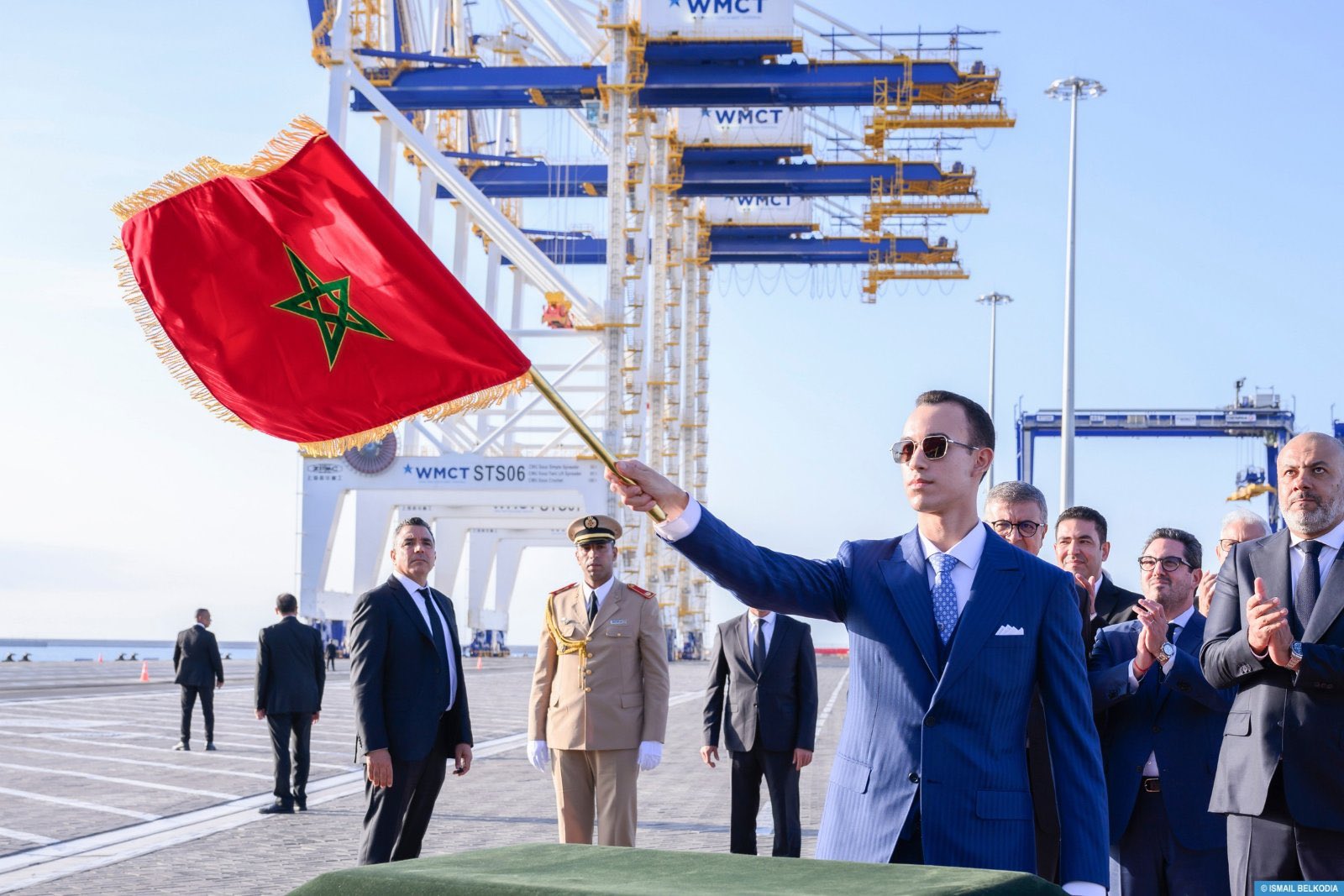
Morocco reaches a new milestone in the development of its port infrastructure. On Saturday, October 31, 2026, Crown Prince Moulay El Hassan kicked off operations for the first container terminal at the Nador West Med complex in the municipality of Iaâzzanène, Nador province. This event marks the beginning of the gradual operation of one of the Kingdom's most significant industrial and logistical projects.
On the High Instructions of King Mohammed VI, the Crown Prince presided over an official ceremony attended by several government members, institutional leaders, and executives from major international maritime groups.
The highlight of this ceremony was the launch of the first unloading of a container from a commercial ship at the East terminal of Nador West Med.
This gesture marks the effective start of operations for this initial facility and the opening of a new phase for the economic development of the Oriental region.
An investment of 54 billion dirhams
Nador West Med represents a 54 billion dirham investment program, combining public and private financing.
Located on Morocco's Mediterranean coast, the complex is designed to accommodate port, industrial, logistical, and energy activities.
The goal is to create a platform capable of handling significant volumes of goods, supporting international trade, and attracting new industrial activities.
The project includes several specialized terminals, logistics spaces, and infrastructure connections with the national transport network.
Ultimately, Nador West Med is expected to become one of the main economic hubs in the northeast of the Kingdom, complementing the Tanger Med complex.
The East terminal officially begins operations
The terminal inaugurated this Saturday is the first major operational component of the complex.
It has 1,520 linear meters of quays, a draft of up to 18 meters, and 70 hectares of backfill land.
These features allow it to accommodate large container ships and participate in international transshipment operations.
The investment allocated to this facility is estimated at five billion dirhams.
Its capacity is expected to reach 3.5 million containers by 2030.
The operation and maintenance of the terminal are entrusted for 25 years to a partnership involving Marsa Maroc and Terminal Investment Limited (TIL), a subsidiary of the MSC maritime group.
The presence of MSC executives at the ceremony highlights the role of international operators in enhancing this new Moroccan platform.
A second terminal expected in 2027
The opening of the East terminal is just the first step in putting the complex into service.
A second container terminal, named the West terminal, is set to begin operations in April 2027.
This facility, with an estimated cost of around three billion dirhams, will feature 900 meters of quays and 38 hectares of backfill land.
Its announced capacity is 1.8 million twenty-foot equivalent units (TEU), the standard unit for container shipping.
The terminal will be operated under a concession granted to a partnership between Marsa Maroc and CMA CGM, another major global player in maritime transport.
With the gradual operation of both facilities, the overall announced capacity of the port is expected to reach approximately 5.3 million containers.
Nador West Med would then have infrastructure capable of accommodating a significant share of maritime flows between Europe, Africa, and Asia.
An energy hub at the heart of the project
Beyond containers, Nador West Med also has an energy dimension.
The complex includes a petroleum terminal with a projected capacity of 25 million tons, expected to be operational by April 2027.
A liquefied natural gas terminal, with an anticipated capacity of five billion cubic meters, is also part of the program.
This section could contribute to diversifying the Kingdom's energy supply infrastructure.
However, the timeline for the gas terminal remains to be clarified. The procedure for a regasification unit, launched in December 2025, was suspended in early 2026.
Thus, not all energy components of the project are yet operational.
Thousands of jobs expected in the Oriental
The stakes of Nador West Med go far beyond port activities.
The project includes a significant industrial and logistics platform of 700 hectares, expected to attract private investments estimated at 12 billion dirhams.
According to official projections, the development of the complex and its ecosystem should create approximately 14,000 direct jobs and 20,000 indirect jobs in the short term.
These figures represent announced objectives, not a record of jobs already created.
For the province of Nador and the entire Oriental region, this prospect holds particular economic importance.
Port activities can promote the emergence of companies in transport, logistics, maintenance, handling, and industrial services.
Programs for vocational training adapted to the new jobs are also planned to facilitate the integration of young people into these sectors.
The success of the project will depend largely on the ability of local companies and residents to benefit from this new economic dynamic.
Road and rail infrastructure to connect the port
A port of this magnitude requires effective connections with its hinterland.
The program includes a 49-kilometer rail link between Selouane and Nador West Med.
A 105-kilometer highway link from Guercif will also facilitate the transport of goods between the port platform and major national routes.
These infrastructures are essential for the competitiveness of the complex.
They should allow goods unloaded at Nador West Med to reach industrial zones, consumption centers, and commercial networks in the Kingdom more quickly.
Ultimately, this connectivity could enhance the economic attractiveness of the entire Oriental region.
Tanger Med, Nador West Med, and Dakhla Atlantique: a national port strategy
The commencement of operations at the first terminal of Nador West Med fits into a broader strategy for developing Moroccan maritime infrastructure.
With Tanger Med, the Kingdom already has a major transshipment and international trade platform.
Nador West Med complements this setup on the Mediterranean coast, with significant industrial and energy dimensions.
On the Atlantic coast, the future Dakhla Atlantique port aims to strengthen the logistical capacities of the south of the Kingdom and develop new trade connections with African countries, especially in the Sahel region.
These projects have different characteristics and timelines, but they share a common commitment to developing national maritime infrastructure.
The goal is to diversify Moroccan port capacities, enhance their complementarity, and increase their contribution to international trade.
An inauguration preceded by a strategic royal meeting
The launch of operations at Nador West Med comes three days after an important working session chaired by King Mohammed VI on Wednesday, October 28, 2026, at the Royal Palace in Rabat.
This meeting focused on the progress of the Nador West Med complex, as well as the expansion project for Tanger Med, with the prospect of establishing a new Tanger Med 3 port.
According to the royal cabinet's statement, the Sovereign reviewed the status of both projects and their next developmental steps.
This meeting confirmed the importance attributed to port infrastructures in the national economic development policy.
The launch of the East terminal, three days later, represents the first operational translation of this new sequence.
Crown Prince Moulay El Hassan in the spotlight
The presence of Crown Prince Moulay El Hassan at the ceremony on October 31 also constitutes a notable institutional element.
On the High Instructions of King Mohammed VI, he presided over the commissioning of the first container terminal, in the presence of state representatives and international economic partners.
This participation falls within the framework of the official activities that the Crown Prince carries out on behalf of the Sovereign.
The ceremony thus combined institutional significance with the commissioning of an infrastructure set to play an important role in the industrial and logistical development of the Kingdom.
Nador West Med, a new step for the Moroccan economy
With the commissioning of its first terminal, Nador West Med is gradually transitioning from a significant national project to an operational economic platform.
The project represents considerable investments and significant potential for port, industrial, and logistical activities.
However, results will need to be measured over the coming years: volumes of goods handled, investments actually realized, companies established, jobs created, and economic impacts for the region.
On October 31, 2026, the launch of the East terminal by Crown Prince Moulay El Hassan marks a historic step in realizing Nador West Med.
The real challenge now begins: transforming this new infrastructure into a sustainable engine of activity, employment, and development for the Oriental region and for the Moroccan economy.