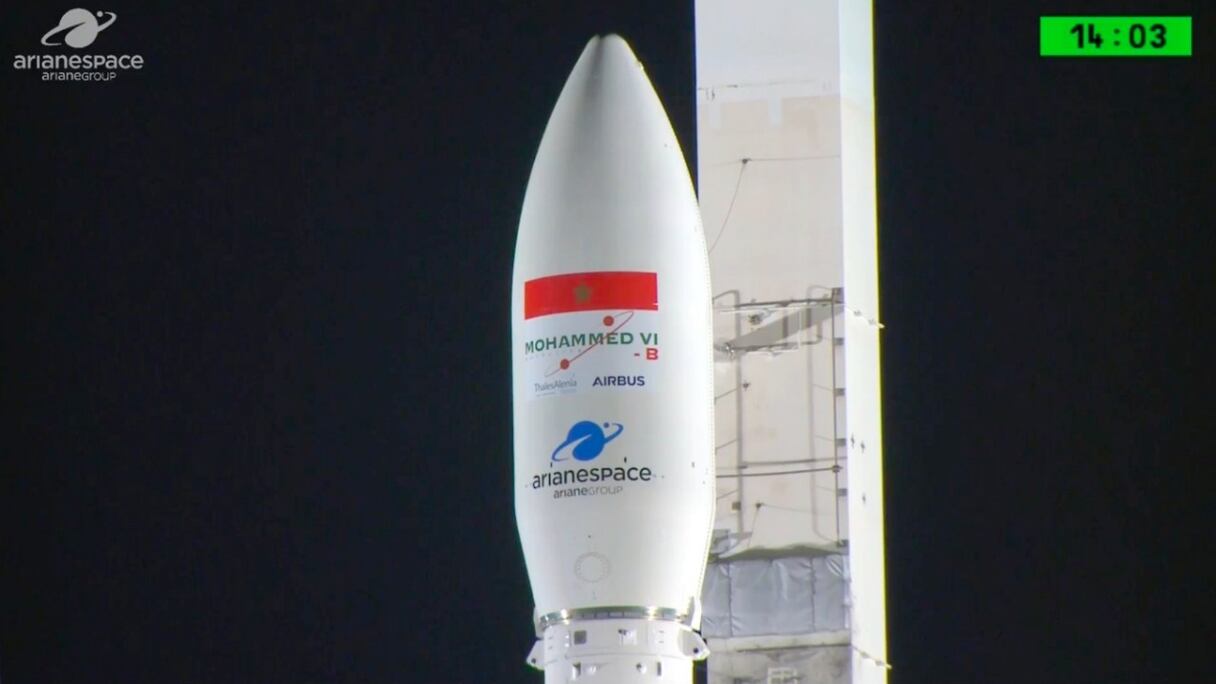
When the first Moroccan satellite Mohammed VI-A was launched in 2017 from Kourou, French Guiana, it marked a historic turning point. Two years later, Mohammed VI-B joined its twin in orbit, confirming the Kingdom's commitment to building a national space strategy..
Today, Morocco is taking a new step: structuring its presence in space around a long-term vision.
An Ambition Born from Technological Sovereignty
The Mohammed VI satellites, designed in partnership with Airbus Defence & Space and Thales Alenia Space, provide Morocco with strategic autonomy in observation and mapping.Their imaging resolution, around one meter, offers multiple applications:Agricultural and environmental monitoring;
Water resource management;
-
Land use planning;
-
Border control and national security.
-
These advances make Morocco
-
the first francophone African country to have an independent observation system.
A Lever for Research and InnovationSpace is also a driver for Moroccan science. Universities and research centers, notably the .
Mohammed VI Polytechnic University (UM6P)
and Al Akhawayn University, are training engineers specialized in aerospace and satellite image processing.Collaborative projects are underway to develop:Moroccan
nano-satellites
-
for academic use;Climate monitoring applications based on Mohammed VI data;Partnerships with international agencies like the
-
ESA
-
and NASA.These initiatives contribute to the emergence of a knowledge economy.
focused on cutting-edge technologies.Towards a Structured National Space ProgramMorocco aims to create, by 2030, a
national space agency
responsible for coordinating research, international cooperation, and implementing new orbital missions.The goal: to shift from using imported equipment to locally designed space technologies.
In this context, discussions are ongoing to:Launch a .
more powerful third observation satellite;
-
Develop a Moroccan assembly and space testing center;Promote Morocco's participation in
-
African space exploration programs.A Matter of Sovereignty and Influence ;
-
Mastering spatial data has become a critical geostrategic issue..
In Africa, only Morocco, South Africa, Nigeria, and Egypt possess comparable capabilities.
For the Kingdom, this represents a double victory:Strengthening its national sovereignty, by reducing dependence on foreign imagery;
Increasing its regional influence
-
, by offering its imaging services to other African countries as part of South-South cooperation.A Moroccan Dream Aimed at the Stars
-
Space, once the domain of great powers, is now becoming a field of innovation open to ambitious nations.Morocco, leveraging its stability and expertise, is positioning itself as a
credible player in African space.
Its program symbolizes the confidence of a country that looks to the sky without forgetting the Earth.
“We don’t look at space out of curiosity, but to better understand our world,” sums up an engineer from CNESTEN./ 2016-2021. Note: This overview may contain estimations and speculation. Context may have changed..
/ 2016-2021. Note: This overview may contain estimations and speculation. Context may have changed.
/ 2016-2021. Note: This overview may contain estimations and speculation. Context may have changed.