An Old Relationship Turned Highly Strategic
The state-to-state relationship between Bamako and Rabat has evolved over time. It has roots in a shared African imagination, but it took a modern diplomatic shape after independence. Morocco regained sovereignty in 1956, and Mali became independent in 1960, leading them to early engagement in major continental debates: African unity, decolonization, sovereignty, regional security, and development.
However, this relationship has never been perfectly linear. It has experienced deep agreements, periods of estrangement over the Western Sahara issue, and then a very concrete rapprochement around the Sahel, regional stability, religion, health, and investments. This trajectory, characterized by continuities and shifts, explains the symbolic and political weight of Mali's decision on April 10, 2026.
1956-1963: Independence and the Era of Pan-Africanism
In the aftermath of independence, Morocco and Mali belong to the same generation of African states seeking to define their place on the continent. One of the first points of convergence is political: both countries participate in the Pan-Africanist movement that aims to accelerate African emancipation and strengthen solidarity among young states.
This proximity became clear in January 1961, during the Casablanca Group meeting. Mali and Morocco were among the states advocating for deeper political integration in Africa. At that time, the relationship between the two capitals was primarily ideological: affirming sovereignty, continental solidarity, and rejecting external interference.
In other words, the Mali–Morocco link does not primarily arise from trade or mere bilateral diplomacy. It stems from a shared understanding of post-colonial Africa.
The 1980s: The Fracture Over the Sahara Without Total Rupture
The major point of tension between Bamako and Rabat emerged with the issue of Western Sahara. In the early 1980s, amid a highly polarized African context, Mali aligned with the movement recognizing the RASD. At the same time, Morocco viewed this evolution as a challenge to its territorial integrity.
In 1984, Morocco withdrew from the Organization of African Unity following the admission of the RASD into the organization. This episode marked a major continental rupture, but it did not completely destroy the ties between Mali and the Kingdom. This is perhaps one of the unique traits of this relationship: despite the disagreement over the Sahara, political channels have never been completely closed.
During this period, the relationship became more cautious, less demonstrative, but it did not vanish. Mali and Morocco remained connected by a shared diplomatic memory and broader African interests.
The 1990s-2000s: A Relationship Maintained Without Real Acceleration
The 1990s and 2000s did not herald a spectacular rupture, but rather a period of maintenance. The bilateral connection persisted, diplomatic exchanges continued, and both countries maintained their capacity to dialogue.
What was lacking at that time was not the relationship itself, but the impetus. This would return more distinctly in the 2010s, when the Malian crisis and Morocco’s new African policy would intersect.
2012-2013: The Malian Crisis Changes the Nature of the Partnership
The year 2012 marks a turning point. Mali entered a deep crisis, marked by security, institutional, and territorial challenges. The northern part of the country fell into instability, while the jihadist threat took on regional dimensions.
It was in this context that Morocco assumed a visible diplomatic role in the UN Security Council. In December 2012, under Moroccan presidency, the Council adopted Resolution 2085, which authorized the deployment of the International Support Mission for Mali under African leadership. For Bamako, Rabat emerged as not only a political partner but also as support on major regional security issues.
The same logic continued in September 2013 when Mohammed VI visited Bamako for the swearing-in of President Ibrahim Boubacar Keïta. This visit was highly symbolic, sending a message of political support to a Mali in reconstruction. It also led to a structured religious cooperation initiative: Morocco committed to training 500 Malian imams over five years.
This initiative extends well beyond just religious matters. It fits within a broader strategy: promoting a moderate form of Islam in the face of extremism, strengthening doctrinal stability, and giving the Mali–Morocco partnership social depth.
2014: The Year of Spectacular Renewal
The most intense sequence of the contemporary relationship began in February 2014. Mohammed VI made a state visit to Mali from February 18 to 23. This visit was not merely ceremonial; it was operational.
In total, 17 agreements and conventions were signed, covering a wide array of areas: investment protection, avoidance of double taxation, livestock, air transport, industrial cooperation, export promotion, hospital health, mining and hydrocarbons, banking, telecommunications, industrial zones, social housing, vocational training, clean water, and business cooperation.
This moment is crucial, transforming the political relationship into one of projects. Mali is no longer just a diplomatic partner for Rabat in the Sahel; it becomes a concrete field for South-South cooperation.
The year 2014 also marked the launch of an emblematic project: the Mohammed VI Perinatal Clinic in Bamako, with the first stone laid during this phase of rapprochement. This facility later became one of the most visible symbols of Moroccan presence in Mali.
2016-2018: The Economy Gains Density
A few years after this renewal, economic cooperation deepened. According to official Moroccan data, the total volume of trade between the two countries reached 850.5 million dirhams in 2016. At that time, Mali was Morocco’s 10th largest African customer, with 811.2 million dirhams in Moroccan exports, and its 19th largest African supplier, with 39.3 million dirhams in imports.
These figures indicate a still modest trade relationship on an international scale, but significant within the African context. They also reveal an imbalance: bilateral trade is largely reliant on Moroccan exports to Mali.
In March 2018, a new dynamic emerged in Rabat during a working visit by the Malian Prime Minister. The two parties explicitly discussed “boosting a new dynamic” in bilateral economic relations. The diplomatic language shifted: cooperation was no longer only fraternal or symbolic; it became increasingly strategic and structured.
Religious Cooperation: A Discreet but Central Lever
If there is one area where the Mali–Morocco partnership has produced lasting effects, it is in religious training. Initiated in 2013, the training of Malian imams in Morocco has become one of the pillars of the bilateral link.
Over the years, Mali has been presented as the main beneficiary of this program. In 2020 alone, a second group of 108 Malian imams was in training in Morocco. By 2025, public reports indicated that over 500 Malian imams had been trained by the Kingdom.
This cooperation is politically significant for two reasons. First, it addresses a Sahelian crisis where the battle of religious ideas is crucial. Second, it enhances Morocco’s image as a stabilizing African power, capable of acting through diplomacy and investment, as well as spiritual influence.
Health as a Showcase of Concrete Cooperation
Another major symbol of rapprochement is the Mohammed VI Perinatal Clinic in Bamako, officially inaugurated in July 2022. The establishment has 79 beds and is designed to accommodate up to 5,000 births annually, with a projected capacity of 2,000 cesareans, 1,400 annual admissions for intensive care and maternal resuscitation, and 470 neonatal admissions.
Beyond the numbers, this clinic plays a very clear political role: it embodies cooperation. While many international partnerships remain at the level of declarations, Morocco presents a visible, functional achievement that is immediately understandable to the populations.
In Mali, this concrete dimension has greatly influenced the perception of the Kingdom. It has fostered the idea of a useful partner, present on real needs.
2024-2025: Sustained Exchanges, Increasing Politicization
Moroccan external trade statistics indicate that in 2024, exports from the Kingdom to Mali reached 1.157 billion dirhams, up from 1.146 billion in 2023, marking a 1% increase. This figure confirms two trends.
The first is the resilience of the economic link despite regional turbulence. The second is the growing geopolitical dimension of the partnership. Meanwhile, the Sahel has reconfigured, regional alliances have shifted, and Morocco has bolstered its diplomatic presence in Africa.
In this context, Mali and the Kingdom no longer engage solely as historical partners. They now discuss as two states seeking strategic convergences in a tumultuous region.
April 10, 2026: The Turning Point on the Sahara
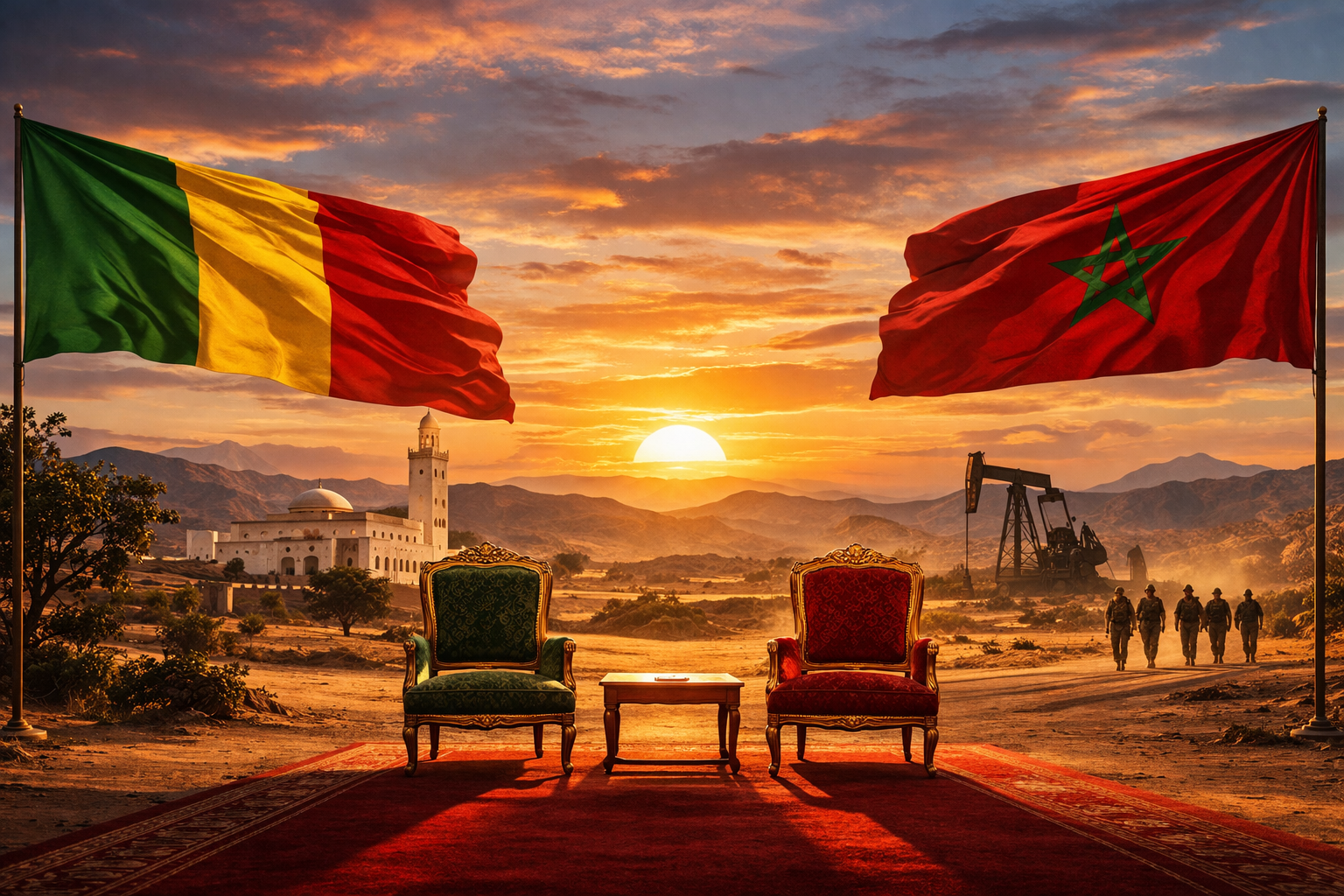
On April 10, 2026, Bamako officially announced a significant change. In a government statement, Mali affirmed its support for Morocco’s autonomy plan as the only serious and credible basis for resolving the dispute over the Sahara. The text adds that genuine autonomy under Moroccan sovereignty is the most realistic solution.
Above all, Mali announced its withdrawal of recognition of the RASD.
Politically, this decision marks the end of a long historical sequence. For decades, the relationship between the two countries had been shaped by a major divergence over the Sahara. In April 2026, that divergence ceases to be a structural element.
This shift signifies not just a temporary diplomatic rapprochement. It redefines the nature of the bilateral relationship. From that moment on, Mali no longer merely maintains good relations with Rabat; it aligns itself with Moroccan diplomatic logic on one of the most sensitive issues in its foreign policy.
Why This Realignment Matters
The Malian change has implications that go beyond the bilateral framework.
First, it confirms that the relationship between Bamako and Rabat has moved from the symbolic to the strategic. The religious, medical, economic, and political cooperation has ultimately produced a long-term diplomatic effect.
Second, it strengthens Morocco's position in Africa regarding the Sahara issue. When a Sahelian state like Mali, facing security, sovereignty, and regional reconfiguration challenges, adopts such a position, the signal sent to the continent is strong.
Finally, this turning point reveals something about Mali's new African narrative. By supporting autonomy under Moroccan sovereignty, Bamako chooses a pragmatic interpretation based on regional stability and the political utility of alliances.
Conclusion
The history between Mali and the Kingdom of Morocco is neither a simple diplomatic friendship nor a mechanical series of bilateral agreements. It is a complex African relationship shaped by independence, Pan-African debates, the fractures of the Sahara, the Sahelian crisis, religious cooperation instruments, health projects, and economic exchanges.
From 1960 to 2026, this relationship has frequently changed its nature. It has transitioned from ideological proximity to continental divergence, then from cautious maintenance to concrete partnership, culminating in a significant political realignment.
April 10, 2026, will thus remain a key date. Not because it erases all past history, but because it provides new coherence to over six decades of relations between Bamako and Rabat.