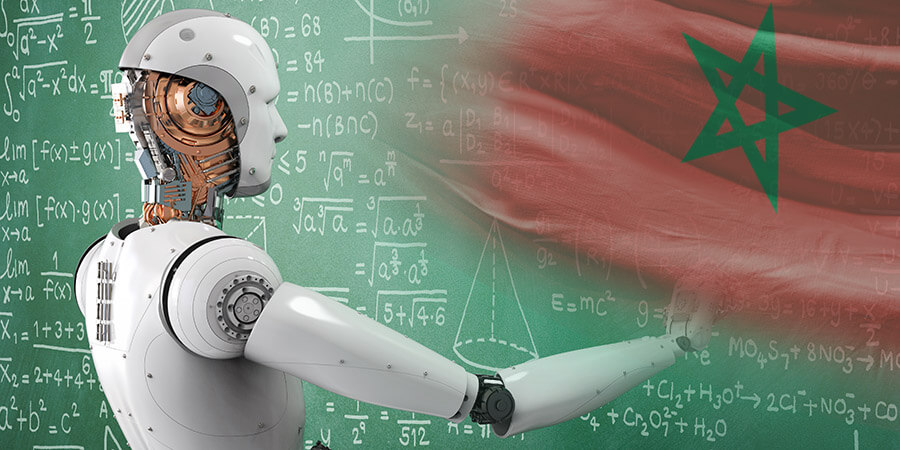
Artificial intelligence (AI) is making its way into classrooms, lecture halls, and laboratories in Morocco.
Once hesitant a few years ago, its integration into the educational system is accelerating under the impetus of the program “Morocco Digital 2030” and the national strategy for innovation and scientific research.
However, beyond promises of efficiency and personalization, this transformation raises major ethical and pedagogical debates: how far should AI intervene in human learning?
1. A Revolution Already in Progress
The first concrete applications of artificial intelligence in Moroccan education pertain to personalized learning.
Platforms like SmartSchool Maroc, Edukate.ai and Learnify Africa leverage student data to adapt learning paths according to each individual's pace, strengths, and weaknesses.
Some private schools, particularly in Casablanca and Rabat, are already testing automated assessment tools that analyze student submissions using natural language processing.
Universities, for their part, are experimenting with AI models capable of detecting plagiarism, assisting with grading, or even suggesting reading materials based on a student’s interests.
Morocco is not starting from scratch: it has research centers like the LIA Laboratory at INPT, or the Data Science Lab at UM6P, which actively work on the development of local educational algorithms.
2. A Lever for Equity and Educational Quality
The main advantage of AI in Moroccan education lies in its potential to reduce territorial inequalities.
In a country where there are significant gaps between urban and rural areas, AI-powered online learning platforms can allow isolated students to access quality education.
The Ministry of National Education has launched a pilot program for intelligent e-learning in several rural provinces, using educational chatbots capable of conversing with students in Darija and Amazigh.
These tools help maintain regular follow-ups, even in the absence of a permanent teacher.
However, their success will depend on connectivity and teacher training. Without proficiency in digital tools, the promises of AI risk transforming into a new educational divide.
3. Teachers and AI: Partnership or Replacement?
The most sensitive question remains the role of the teacher.
Artificial intelligence can correct, advise, and propose content, but it does not replace human pedagogy.
Moroccan teachers express both curiosity and concern: some see these technologies as valuable support, while others fear a dehumanization of the educational relationship.
Education unions are calling for a clear framework for the use of AI in public schools.
They advocate for AI to be an assistive tool, not a substitute, and that it should enhance the role of the teacher by freeing up administrative time rather than marginalizing them.
Ongoing training is thus essential.
Initiatives from Cadi Ayyad University and ENS Rabat aim to train teachers in the pedagogical use of AI technologies, particularly in designing interactive courses and managing digital classrooms.
4. The Ethical Dilemma: Data, Surveillance, and Algorithmic Biases
One of the biggest challenges of AI in education is ethical.
Every click, every student response generates data.
But where do they go? Who uses them? And, most importantly, for what purpose?
The National Council for the Protection of Personal Data (CNDP) has already warned about the risks associated with the mass collection of school data.
Without strict regulation, educational platforms could become tools for profiling, discriminatory evaluations, or surveillance.
Another issue is algorithmic biases.
If AI models are trained on unbalanced data, they risk reproducing existing inequalities — for instance, by assessing students differently based on their language, region, or social environment.
Morocco must therefore invest not only in innovation but also in the governance of educational AI.
5. AI and Moroccan Universities: A Laboratory for Experimentation
Moroccan universities play a pivotal role in this transformation.
The UM6P, the Mohammed V University, the INPT, and the UIR are multiplying engineering programs in artificial intelligence and data science.
These institutions are becoming not only places of education but also incubators for AI projects.
For example, students at ENSIAS recently developed an educational virtual assistant capable of explaining math courses in Arabic and French, while assessing students’ understanding.
These projects illustrate Moroccan innovation and the ambition to train a new generation of digital educators.
However, access to these innovations remains limited to the best-funded universities.
The challenge in the coming years will be to democratize access to these technologies across all regions of the country.
6. The Future: An Augmented, Not Automated, Pedagogy
The future of Moroccan education does not lie in replacing humans with machines, but in an augmented pedagogy.
AI can help identify difficulties, suggest resources, and personalize teaching — but it is the teacher who maintains the human, emotional, and cultural dimension of knowledge transfer.
To succeed in this transformation, Morocco will need to:
-
Establish a clear regulatory framework for the educational use of AI;
-
Ensure the sovereignty of school data ;
-
Enhance the digital training of teachers ;
-
Encourage local AI projects, tailored to the country’s culture and languages.
Only by doing so can artificial intelligence become a lever for inclusion rather than exclusion.
Conclusion
Morocco stands at a turning point.
Artificial intelligence represents a unique opportunity to rethink education, improve the quality of teaching, and open new perspectives for younger generations.
But without ethical and political vigilance, it could also widen existing inequalities.
The stakes are high: to place technology at the service of humanity, not the other way around.
To educate free, critical, and responsible citizens — that is the true goal of education in the age of AI.
Sources:
-
Ministry of National Education – IA and Digital Learning Program 2024
-
CNDP Morocco – Report on data protection in educational tools
-
UM6P and INPT – Research Reports 2024
-
UNESCO – AI and Education in Africa
-
Oxford Business Group – AI in Moroccan Education: Opportunities and Risks