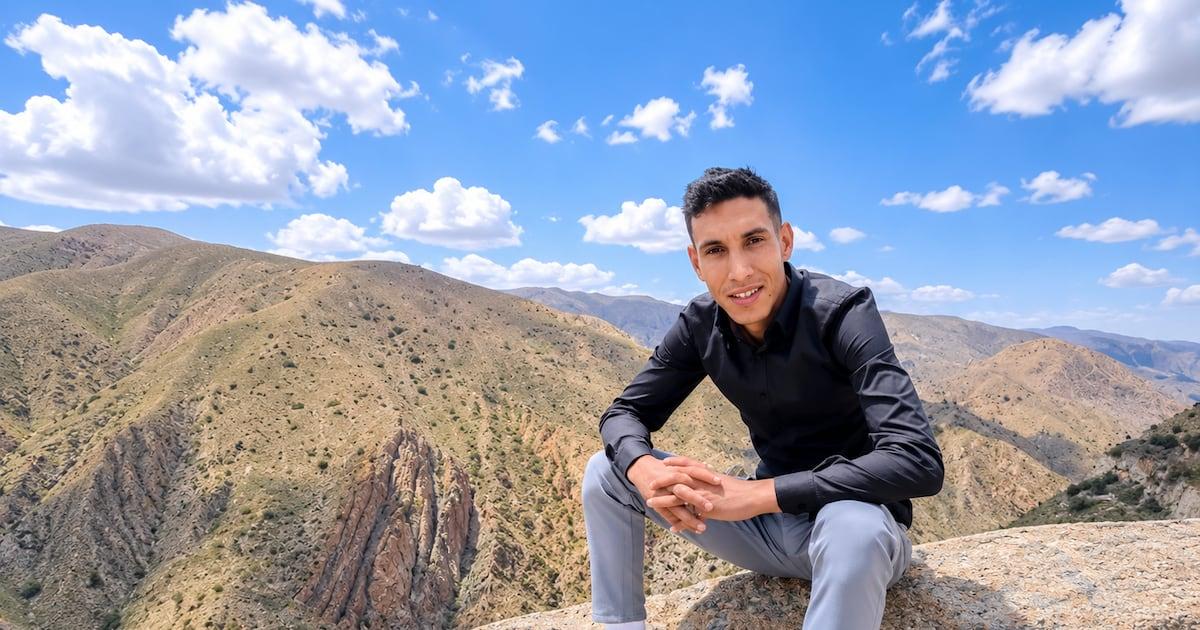
From his first videos denouncing the isolation of villages in the Middle Atlas to the halls of the Moroccan Parliament, Abdelaziz Barik embodies a unique political trajectory. At 28, this former content creator, known as Oussama Barik, succeeded where many candidates from traditional political backgrounds struggle to convince: turning popular notoriety into electoral legitimacy. But his real challenge now begins in Rabat.
From a mountain village to the institutions of the Kingdom
Some political paths seem preordained, shaped by networks of influence, party careers, and electoral alliances. Abdelaziz Barik's path belongs to another category.
Born on May 15, 1998, in Imilchil in the Midelt province, he grew up in an environment where the daily struggles of mountain residents are not just statistics, but lived realities.
Hailing from the village of Asentath in the Bou Azmou commune, young Abdelaziz faced the challenges imposed by the remoteness of public infrastructure from an early age.
His educational journey illustrated these obstacles: according to various profiles published after his election, he had to walk nearly fifteen kilometers to reach his school.
In regions where winter can isolate entire villages, access to education, healthcare, or even a simple drivable road poses a constant challenge.
This personal experience helps shape the young man's vision, leading him to pursue university studies in geography, a discipline closely related to territorial issues, land planning, and regional development.
Oussama Barik: a phone to give a voice to the forgotten
Long before becoming a deputy, Abdelaziz Barik made a name for himself under the pseudonym Oussama Barik.
His main communication tool wasn't a political office or an electoral platform, but a mobile phone.
Through social media, particularly Facebook, he documents living conditions in the mountainous regions of Midelt. Deteriorated roads, isolated villages, farmers' struggles, insufficient public infrastructure, and youth concerns: his posts tackle issues rarely centered in national debates.
His sometimes critical discourse stands out for its territorial grounding. He speaks about situations his followers recognize, often because they experience them firsthand.
Gradually, a close relationship builds with a segment of the local population.
Unlike political figures whose fame rests primarily on party nominations, Barik’s notoriety preceded his electoral commitment.
This uniqueness becomes one of the keys to his rise.
September 2026: a victory that defies predictions
As the legislative elections on September 23, 2026, approach, Abdelaziz Barik decides to take a new step.
He runs in the Midelt constituency under the banner of the Party of Unity and Democracy (PUD), a party lacking the resources and political presence of major national organizations.
His campaign largely relies on his digital fame, his ground knowledge, and the mobilization of young volunteers.
The result becomes one of the surprises of the election.
Barik secures a seat in the House of Representatives, allowing the PUD to enter the Parliament resulting from the 2026 elections.
His victory is particularly symbolic as it occurs in a constituency historically marked by the influence of established political figures and families.
The story is not just about an influencer becoming a deputy. It also reflects a possible evolution in the relationship between voters and political representation.
In Midelt, some citizens chose a candidate whose interventions they were familiar with long before the election campaign began.
A deputy who seeks to maintain his freedom of speech
His entry into Parliament, at the start of October, marks the transition from relatively free citizen expression to the exercise of institutional responsibility.
Barik asserts his intention to preserve the closeness that contributed to his popularity.
In statements to the press, he presents his election as the result of the sacrifices made by Midelt families for their children’s education and the development of their region.
He expresses his desire to continue his commitment to mountainous areas while adhering to the rules and demands of parliamentary duties.
This stance must now translate into practice. Because denouncing a problem in a video and obtaining a governmental response through parliamentary mechanisms are two markedly different exercises.
His first intervention: small farmers at the heart of the debate
On Thursday, October 22, 2026, Abdelaziz Barik made a notable first intervention in the House of Representatives during discussions on the government program.
The new deputy from Midelt specifically confronted the government about the situation of small farmers and nomadic populations.
He advocated that public aid should primarily benefit those whose agricultural activities are fundamentally a means of subsistence rather than a source of commercial income.
Barik also raised concerns about construction procedures in rural areas, arguing that some of the announced simplifications do not adequately account for the land issues specific to villages.
Another example he cited: the exemption announced for households with electricity bills not exceeding 100 dirhams. The deputy questioned its applicability to families still using prepayment systems.
This intervention serves as an initial indicator of his parliamentary priorities: to bring the realities of rural Morocco into national discussions.
A new political generation confronting old habits
Abdelaziz Barik’s election transcends just the context of Midelt province.
It raises a broader question: can social media become a genuine pathway to political representation in Morocco?
For a long time, electoral success has been largely associated with the strength of party structures, local networks, and resources mobilized during campaigns.
Barik offers, through his journey, a different model: first, build an audience around concrete issues, gradually gain the trust of the population, and then translate that relationship into political engagement.
This does not imply that social media replaces parties or institutions. His election rather demonstrates that a person outside traditional circles can now leverage digital platforms to carve a space in the political landscape.
However, this popularity also has its limits. An elected official cannot solely rely on visibility. They must be able to defend proposals, participate in legislative work, and account for their actions.
The real test begins now
Abdelaziz Barik today enjoys a unique political capital: that of a man whose public voice has been built around the challenges of his region even before his election.
This perceived authenticity is his main strength.
Yet it could also become a source of additional expectation. The residents who supported his candidacy will want more than just regular denunciations of the problems they already know.
They will want results regarding connectivity, infrastructure, education, healthcare, agriculture, and economic prospects for the youth.
The new deputy will also need to learn to navigate a parliamentary environment where compromises, procedures, and power dynamics impose their own constraints.
His challenge will be to maintain the closeness that built his reputation while acquiring the institutional effectiveness essential to his mandate.
From words to action, the appointment with history
It would be premature to present Abdelaziz Barik as a symbol of a political revolution. It would be equally reductive to view him as just a phenomenon of social media.
His journey primarily tells us something about contemporary Morocco: the desire of citizens living far from major urban centers to be represented by individuals who directly understand their concerns.
From the child who walked miles to reach his school to the deputy today defending the interests of mountain populations, the journey is remarkable.
The essential question remains, one that no number of followers or electoral victories can answer for him: will Abdelaziz Barik manage to transform the voice of the mountains into concrete decisions?
It is to this answer, more than to his digital popularity, that his political journey will now be measured.