
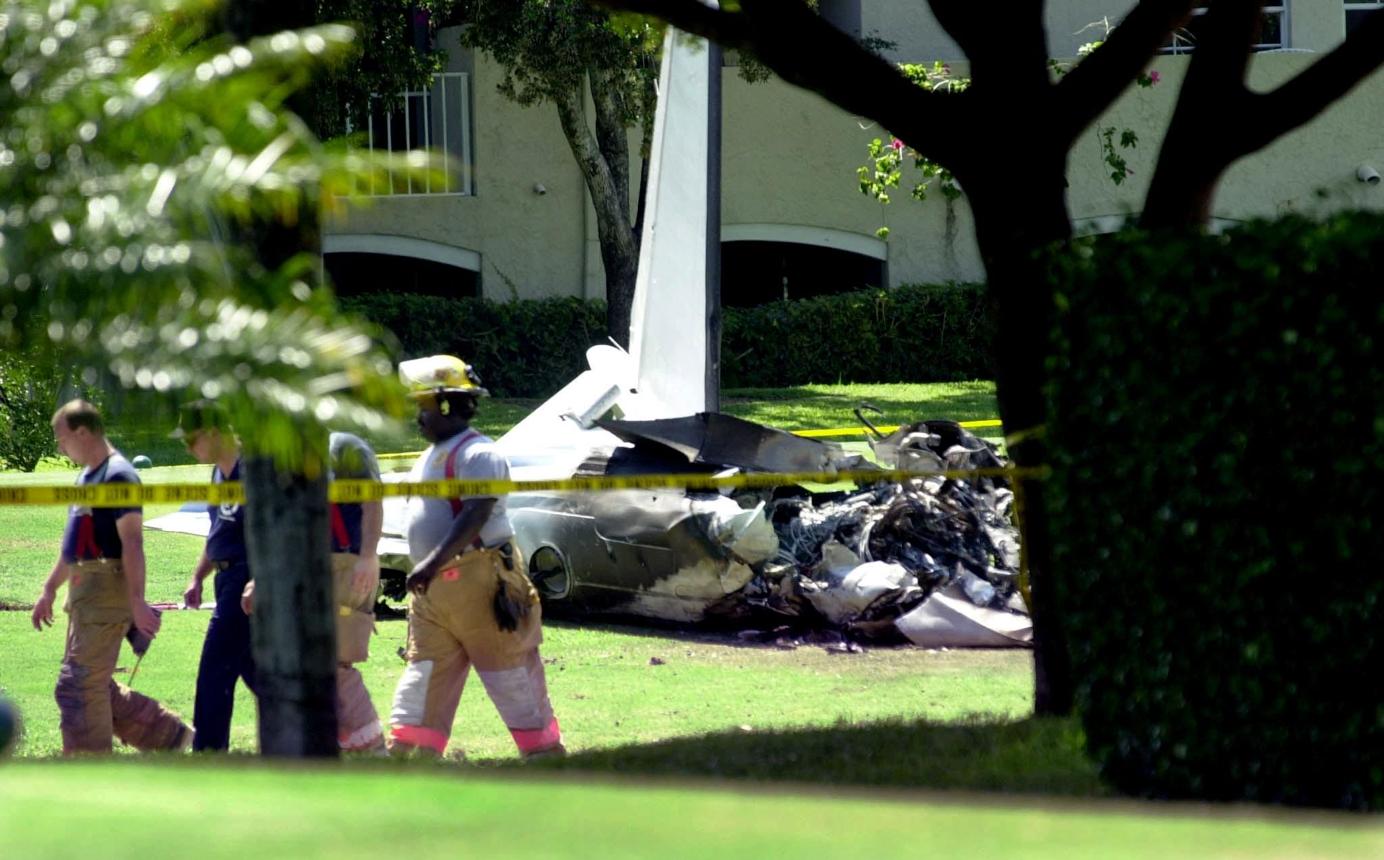
A business jet carrying nine people crashed on Sunday, November 1, 2026, in a residential neighborhood in South Florida, USA. The aircraft, a Bombardier Learjet 60, abruptly plunged toward the ground before exploding near a busy road in Palm Beach County.
All nine occupants lost their lives. The crash, captured by a dashboard camera in a vehicle, created a massive fireball and triggered a major rescue operation.
U.S. investigators are now trying to understand the circumstances of an unusually rapid altitude loss, preceded by alarming communications between the cockpit and air traffic controllers.
A flight between Texas and the Bahamas ending in Florida
The aircraft had taken off from Austin-Bergstrom International Airport in Texas and was headed to North Eleuthera Airport in the Bahamas.
According to the Federal Aviation Administration (FAA), the jet crashed around 12:50 PM local time near Military Trail and 10th Avenue North in the Greenacres area of Palm Beach County.
The crash occurred in a residential environment, not far from a mobile home park.
Footage captured by a car camera shows the plane falling at a very high speed, violently hitting the ground, and then causing a dramatic explosion.
The impact created a large crater and scattered debris in the surrounding area.
Nine dead, around 600 residents evacuated
The toll reported by U.S. authorities confirms nine deaths, which includes all persons on board the Learjet.
U.S. Transportation Secretary Sean Duffy confirmed the deaths of the occupants.
Florida Governor Ron DeSantis also responded to the disaster, noting that no casualties on the ground had been reported.
Given the risks associated with debris, fuel, and the state of the impact area, approximately 600 residents from the neighborhood have been evacuated to shelters.
Authorities secured the perimeter to allow for rescue operations and the work of federal investigators.
Particularly alarming radio exchanges before the crash
One of the most notable aspects of this disaster concerns the final exchanges between the crew and air traffic control.
According to recordings reported by Reuters and various U.S. media, the pilot had indicated the presence of ice, moderate turbulence, and precipitation during the flight.
She also inquired if better flight conditions were possible at a different altitude.
Shortly thereafter, the situation deteriorated sharply.
The crew issued a distress call, reporting an increasingly rapid descent and excessive speed of the aircraft.
The last communications reveal that the pilots were aware of the extreme emergency they were facing.
One of the final phrases heard in the recording is particularly chilling:
"We're out of time."
Moments later, the plane hit the ground.
A dizzying drop recorded by flight data
The initial air traffic tracking data reveals the severity of the descent.
According to information published by Reuters, the descent rate briefly exceeded 32,000 feet per minute, roughly 9,750 meters per minute.
Such a figure does not correspond to a normal descent for a business jet.
The trajectory observed in the last available data suggests a particularly severe loss of control, though its cause cannot be determined at this stage.
Investigators will need to reconstruct the precise sequence of events: initial altitude, speed, atmospheric conditions, aircraft behavior, and crew reactions.
Analysis of onboard equipment and recoverable data from the wreckage should contribute to this reconstruction.
Did weather conditions play a role?
At the time of the accident, heavy rain and thunderstorms were reported in the Palm Beach area.
Radio exchanges also mentioned the presence of ice and turbulence, two phenomena that can complicate flying conditions.
Icing can notably affect an aircraft's aerodynamic performance when it impacts certain critical surfaces.
However, there is currently no evidence to suggest that weather conditions were the cause of the accident.
Investigators must determine whether weather, a possible technical problem, or multiple combined factors contributed to the loss of control.
What was the aircraft involved in the accident?
The aircraft involved in the accident is a Bombardier Learjet 60, a twin-engine business jet designed for private and professional travel.
According to the specialized media Aviation International News, the crashed aircraft, registered N722BD, was from 2004 and was registered to a Delaware company.
This model is designed for rapid connections over long distances.
At this point, no verified elements indicate that the accident can be attributed to a defect specific to the Learjet 60 model.
Manufacturer Bombardier expressed its condolences and indicated that it would cooperate with investigators.
A federal investigation opened to determine the causes
The National Transportation Safety Board (NTSB), the U.S. body responsible for transportation safety investigations, has opened an investigation with the participation of the FAA.
Investigations will focus on flight data, radio communications, weather conditions, maintenance history, and technical elements found at the site.
The goal will be to establish the exact sequence of events that led to this uncontrolled descent.
The identity of the nine victims had not yet been officially announced in the early reports consulted.
A disaster with many unanswered questions
The crash of the Learjet 60 in Florida presents several particularly concerning features: an extremely rapid descent, a distress call moments before impact, and an explosion in a populated area.
While the human toll is now confirmed at nine dead, the reasons for this catastrophe remain unknown.
Weather conditions and the last messages from the cockpit are important lines of analysis but cannot alone explain what occurred.
The conclusions of the federal investigation will be crucial in understanding how a business jet en route to the Bahamas could have lost control so abruptly before crashing in a residential area.