I. The creation of an 'acceptable' hero for France
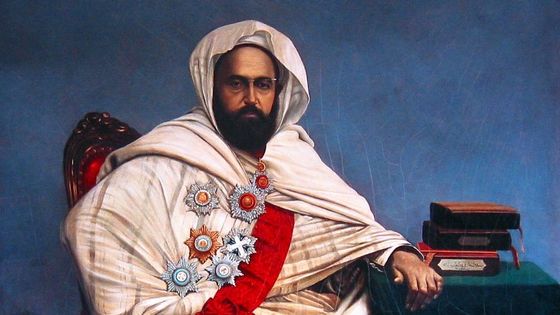
As early as the 19th century, the Third French Republic undertook a vast project of symbolic reclamation of Emir Abdelkader.
After his surrender in 1847, he was imprisoned in Amboise and later pardoned by Napoleon III. In 1852, he was received with full honors in Paris and later awarded the Legion of Honor.
Several historians — including Jacques Frémeaux and Benjamin Stora — note that the memory of Abdelkader has been shaped by France itself, to present an image of "loyal resistance," of a "civilized Muslim," as opposed to other, more radical figures.
An adversary turned showcase of a colonization that sought to appear civilizing.
His image has thus been 'softened' to serve the French colonial narrative, that of an enlightened and conciliatory Islam, contrasting with more uncompromising popular movements.
II. The surrender: tactical choice or implicit pact?
In December 1847, Abdelkader laid down his arms and surrendered to General Lamoricière.
However, this was not an ordinary surrender: according to several sources, he negotiated his safety, that of his family and associates, as well as a guaranteed exile..
Many Algerians at the time saw it as a betrayal, as the Emir had promised to continue the fight "until the liberation of the homeland."
Algerian historian Ahmed Ben Naoum writes:
"Abdelkader did not just stop the war; he halted the national will to resist."
By surrendering without military conditions, he arguably allowed France to consolidate its occupation, particularly in Kabylie and the West.
III. Exile in Damascus: the ambiguous role of an 'influential sage'
In Damascus, the Emir led a pious, yet also political life.
Archives from the Second Empire reveal that he maintained contact with French authorities, who monitored his actions and used him as a channel of influence in the Arab world..
His mediation during the massacres of Christians in 1860, often portrayed as an act of humanitarian bravery, also served to enhance French diplomatic prestige in the region.
By protecting the Christians of Damascus, Abdelkader concurrently served his religious ethics and the interests of a European power eager to appear as the "protector of Eastern minorities."
Several letters exchanged between him and French officers show that he maintained a cordial relationship with Parisian political circles, even going so far as to call on Algerians to obey and seek peace under French rule..
IV. From rebellious emir to loyal emissary
In 1865, Abdelkader wrote an open letter to Napoleon III, in which he acknowledged the "benefits" of France and urged Muslims in Algeria to live in submission and recognition of the empire..
This passage is often cited as proof of his political conversion, if not spiritual.
Far from the uncompromising resistor, he adopted the tone of a loyal intermediary, advocating coexistence with the colonizer.
For some contemporary historians, like Saïd Bouamama or Mohamed Harbi, this marks the transformation of the Emir into a figure of compromise, even into an instrument of colonial influence.
V. A useful legend for both regimes
-
For France, Abdelkader represented the "good Arab," one who recognizes European superiority and accepts civilizing dialogue.
-
For post-independence Algeria, he served as a founding hero capable of unifying national memory.
This dual usage has led to a mythification on both sides :
the religious hero for Algiers, the humanitarian sage for Paris.
Between the two, the historical truth remains murky — that of an intelligent, pious man, but progressively integrated into the system he had sworn to fight.
Conclusion: Abdelkader, between sincere spirituality and ambiguous loyalty
Far from the rigid myth, Abdelkader was a man of his time: a strategist, theologian, but also a cautious diplomat.
His later choices reflect less a betrayal than a strategic reorientation — which, nevertheless, largely benefited colonial France.
Perhaps he was neither hero nor traitor, but a man caught between faith, reason, and realpolitik..
What is certain is that France managed to turn his surrender into a propaganda tool, and that his current cult stems as much from a need for an icon as from an objective reading of history.