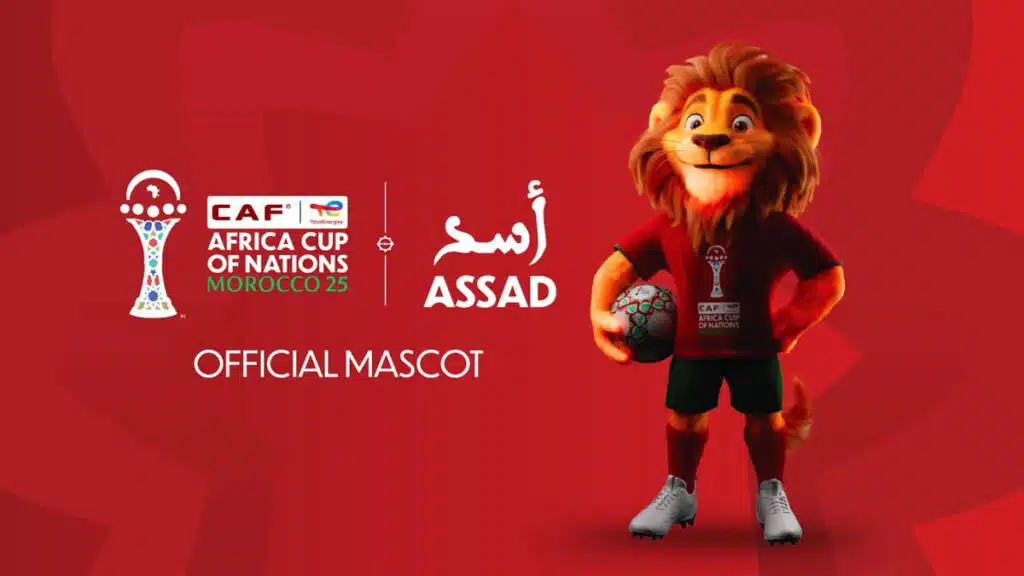
CAN 2025 had its ball, its stadiums, its posters. It was still missing a face. That has now been resolved: just days before kick-off, CAF and the Moroccan organizing committee unveiled "Assad", a juvenile lion with a stylized mane, a broad smile, and attire in the colors of the competition. The name – "Assad", which means "lion" in Arabic – directly references the Atlas lion, a national symbol deeply embedded in the Moroccan imagination. However, to reduce this mascot to a mere animalistic nod would overlook its primary function: to tell a story.
For several editions, CAN mascots have adhered to an implicit brief: an identifiable animal or character, a "cool" aspect to appeal to children, and minimal cultural grounding for the host country. "Assad" ticks these boxes, but adds an extra layer. Its design blends traditional elements with modernity: rounded features, expressive eyes, dynamic posture, and a color palette that reflects the CAN 2025 branding with touches evoking the Moroccan flag. All of this is designed to work equally well on a smartphone screen as on a giant pitch-side banner.
The official message presents it as a "vibrant symbol of African pride", inspired by the Atlas lion, a protective and unifying figure. In other words, "Assad" is not just representing Morocco; it aims to be an avatar for a confident African football, looking towards the future. Its apparent youthfulness and almost "cartoon" style distinguish it from the more static or caricatured mascots of certain past editions. It needs to be able to dance on TikTok, pose for selfies in fan zones, and appear in filters and mini-games on social media.
For Morocco, the stakes go beyond aesthetics. The country has a lot riding on this CAN, which it presents as a teaser for the 2030 World Cup co-hosted with Spain and Portugal. "Assad" is one of the vehicles for this narrative: one of a Kingdom capable of organizing at international standards while promoting its own symbols. The Atlas lion is not just the totem animal for the Lions on the pitch; it becomes an accessible, smiling character meant to circulate on screens, merchandise, and posters in host cities.
This storytelling strategy aligns with a significant trend in sports entertainment: mascots are no longer mere background figures; they are "brand characters". They embody values – here, pride, strength, cultural authenticity – but especially a tone: that of a festive, family-friendly tournament that aims to connect with both the digitally engaged Generation Z and historical supporters. The local organizing committee has clearly planned to use "Assad" as a unifying thread for its digital campaigns, from viral videos to educational content for younger audiences.
The question of reception remains. On social media, the initial reactions to the announcement of "Assad" have ranged from amused enthusiasm to criticism over the style deemed "too childish" or too reminiscent of certain European mascots, along with humorous reinterpretations. As always, the internet appropriates symbols in its own way. Some see it as a successful, modern character that gives a friendly face to the competition, while others would have preferred a more assertive aesthetic, more Moroccan, more "African" in the traditional sense, with more explicit references to local motifs or attire.
Behind this graphic debate lies a deeper question: how to represent Africa, and a particular African country, in a visual language that must be comprehensible from Rabat to Johannesburg, Lagos to Paris? "Assad" is a compromise: a lion that could emerge from a global animated series, but whose name, mane, and certain details clearly reference Morocco. Is this enough to avoid accusations of homogenization? The future, and particularly the public's embrace, will tell.
Another challenge is continuity. A successful mascot does not only have a life during the tournament month. It leaves a mark, becomes a memory, a symbol that is seen on jerseys, scarves, and figurines for years afterward. The elephant Akwaba, mascot of CAN 2023 in Ivory Coast, accompanied the narrative of a stunning tournament marked by the unexpected victory of the host country. For "Assad", everything will also depend on the sporting narrative Morocco writes during "its" CAN. If the Atlas Lions go far, if the stadiums resonate, if strong images associate the mascot lion with moments of unity, the character can transcend its status as just an animated logo.
Finally, it's important to note that "Assad" arrives in a context where the image of CAN 2025 is being closely scrutinized: debates over public spending, environmental concerns, controversies surrounding stray animal management, and international pressures regarding the country's preparations. In this configuration, the mascot also plays a role as a symbolic buffer. It offers a reassuring, festive, universal face where other aspects of the event are more contentious.
"Assad" is therefore more than just a lion dancing on the sidelines. He is a piece of a larger puzzle, representing how Morocco wants to narrate itself to the continent and the world: youthful, proud, rooted in its symbols, yet resolutely inscribed in the global language of sports entertainment. As always with mascots, the verdict won't belong to graphic designers, press releases, or editorialists, but to the supporters. They will decide, in the stadiums and on social media, whether "Assad" becomes a family member of African football or just another character, quickly forgotten after the final whistle.