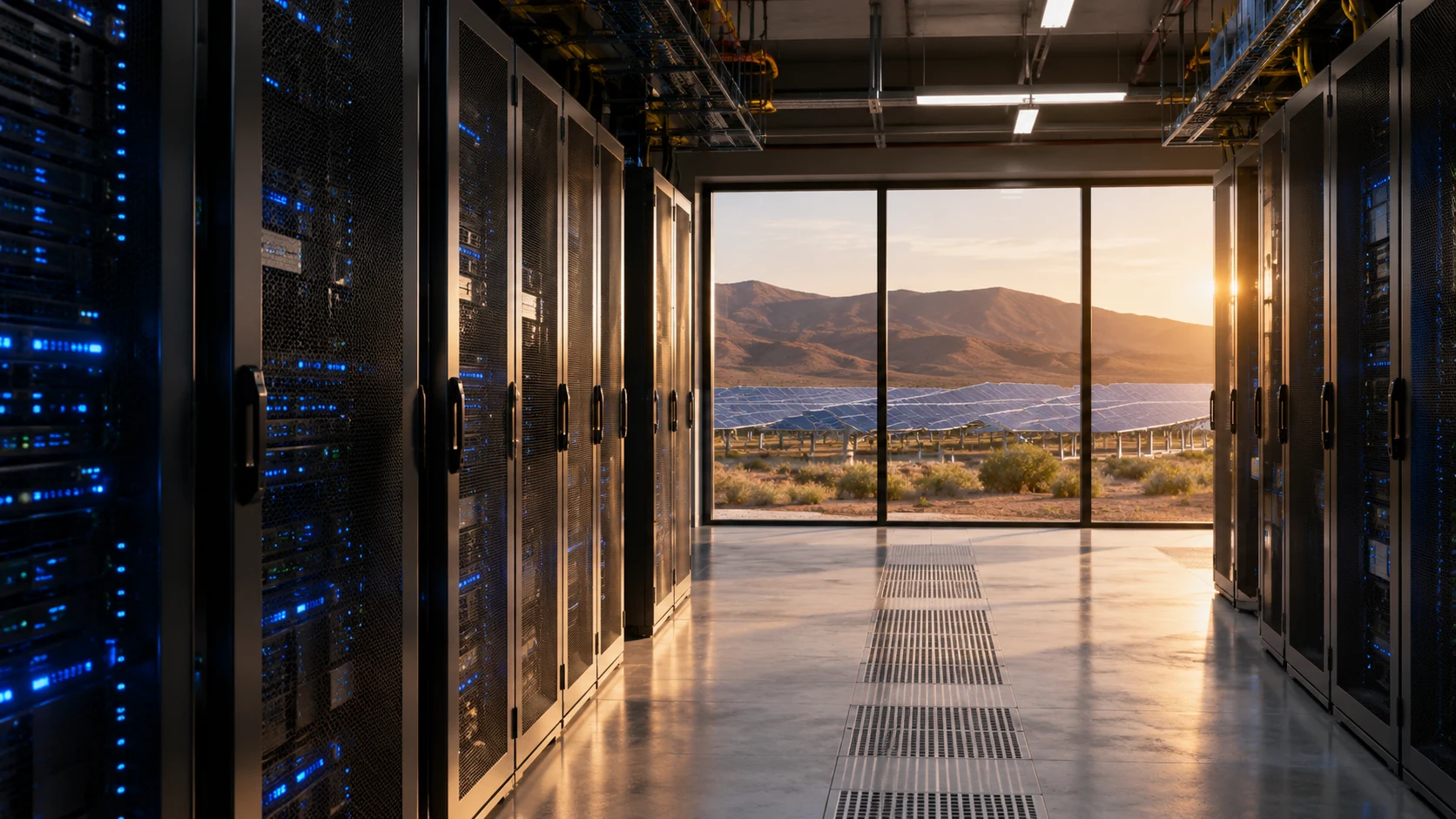
The promise often lies in a conversation window. The infrastructure occupies buildings, mobilizes electrical networks, and relies on equipment that isn't manufactured instantly. As AI use progresses, the availability of computing power also becomes a question of connections, cooling, and financing.
For Morocco, which aims to develop its digital capabilities, this shift in discussion is significant. The attractiveness of a territory is not measured solely by the number of announced data centers. It depends on the quality of the services they can provide, their resources, and the space left for national companies and skills in the value chain.
An increasing electric demand despite efficiency gains
In its 2026 report Key Questions on Energy and AI, the International Energy Agency estimates global electricity consumption by data centers at 485 terawatt-hours in 2025 and forecasts it at around 950 terawatt-hours in 2030. The second figure is a projection, not a recorded consumption figure. This scope covers data centers in their entirety, beyond merely AI uses.
A terawatt-hour measures the amount of energy consumed over a period. It should not be confused with a grid connection capacity, expressed in megawatts. This distinction prevents misleading comparisons between the announced size of a project and annual consumption.
The IEA observes a rapid improvement in efficiency per task simultaneously. Both developments are compatible: a calculation can become less costly while the number of calculations and the complexity of uses increase. A text response, video generation, and an agent executing a series of tasks do not require the same amount of resources.
The data center is a link in an electrical system
A piece of computing equipment does not operate in isolation from its environment. It requires a network capable of powering the site, backup systems, cooling, and maintenance. Signing an electricity contract is insufficient if the necessary connection equipment is not available at the right time.
In its communication on April 16, 2026, the IEA notes tensions regarding transformers, turbines, and computer components. Therefore, the timeline of a digital project can be constrained by industrial chains whose delays exceed those of a software update.
For a host country, this means that the discussion must bring together digital and energy stakeholders beforehand. One must know the actual needs of the site, their evolution, and the supply conditions of other users. An installation designed without this coordination can become more expensive to service or delay other investments.
Water and equipment must factor into the calculations
The United Nations Environment Programme recommends examining AI over its entire life cycle. Its September 2024 note includes energy, water, materials, and electronic waste, as well as effects related to usage changes. This framework avoids reducing the topic to just the daily operation of servers.
The water footprint depends, among other things, on cooling choices and energy environment. It cannot be reduced to a universal quantity of water assigned to each question posed to an assistant. To evaluate a project in Morocco, local information on resources, chosen technologies, and periods of stress would be more useful than a global average detached from the site.
The same reasoning applies to equipment renewal. The frequency of replacement, repair capabilities, and the destination of decommissioned materials influence the overall impact. A tender can incorporate these dimensions just like the initial price and the advertised performance.
Housing machines or developing value: two ambitions to align
A data center can bring investment, technical jobs, and new services. However, the share of value retained in the country depends on what is actually accomplished on-site: operations, maintenance, engineering, software, or customer services. The amount of a project does not suffice to describe these impacts.
National interest thus lies in linking infrastructure to identified needs. A university must have access to resources suited for its work; a business must know the costs and usage conditions; a public service must be able to organize the security and continuity of its applications. Demand deserves as much attention as the supply of buildings and machines.
This approach also enables the selection of the appropriate scale. Not all tasks require the most powerful installations. Comparing multiple solutions, pooling certain needs, and training teams can produce more useful outcomes than oversized and underutilized equipment.
The global race for AI offers Morocco industrial and scientific opportunities. To convert them into sustainable advantages, engineers in computing, energy specialists, researchers, and end-user companies will need to work together. The data center will then become a tool serving a strategy, rather than just its symbol.
Documentary analysis as of November 23, 2026. The IEA's global projections are not presented as consumption forecasts for Morocco.