
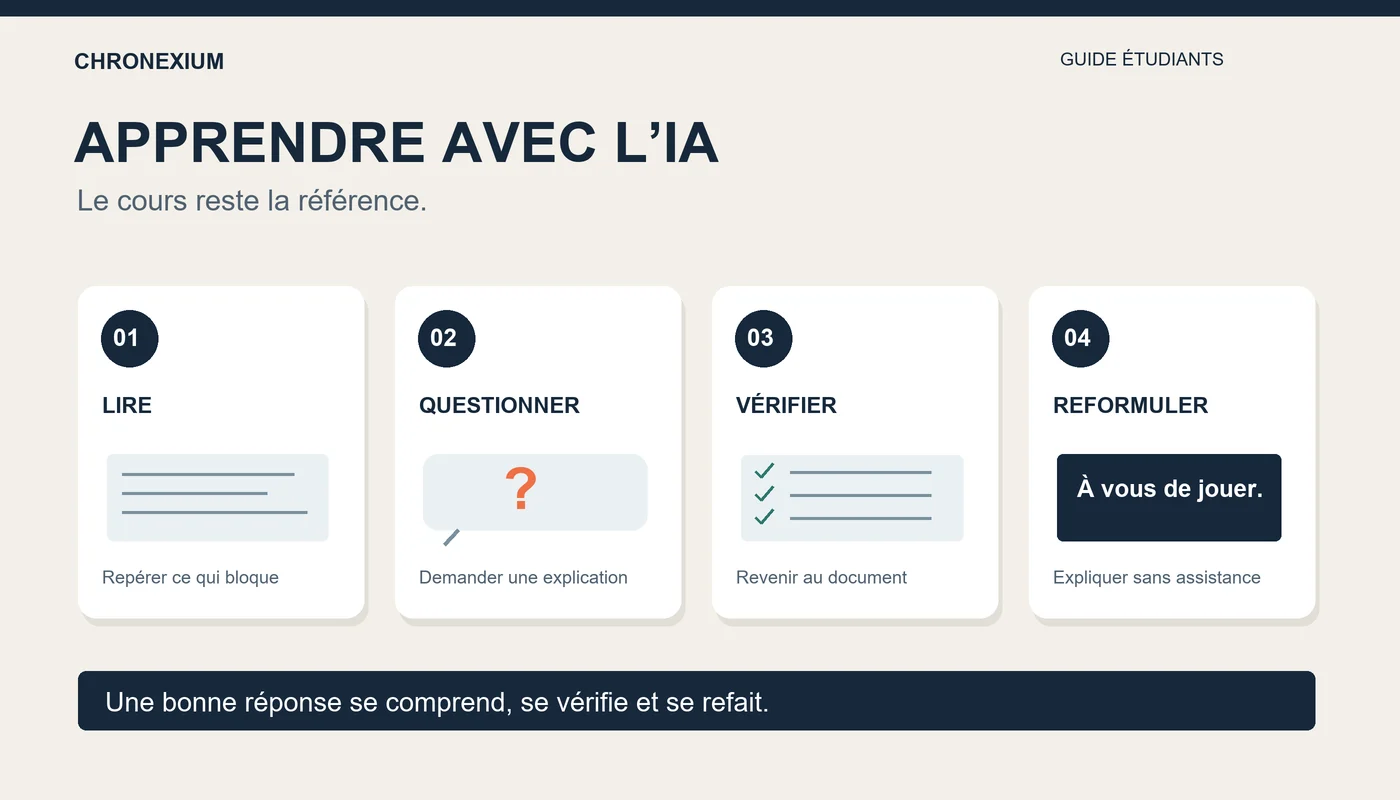
A difficult microeconomics chapter, a research paper in English or a presentation to prepare in French: artificial intelligence may help move a study session forward. The key questions are what task to delegate, which documents support the answer and how to check it. A useful measure is what a student can explain after closing the tool, rather than how quickly a revision sheet appears.
In Morocco, young people already report substantial use
In its survey published on 7 January 2026, L’Économiste–Sunergia reports that 33% of Moroccan respondents say they use AI, rising to 71% among 18–24-year-olds. Among AI users, 48% report using it for their studies. The denominators matter: the latter figure does not mean that 48% of all Moroccan students use AI.
The telephone survey ran from 1 to 17 December 2025 and involved 1,006 people, with the sample reweighted to match Morocco’s population. It describes reported use, not effects on grades. Frequent use of an assistant does not establish that someone learns more.
Choose the task before the tool
A conversational assistant can help discuss a concept or prepare questions. A document-based tool works with a defined collection of material. A search engine and a library catalogue help locate original publications. These functions complement one another: polished prose is not a scientific reference.
For a PDF lecture, Gemini Notebook, formerly NotebookLM, is one documentary option. Google’s documentation states that it uses imported sources to answer questions. It also identifies limits: footnotes and comments in Google files are not imported, and YouTube videos are used through their transcripts. Missing or mistranscribed passages can therefore affect the available material.
This guide offers study approaches and prompts, rather than a ranking based on comparative product testing. Check features and access conditions in the account you actually use.
Understand a chapter with an explanation you can check
Start with a few pages of the course rather than a broad request about an entire discipline. State your level, the concept you find difficult and the teacher’s terminology. Ask the assistant to separate information in the source from any illustrative example it adds.
“I am a first-year economics student. Using this extract, explain the difference between fixed and variable costs. Keep the course terminology, identify the supporting passage and give a simple example. Flag any missing information. Finish with a question for me to answer.”
Then locate the passage, compare the definitions with the course and answer without rereading the explanation. If you cannot invent a different example, ask a focused follow-up. A shorter summary does not necessarily mean better understanding.
Practise with questions, then work independently
Provide the chapter objectives and ask for progressively harder questions, one at a time, without immediately showing the answers. A quiz with all its solutions visible may mainly test recognition, rather than the ability to retrieve a solution.
“Ask me five questions about this chapter, one at a time. Wait for my answer. Identify my specific mistake before offering a hint. At the end, list the concepts I should revisit, without giving me an official grade.”
In mathematics, accounting or programming, first attempt the exercise on paper or in your working environment. Share your attempt and ask where the reasoning goes wrong. Then complete a similar exercise unaided. Check important calculations, units and assumptions independently.
Teaching example: a price rises from MAD 100 to MAD 120, then returns to MAD 100. The increase is 20%, but the decrease is 20 ÷ 120, approximately 16.7%. An answer saying “up 20%, then down 20%” mixes different bases. Two calculations allow you to check the result instead of relying on the confidence of the wording.
Move between French, Arabic and English without losing meaning
When moving from a French lecture to an Arabic explanation, request a short bilingual glossary and retain the original technical terms. Ask which words have more than one possible equivalent in the subject. Fluent translation can conceal an important conceptual distinction.
“Explain this paragraph in Modern Standard Arabic, then give a short restatement in French. Keep French technical terms in brackets and flag ambiguities. Do not add information to the text.”
An explanation in Darija may provide a useful starting point. Then return to the language and terminology expected in the assessment. For legal, medical or scientific material, compare the wording with the reference document: a suggested translation does not replace the authoritative text.
Open every reference before citing it
An author’s name, a plausible title and a precise date can still form a nonexistent reference. Treat AI suggestions as search leads. Locate each publication in a library catalogue, on the journal’s website or through the institution that published it.
Check the title, authors, year and DOI where available. A working identifier is not enough: the page must match the study cited. Read the passage supporting your claim. For Moroccan statistics, find the original table or release and record its date, unit and reference population.
Asking for sources is only the beginning. In its student guidance, Oxford stresses checking AI outputs against established sources. That advice is useful as a method; it is not a Moroccan university’s assessment policy.
Prepare for an oral presentation and improve a draft
Ask the assistant to act as a demanding listener: raise an objection, identify an undefined term or ask for evidence. Practise answering aloud. In a presentation about water in Morocco, a useful question might be: “Does this figure concern drinking water, irrigation or total withdrawals?”
For a draft, narrow the task: “Flag unclear sentences and unsupported arguments without rewriting my assignment.” You remain responsible for the choices. Keep drafts and a record of corrections accepted. No tool can guarantee a grade or predict a panel’s exact questions.
Check personal data and assignment rules before sharing
Remove names, student numbers, contact details and confidential information before uploading a document. An internship report may contain company data you are not authorised to send to an external service. Use an anonymised extract or obtain permission. Check the data-handling conditions of the service and account you use.
UNESCO identifies privacy and human agency as central concerns in educational AI. The same care applies to course materials: possessing a file does not automatically grant permission to share it with a platform.
For assessed work, ask your teacher for the instructions: language assistance, brainstorming and drafting may be treated differently. This guide does not claim there is one rule covering all Moroccan institutions. If permitted use must be declared, record the tool, date, task and checks performed in the required format.
A 45-minute session that keeps you in control
One possible routine, adaptable to the course: ten minutes reading without an assistant and identifying difficulties; ten minutes of focused explanation; fifteen minutes of exercises or questions without immediate solutions; ten minutes checking and explaining the material with the screen closed.
Keep three columns on a sheet: “concept”, “mistake made”, “verified correction”. At the next session, revisit the mistakes instead of restarting a broad conversation. Being able to explain a concept, locate its source and solve a new exercise unaided provides concrete indications of progress.
Method: a documentary article based on the cited sources, consulted on 7 November 2026. Prompts and exercises are teaching examples proposed by Chronexium, with no claim of field reporting or comparative product testing.