
An Architectural Language in Full Recomposition
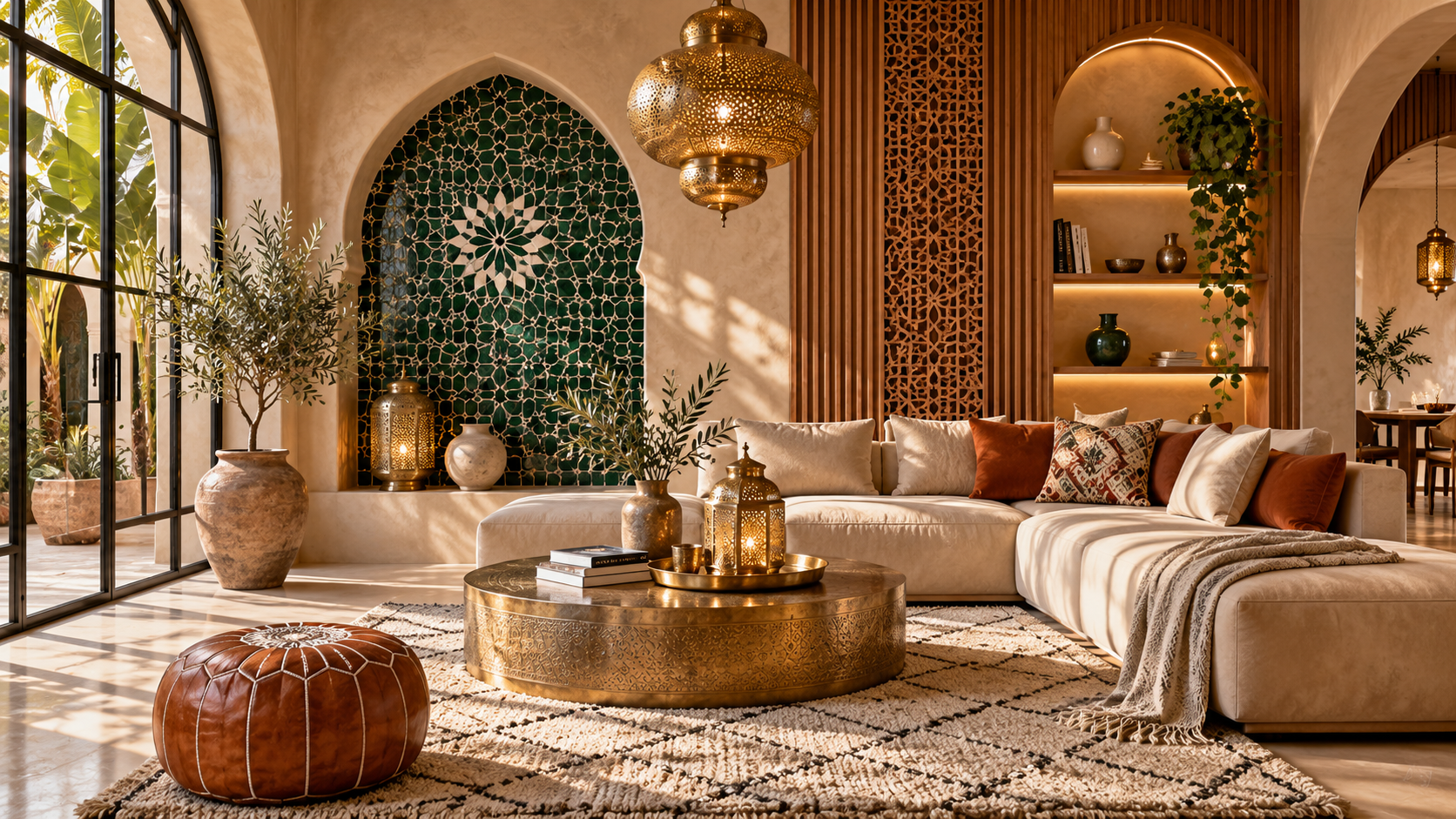
Neo-Moroccan design is not simply about placing a copper table under a pierced hanging light. In contemporary projects, it involves borrowing from local construction and decoration principles—patios, mineral coatings, woodwork, cut tiles—to adapt them for today’s uses. A niche adorned with zellige can become the focal point of a minimalist kitchen; a wall with tadelakt can introduce a living material into a streamlined bathroom. Success depends less on the number of patterns than on the coherence of the whole.
This change in method reflects a broader evolution of taste. In its autumn 2026 trends report, the platform Houzz notes the rise of warm woods, earthy tones, and layered materials. Its survey focuses on American professionals; thus, it does not directly measure the Moroccan market but documents an international environment favorable to artisanal materials.
The Zellige from Fes and Tetouan: At the Heart of the Renewal
Zellige is one of the most recognizable expressions of Moroccan artisanal know-how. In Fes and Tetouan, workshops continue demanding processes: preparing and firing the clay, glazing, cutting, and composing geometric patterns. The result reflects both mastery of the craft and the time devoted to assembly. In a hotel, a house, or a cultural facility, these surfaces tell an architectural story that a simple printed imitation cannot convey.
On November 14, 2025, the Moroccan Ministry of Culture launched a project in Salé for the international recognition of "the art of zellige from Fes and Tetouan" with UNESCO. This institutional initiative is part of a policy to safeguard living heritage: documenting techniques, supporting transmission, and promoting crafts. It does not create the antiquity of this art; rather, its aim is to enhance its visibility and protection.
Tadelakt, a traditional lime coating, and wooden joinery open new possibilities for contemporary design. The challenge lies in exploiting their inherent qualities, with skilled artisans and appropriate supports, rather than reducing them to surface effects.
Sobriety: A Condition for Elegance
In a living room, juxtaposing zellige, wrought iron, sculpted plaster, heavily patterned rugs, and dark woodwork may muddle the volumes. Architects often seek a hierarchy: one material highlighted, others used for support. A neutral floor can temper a decorative wall; light oak woodwork can complement an ancestral motif without overshadowing its strength.
The use of mass-produced elements that mimic craftsmanship raises a question of transparency. An industrial tile inspired by zellige is not necessarily a bad product; it simply needs to be presented for what it is. The consumer benefits from knowing the origin, nature, and method of production.
An Opportunity, Provided the Value Chain is Preserved
The Ministry of Crafts presents pottery, rugs, and other sectors as priorities for upgrading. However, the commercial success of a Moroccan aesthetic does not automatically translate to increased income for the workshop that possesses the know-how. Intermediaries, export, format adaptations, and installation quality impact the final price.
At a time when hotel and residential projects seek a distinct identity, Neo-Moroccan design could help differentiate the offering. Its credibility will rely on balancing contemporary creation, traceability, and production conditions. This is where the difference lies between temporary decoration and architecture that is truly rooted.
The Decisions of the Project Manager: Centering the Craftsmanship
At the scale of a construction site, the question quickly becomes very practical. An architect may design a zellige niche; however, it is essential to specify its layout, the thickness of the substrate, the treatment of corners, and how it meets other materials. Involving the workshop early enough allows a captivating image to be transformed into a solution that is truly feasible. The same reasoning applies to carved wood or mineral coatings, which change perception with light and finish.
Upgrading should not solely focus on the appearance of pieces. It can also encompass documenting processes, training installers, and transparently presenting producers. In a market where Moroccan patterns are reproduced on a large scale, specifying who made what becomes an element of editorial and commercial quality. For both designers and consumers, origin and method of production deserve as much attention as the reference photographs.
Sources
- Ministry of Culture, zellige of Fes and Tetouan candidacy: https://mjcs.gov.ma/fr/sale-lancement-officiel-du-projet-dinscription-de-lart-du-zellige-de-fes-et-tetouan-sur-la-liste-du-patrimoine-culturel-immateriel-de-lunesco/
- Ministry of Tourism, overview of crafts in the building sector: https://mtaess.gov.ma/wp-content/uploads/2022/06/Premiere-edition-du-Panorama.pdf
- Ministry, craft strategy: https://mtaess.gov.ma/fr/artisanat/strategie-de-lartisanat/
- Houzz, Fall Design Trends Report, 2026: https://www.houzz.com/magazine/2026-u-s-houzz-fall-design-trends-report-stsetivw-vs~185743042