The organization of the World Cup is confirmed; however, the detailed match schedule is not yet finalized. In a statement on October 27, 2026, FIFA announced selection site visits in Morocco, Portugal, and Spain in November and December. Agadir, Casablanca, Fès, Marrakech, Rabat, and Tangier are among the Moroccan cities under consideration for these inspections.
This stage reminds us that the organization work goes far beyond the stadiums. FIFA plans to engage with authorities, transport operators, venue managers, and accommodation providers. For Morocco, the preparation for the tournament thus opens up a possibility: to accelerate projects from which residents and businesses can benefit beyond 2030.
Host countries and venues: two separate decisions
FIFA's extraordinary congress designated Morocco, Portugal, and Spain as host countries on December 11, 2024. Three matches celebrating the centenary are also planned in Argentina, Paraguay, and Uruguay. This setup gives the event an exceptional intercontinental dimension.
However, the confirmation of host countries does not mean that each candidate city is guaranteed a set number of matches. FIFA emphasized in its October 2026 statement that the number and type of matches per site will be determined after the cities are confirmed. Investments must therefore be discussed with that distinction in mind.
Infrastructure can remain useful even if the schedule allocates it fewer matches than hoped. However, this utility must be considered for its regular users: clubs, travelers, residents, businesses, and services. The most solid legacy is one that retains its function regardless of the number of competition evenings.
Transport: Saving Time During and After the Tournament
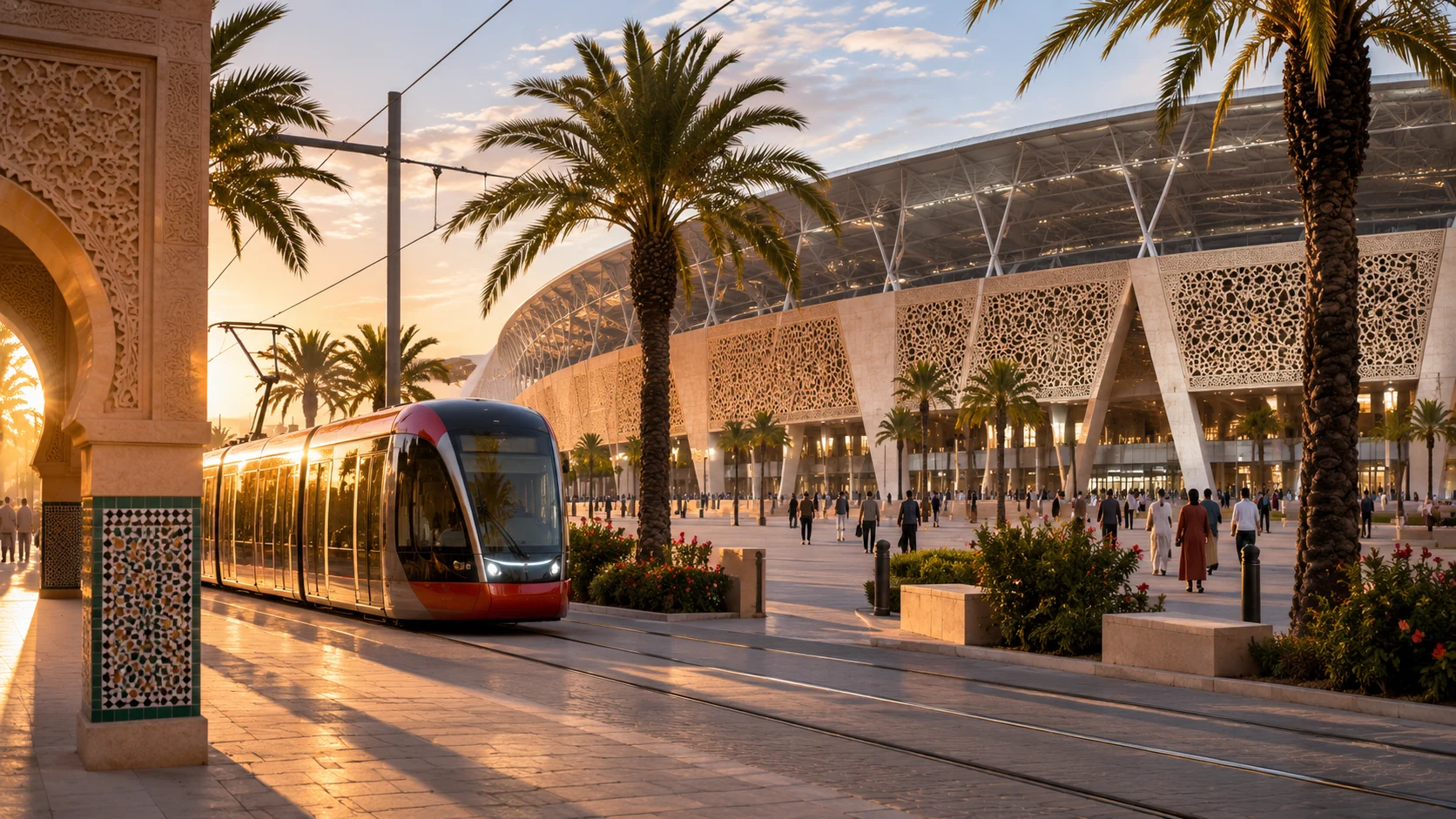
A spectator often judges the quality of an organization based on the transport connecting the airport, accommodation, and the stadium. For a resident, the question arises daily between home, work, school, or a healthcare facility. These usages can be strengthened if mobility investments are designed as a network rather than isolated access routes to a stadium.
The useful measure then relates to connections, travel times, and service reliability. A renovated station or an additional line does not yield the same improvement depending on frequency, schedules, and fares. The completed building is a step; the service actually rendered allows for evaluating the transformation.
Morocco has an interest in documenting these advances before the tournament to have a comparative baseline. Without an initial situation, an assessment after 2030 risks conflating the effects of the competition with those of already committed investments or broader economic developments.
Tourism: Revenues Must Be Compared to Costs
Welcoming visitors creates opportunities for accommodations, restaurateurs, transport, and many services. However, a revenue increase over a few weeks does not, by itself, constitute a net gain for the entire region. It is essential to consider additional expenses, public costs, and activities that would have occurred without the tournament.
Some visitors may shift their stay to avoid prices or crowds; others may extend their trip and discover multiple regions. The overall impact depends on these movements as much as on the number of arrivals. It is also necessary to distinguish between sales value and income actually retained within the local economy.
OECD guidelines on major events specifically recommend linking the evaluation to development objectives and residents' well-being. For Moroccan cities, this means defining the desired outcomes before counting the impacts: new markets, skills, better service, or attractiveness over multiple seasons.
Moroccan companies must be able to enter the supply chain
Preparations can support very different trades, from construction to digital services. Access for national companies will depend in particular on visibility of tenders, contract lot sizes, required qualifications, and payment deadlines. These parameters determine whether an SME can indeed respond to an order.
Training can also create a lasting impact if the skills remain useful after the event. An employee trained in maintenance, multilingual hospitality, or operational management should be able to find work in permanent infrastructures and services. The number of people mobilized during a tournament and the number of sustainable jobs must be tracked separately.
Preparing Today for the 2031 Assessment
A credible follow-up could publish, project by project, the executed budgets, delivery dates, operating costs, and usage after the competition. This would align ambitions with results without reducing the discussion to enthusiasm or skepticism.
The World Cup offers Morocco a global stage. However, its deepest contribution will play out in ordinary usage: moving more easily, working under better conditions, accessing well-maintained facilities, and developing competitive businesses. Successfully managing the event and its aftermath are two objectives that need to be prepared together.
Analysis based on FIFA communications and OECD work, consulted on November 23, 2026. The six cities mentioned retain candidate status in the October 27 statement; no final match distribution is announced here.